Iran13 May, 20262 min read
BRICS Foreign Ministers End New Delhi Talks Without Joint Declaration Over Iran War Dispute
BRICS ministers end New Delhi talks without joint declaration due to Iran-war divisions. India hosting BRICS released a chair's statement and outcome document instead of declaration.

BRICS deadlock in New Delhi
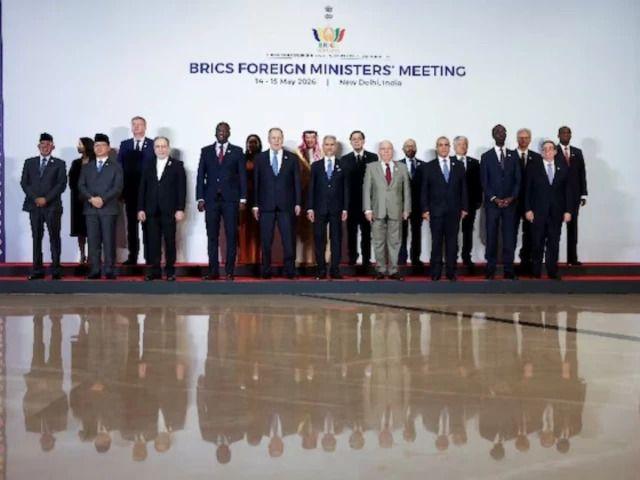
BRICS foreign ministers ended a two-day meeting in New Delhi without adopting a joint declaration, as internal disagreements over the ongoing war involving Iran intensified divisions among member states. TheWire.in said India, as chair, issued a “Chair’s Statement and Outcome Document” instead of a traditional joint communique, and described the Iran-war split as the most consequential fault line in a 63-paragraph text.
TheWire.in also reported that paragraph 21 acknowledged “differing views among some members as regard to the situation in the West Asia/Middle East region,” while listing only broad principles presented by member states. WION said the diplomatic impasse forced host India, holding the 2026 BRICS chair, to release only a “chair’s statement and outcome document” after sharp divisions erupted over the ongoing US-Israeli war on Iran.
Iran and UAE trade accusations
Iranian Foreign Minister Abbas Araghchi urged BRICS members to denounce what he termed as “violations of international law” by the United States and Israel, while also highlighting increasing tensions between Iran and its Gulf neighbours, particularly Saudi Arabia and the UAE. At a press conference after the talks, Araghchi said, “We only hit American military bases and American military installations which are unfortunately on their soil,” and he added that he hoped positions would change before the BRICS leaders’ summit later this year.
The UAE’s representative, Minister of State Khalifa bin Shaheen Al Marar, refuted Araghchi’s statements, accusing Iran of justifying “terrorist attacks” against the UAE. TheWire.in said the UAE had wanted Iran to be explicitly condemned, while Tehran wanted Israel and the US to be named for starting the war, and that this disagreement prevented consensus on a joint declaration altogether.
What BRICS avoided saying
TheWire.in reported that the New Delhi outcome document did not name the US, Israel or Iran, and also said it contained no direct reference to the current situation in the Strait of Hormuz despite the waterway’s importance to global energy flows and India’s energy security. Outlook Business said paragraph 21 highlighted “differing views among some members as regard to the situation in the West Asia/Middle East region,” and noted that paragraph 26 on Gaza and Palestine carried a footnote stating that “A member had reservations on some aspects of this paragraph.”
Outlook Business further said paragraph 29 carried a reservation focused on Red Sea security and Yemen, and it described the statement’s broader emphasis on diplomacy, sovereignty, and the protection of civilian lives. DW reported that Randeep Jaiswal, spokesperson for India’s Ministry of External Affairs, said some BRICS members are directly involved in the current situation in West Asia, and that this affected the formation of a consensus for a common BRICS position on the conflict.