
California Governor Candidates Clash in CBS Debate Over Affordability, Housing, Insurance and Healthcare
Key Takeaways
- Eight candidates debated in a chaotic televised California governor race forum.
- Debate focused on affordability, housing, gas prices, and healthcare funding.
- Eric Swalwell's exit reshaped the race with remaining candidates seeking breakout moments.
Pomona Debate Turns Chaotic
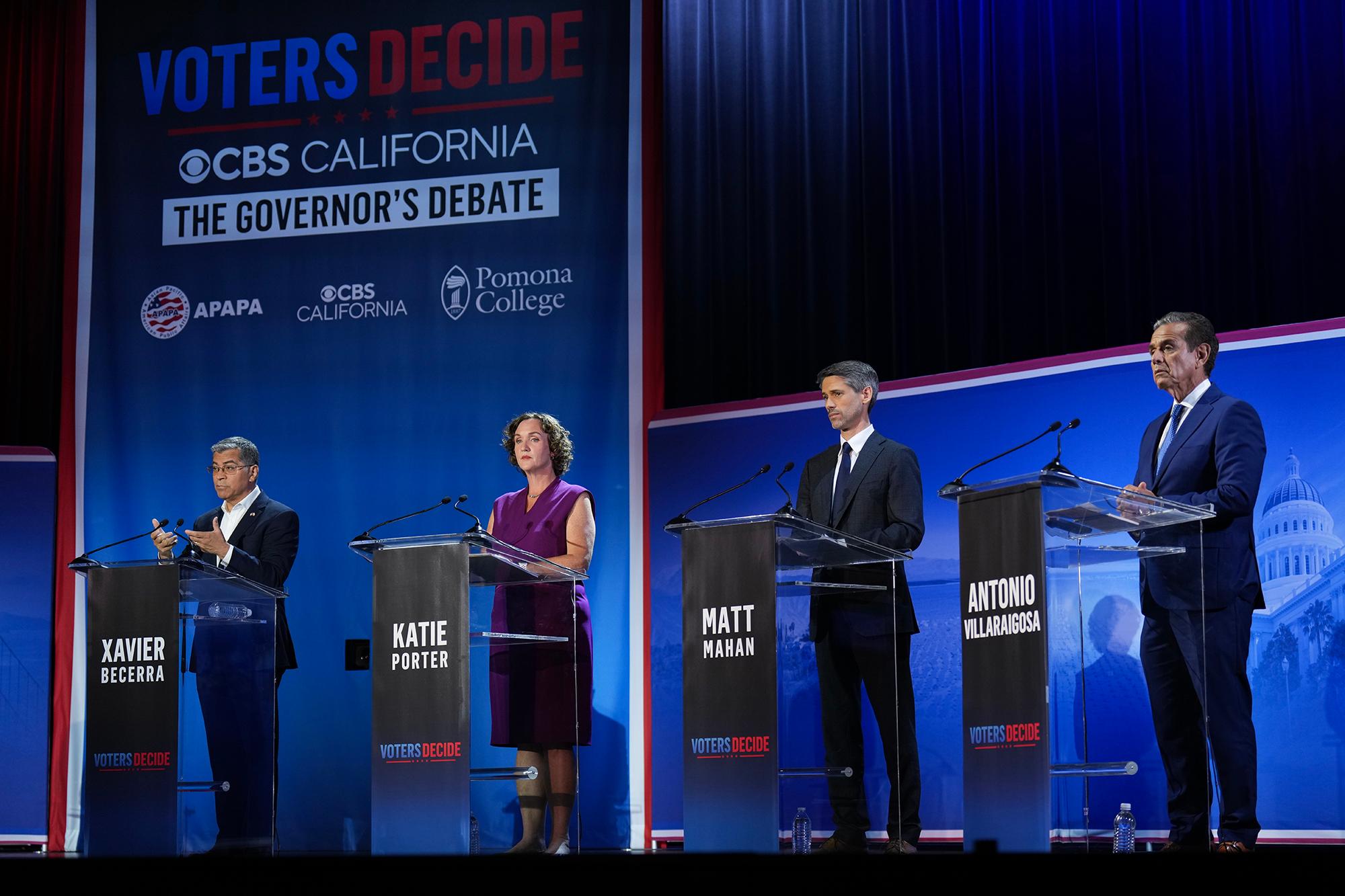
California’s race for governor turned combative Tuesday night in Pomona, where eight candidates clashed over affordability, housing, insurance and healthcare in a CBS debate that multiple outlets described as chaotic and hard to follow.
CalMatters said Democrats targeted Tom Steyer and Xavier Becerra and that “this is worse than my teenagers at dinner,” a line attributed to former Orange County Rep. Katie Porter.

The Los Angeles Times reported the candidates “scrabbled for airtime and breakout moments” during a “fiery exchange” as the June 2 primary approached, with former U.S. Health and Human Services Secretary Xavier Becerra facing persistent attacks.
AP described the same event as a “chaotic televised debate filled with interruptions, tense exchanges and verbal detours,” underscoring that mail ballots would go out to voters in less than a week.
CBS News said the debate at Pomona College included Democrats Xavier Becerra, Matt Mahan, Katie Porter, Tom Steyer, Tony Thurmond and Antonio Villaraigosa, and Republicans Chad Bianco and Steve Hilton.
The Hill similarly framed the night as candidates fighting for “standout moments” in a 90-minute program at Pomona College in Claremont, California.
CNN added that the debate was hosted by CBS News affiliates in California and that it came as the race’s remaining candidates sought to “carve out a lane for themselves” after Eric Swalwell’s exit.
Across outlets, the setting and format were consistent: CBS moderators, crosstalk, and candidates repeatedly interrupting each other as they tried to make an impression before ballots were mailed.
Insurance Emergency and Legal Fight
A central flashpoint in the debate was Xavier Becerra’s pledge to declare a state of emergency to freeze home insurance rates, a proposal that drew repeated challenges from Republicans and questions from moderators.
The Los Angeles Times said Republican Steve Hilton ripped Becerra for promising to declare a state of emergency to address rising homeowner’s insurance rates, arguing “the governor lacks that constitutional authority,” and Hilton added, “We can’t have a governor who doesn’t understand how the government works.”

Becerra defended himself by saying, “We don’t need a talking head from Fox News to tell us how the government works,” and AP reported that moderators pressed Becerra on whether he could legally declare a state of emergency his first day in office and freeze home insurance rates.
AP also quoted Becerra’s response that “The governor’s office is not a place with training wheels,” and said he noted he led through states of emergency during the COVID-19 pandemic.
CalMatters described Becerra arguing with one of the five debate moderators over the legality of his proposal to call a state of emergency to freeze home insurance rates.
The Los Angeles Daily News likewise said Hilton questioned Becerra’s proposal to freeze home insurance rates by declaring a state of emergency, with Hilton saying, “We can’t have a governor who doesn’t understand how the government works,” and Becerra replying, “And we don’t need a talking head from Fox News to tell us how the government works.”
The Hill added that Becerra told CBS News’s Julie Watts he’d be “be willing to go to court” with her when she pushed back on his plan for a proposed state of emergency to freeze insurance rates.
Together, the coverage showed the insurance proposal functioning as both a policy dispute and a legal legitimacy test, with Becerra repeatedly defending his authority and Hilton repeatedly challenging it.
Trump, Healthcare, and Immigration
The debate also turned into a direct clash over Donald Trump and healthcare funding, with Becerra and Hilton trading barbs that repeatedly invoked Trump’s relationship to the race.
“California candidates for governor tangle in messy TV debate with mail ballots about to go out California candidates for governor tangle in messy TV debate with mail ballots about to go out LOS ANGELES (AP) — Eight candidates running to become governor of California lobbed heated criticism at each other Tuesday in a chaotic televised debate filled with interruptions, tense exchanges and verbal detours — even at times from moderators”
CNN reported that as the debate turned to healthcare, moderators asked Becerra how he would respond to the expiration of the Affordable Care Act’s enhanced premium subsidies, and Becerra used the moment to criticize Trump and his endorsed candidate, Hilton.
CNN quoted Becerra saying, “The first thing we have to do is stop Steve Hilton’s daddy,” and added that he continued, “We need someone who’s going to fight Donald Trump, not agree with him.”
Hilton responded in CNN’s account by saying Democrats “can’t do anything but blame Trump,” and the back-and-forth continued as Becerra asked Hilton, “Steve, would you oppose Donald Trump’s cuts?” and Hilton replied, “I think that’s a no,” according to CNN.
AP described the same Trump dynamic in a different framing, saying “President Donald Trump, who has a long-strained relationship with the heavily Democratic state, came up in exchanges,” and that Hilton and Bianco support the president while Democrats vowed to stand in the way of federal immigration raids and Trump’s conservative agenda.
CalMatters similarly said the candidate field included scrutiny about Becerra’s handling of an influx of unaccompanied migrant children as Biden’s health secretary, and it quoted Becerra dismissing criticism as a “MAGA talking point” while saying the Department of Homeland Security was responsible for the child labor.
The Hill described Becerra’s attacks on Steyer and his wealth, but it also quoted Becerra’s line about Trump’s endorsement and said Becerra told the stage, “the first thing we have to do is stop Steve Hilton’s daddy, who has endorsed him,” pointing to the president’s support for Hilton.
Across outlets, the healthcare fight was inseparable from the Trump question, with Becerra positioning himself as the candidate who would resist Trump’s agenda and Hilton positioning the dispute as a failure of Democratic governance.
Affordability, Gas, and Housing Plans
While the Trump-and-insurance fights dominated, the debate’s affordability theme also produced competing proposals on gas prices, housing construction, and healthcare funding.
CBS News said moderators asked candidates what they would do to restore the “California Dream,” and it reported that Steve Hilton vowed to make the state “Califordable” by cutting utilities and making home-buying accessible, while Chad Bianco said the state legislature’s progressive agenda is “destroying California.”

CBS News also quoted Tony Thurmond saying homeownership was “the American Dream,” and it included Thurmond’s pledge: “We will build two million housing units using surplus property that school districts have in every single county in this state,” and “We will build 2.3 million units by the year 2030.”
Tom Steyer argued for cutting the cost of permitting and construction, telling moderator Julie Watts, “We need to work to shorten and reduce the cost of permitting,” and “We need to drop the cost of construction.”
The Los Angeles Times and AP both emphasized gas prices and insurance, with AP saying candidates sparred over “how to cut gas prices” and “how best to contend with wildfires,” while CBS News said Mahan renewed a promise to suspend the gas tax.
CBS News quoted Mahan calling the gas tax “the most regressive tax in California,” and it reported Becerra’s response that cutting the gas tax would upend the state’s infrastructure budget, with Becerra saying, “You have to fund it [all] somehow.”
CalMatters added that Mahan and Thurmond agreed with Republicans Bianco and Steve Hilton that the state gas tax should be suspended, while Becerra, Porter, Steyer and Antonio Villaraigosa disagreed.
Taken together, the coverage showed candidates using affordability as a unifying label while splitting sharply on gas-tax authority, housing scale, and the role of government in healthcare and insurance.
Why Becerra’s Surge Matters
Several outlets tied the debate’s intensity to the recent reshaping of the Democratic field after Eric Swalwell dropped out amid sexual assault and misconduct allegations, leaving Becerra and Steyer as prominent targets and, in some accounts, leading contenders.
The Los Angeles Times said Becerra’s campaign “blossomed after former Rep. Eric Swalwell dropped out amid sexual assault and misconduct allegations,” and it described him as coming under persistent attack during the 90-minute debate but also going on the offensive.
AP said the debate underscored the “instability in a crowded race that has no clear leader,” with mail ballots going out in less than a week, and it noted that the race was shaken up this month after Swalwell’s “dramatic downfall” and that he left the race and resigned from Congress.
The Detroit News reported that Becerra, 68, credited community supporters in Los Angeles for backing his upstart campaign in 1992 and said that “More than 30 years later, Becerra, 68, is again an upstart candidate,” while describing his turnaround after Swalwell’s collapse.
The Detroit News also cited a California Democratic Party tracking poll released in early April showing Becerra near the bottom with “4% support among likely voters,” and said that after the Swalwell scandal broke, a party poll showed his support jumped to “13%,” the biggest increase of any candidate.
It further said Becerra’s surge raised questions about his time as California attorney general and as U.S. Health and Human Services secretary, including that he “oversaw the agency’s response to a massive influx of unaccompanied minors at the southern border.”
CalMatters similarly said Becerra had a “sudden surge in momentum” since Swalwell dropped out amid allegations of sexual assault, and it described the debate’s targets as Steyer and Becerra.
Across these accounts, the debate was not just about policy but about whether Becerra’s momentum could translate into a top-two finish in California’s June 2 primary, where “the two with the most votes go on to the November general election regardless of party,” as AP described.
More on USA

U.S. Prepares Extended Blockade of Iran’s Ports and Strait of Hormuz, Pentagon Estimates $25 Billion
14 sources compared
Donald Trump Posts AI Image With Rifle, Threatens Iran With “No More Mr. Nice Guy”
13 sources compared
King Charles III And Queen Camilla Visit New York 9/11 Memorial Ahead Of 25th Anniversary
14 sources compared

King Charles III Urges U.S. Congress To Defend Checks On Executive Power
27 sources compared