Canada23 April, 20267 min read
Canada’s Bill C-3 Expands Dual Citizenship, Overwhelms U.S. Lawyers With Claims
This article is an automated aggregation of coverage from news outlets. Our editorials offer in-depth analysis curated by the NewsCord team.
Bill C-3 expanded eligibility for Canadian citizenship to Americans with Canadian ancestry. The change took effect December 15, allowing those born before then to claim citizenship.

Law change sparks rush
A change in Canada’s citizenship requirements that took effect Dec. 15 has triggered a surge of Americans seeking dual citizenship, with immigration lawyers in the United States and Canada reporting they are overwhelmed by clients trying to submit proof for citizenship applications.
The Associated Press reported that “Millions more Americans might qualify for dual Canadian citizenship” under the new rules, and it described how people like Zack Loud of Farmington, Minnesota, were surprised that Canada already considered him and his siblings citizens because their grandmother is Canadian.
CBS News said the Canadian bill C-3 “went into effect Dec. 15” and allows anyone born before that date to claim citizenship if they can prove they have a direct Canadian ancestor, including “a grandparent, great-grandparent or even more distant relative.”
Under the expanded framework, descendants of Canadians are already considered citizens but must provide proof to obtain a certificate of citizenship, according to the AP and CBS News.
The AP said immigration attorney Amandeep Hayer’s Vancouver, British Columbia-area practice went from about 200 citizenship cases a year to more than 20 consultations per day, while Nicholas Berning of Boundary Bay Law in Bellingham, Washington, said his practice is “pretty much flooded with this.”
CBS News similarly quoted Berning saying, “We’ve kind of shifted a lot of other work away in order to push these cases through,” as the volume of applications rose.
The AP also reported that the proof of citizenship application fee is 75 Canadian dollars ($55) for those with documentation ready at hand, while CBS News said the application fee is 75 Canadian dollars, or $55.
How the rules changed
The new eligibility framework expands Canadian citizenship by descent beyond the earlier limit that could only be passed down “one generation, from a parent to a child,” a change described in both the Associated Press and CBS News.
The AP said the new law opened up citizenship to anyone born before the relevant date who could prove they have a direct Canadian ancestor, listing “a grandparent, great-grandparent or even more distant ancestor.”

CBS News likewise said the law allows anyone born before Dec. 15 to claim citizenship if they can prove a direct Canadian ancestor, and it reiterated that the earlier rule restricted descent to one generation.
For people born on or after Dec. 15, the AP reported that they need to show their Canadian parent lived in Canada for 1,095 days, adding a specific residency requirement for later births.
The AP also described the practical effect for descendants of Canadians, stating that “descendants of Canadians are already considered citizens but must provide proof to obtain a certificate of citizenship.”
CBS News echoed that descendants are “already considered citizens and need only to apply for a certificate of citizenship to formalize their status.”
In the AP’s framing, immigration attorney Amandeep Hayer explained the concept in plain terms, saying, “You are Canadian, and you’re considered to be one your whole life,” and he added, “That’s really what you’re applying for, the recognition of a right you already have vested.”
The AP also used a comparison to explain the certificate process, quoting Hayer: “The best way I can put it is like, if a baby’s born tomorrow in Canada, the baby’s Canadian even though they don’t have the birth certificate.”
Motivations and personal stakes
The surge in applications is driven by a mix of politics, family heritage, and job opportunities, and the reporting includes multiple Americans describing why they are pursuing dual citizenship now.
The AP said Americans are exploring whether the “easier process” makes “now the right time to gain dual citizenship,” and it linked that interest to “politics, family heritage, job opportunities and other factors.”
Michelle Cunha, of Bedford, Massachusetts, told the AP she decided to move to Canada after reflecting on decades of political activism and deciding she had “nothing left to give,” saying, “I put in my best effort for 30 years. I have done everything that I possibly can to make the United States what it promises the world to be, a place of freedom, a place of equality.”
Cunha added, “But clearly we’re not there and we’re not going to get there anytime soon.”
Troy Hicks, of Pahrump, Nevada, said he was spurred by an international trip, telling the AP: “I recently went to Australia and you know, first words out of the first person I talked to in Australia was basically an expletive about Trump and the U.S.”
Hicks continued, “So the idea of doing that with a Canadian passport just seemed easier, better, more palatable.”
Maureen Sullivan, of Naples, Florida, said she was motivated by the immigration crackdown in Minnesota and described how it hit home when her teenage nephew encountered federal officers near his high school in St. Paul, adding that she sees citizenship in Canada as an option in case things in the U.S. “really go south.”
Sullivan said, “When I first heard about the bill, I couldn’t believe it. It was like this little gift that fell in my lap,” and she described “collective excitement” among family members who wanted “to feel like we were doing something to take care of our security in the future if needed.”
The AP also included Zack Loud’s account from Farmington, Minnesota, where he said, “My wife and I were already talking about potentially looking at jobs outside the country, but citizenship pushed Canada way up on our list.”
Costs, processing, and capacity
Beyond eligibility, the reporting details how much the process costs and how long applicants may wait, while also describing the capacity strain on legal services.
The AP said the proof of citizenship application fee is 75 Canadian dollars ($55) for those with documentation ready at hand, and it contrasted that with higher costs for those seeking help from an attorney.
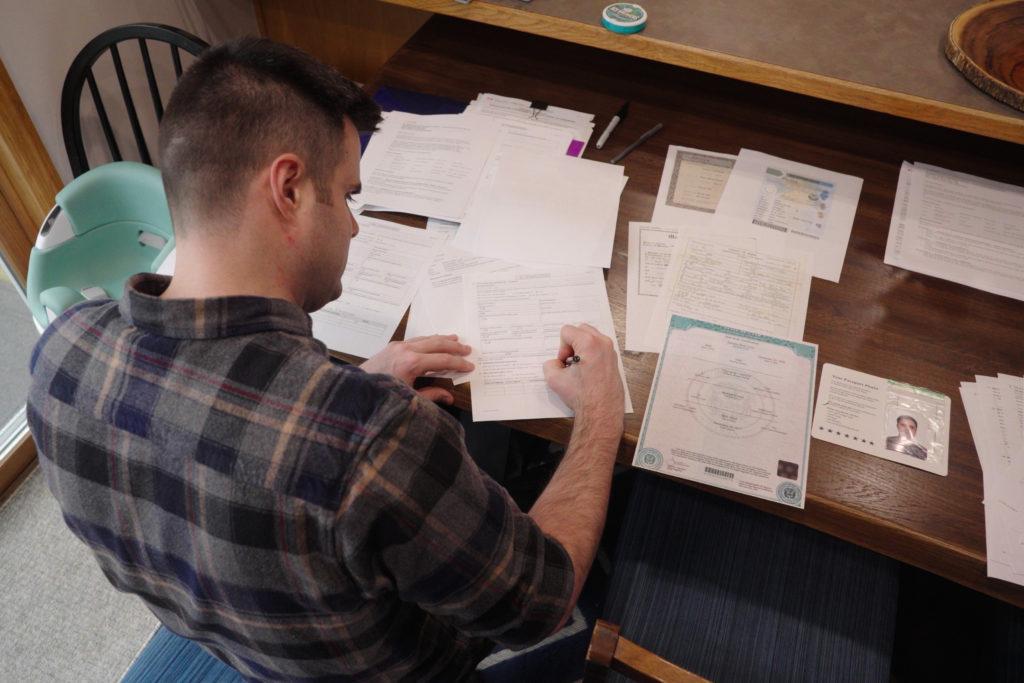
CBS News similarly stated, “The application fee is 75 Canadian dollars, or $55,” and it said costs increase for those hiring an attorney or genealogist.
The AP included a specific estimate from Cunha, who said she used an attorney and estimates the cost will be about $6,500, and it also described Mary Mangan’s approach of filing in January using advice from online forums.
Mangan, according to the AP, said, “There are some situations where a lawyer might be the right thing, but for many people, I would guess 90% of people can probably do this on their own.”
On timelines, CBS News reported that the Immigration, Refugees and Citizenship Canada office said processing times for a certificate of citizenship are around 10 months, and it said “More than 56,000 people are awaiting a decision.”
CBS News also added that from Dec. 15 to Jan. 31, it confirmed citizenship by descent for 1,480 people, though not all were Americans.
The AP did not provide the 56,000 figure, but it did describe how lawyers are shifting work to handle the influx, with Berning saying his practice has “pretty much flooded with this” and Hayer saying his practice went from about 200 cases a year to more than 20 consultations per day.
Together, the accounts show a system where applicants may face both financial and time costs while legal professionals absorb the surge in demand.
Canadian concerns and debate
While the law is drawing interest from Americans with Canadian ancestry, CBS News also included a perspective from Fen Hampson, a professor of international affairs at Carleton University in Ottawa, who described concerns in Canada about the motivations of some applicants. Hampson said Canadians are generally “welcoming people” but some are concerned about people with “thin ties to Canada becoming Canadians of convenience.” He also said some Canadians worry that a surge of interest from Americans could delay efforts by refugees and asylum-seekers, linking the citizenship backlog to broader immigration priorities.
CBS News quoted Hampson saying, “Canadians don't like queue jumpers,” framing the concern in terms of fairness and sequencing. The reporting also showed how the legal demand is being felt by practitioners, with Amandeep Hayer saying his practice went from about 200 citizenship cases a year to more than 20 consultations per day, and Nicholas Berning describing his practice as “pretty much flooded with this.” The AP’s account of the law’s intent also included Hayer’s explanation that the change is about recognizing a right already vested, with Hayer saying, “That’s really what you’re applying for, the recognition of a right you already have vested.”

In that same vein, CBS News quoted Hayer saying, “You are Canadian, and you're considered to be one your whole life,” emphasizing the continuity of citizenship status for descendants. Taken together, the sources depict a debate in which Americans describe citizenship as a practical option for jobs and security, while Canadian voices raise questions about ties, queueing, and downstream effects on refugees and asylum-seekers.