
China Launches Mission Justice 2025 Drills Around Taiwan, Taiwan Deploys Rapid-Response Forces
Key Takeaways
- China launches Mission Justice 2025 around Taiwan with large-scale live-fire drills.
- Taiwan deploys its multi-domain defenses and conducts rapid-response drills around the island.
- US arms sales and drone supply bolster Taiwan's deterrence against Beijing.
Mission Justice 2025
China began, on Monday, the operation "Mission Justice 2025" around Taiwan, described as "major" drills with live-fire munitions, and Taipei said it deployed the "appropriate forces" and carried out a rapid-response drill.
The Taiwanese Ministry of Defense said it detected 89 Chinese military aircraft and drones, including 67 that penetrated Taiwan's air defense identification zone, as well as 28 Chinese naval ships.

France 24 said the escalation followed a recent sale of American arms to the island, and it added that China launched the exercises on December 29 in a tense context.
Le Parisien said China was conducting large-scale, live-fire military exercises in the Strait from Monday, December 29 through Wednesday, and it described the operation as the first since April 2025.
In the same reporting, Le Parisien said Taiwan's Ministry of National Defense mobilized and trained troops to respond in case of a potential Chinese attack.
Aircraft, drones, and drones
France 24 reported that Foreign Ministry spokesperson Lin Jian said at a regular press briefing that any attempt to prevent the reunification of Taiwan with the Chinese mainland would be doomed to fail.
In the same account, France 24 said the Eastern Theater Command of the People's Liberation Army described the drills as including "live-fire on maritime targets north and southwest of Taiwan," and it said the exercises involved destroyers, frigates, fighters, bombers and drones.
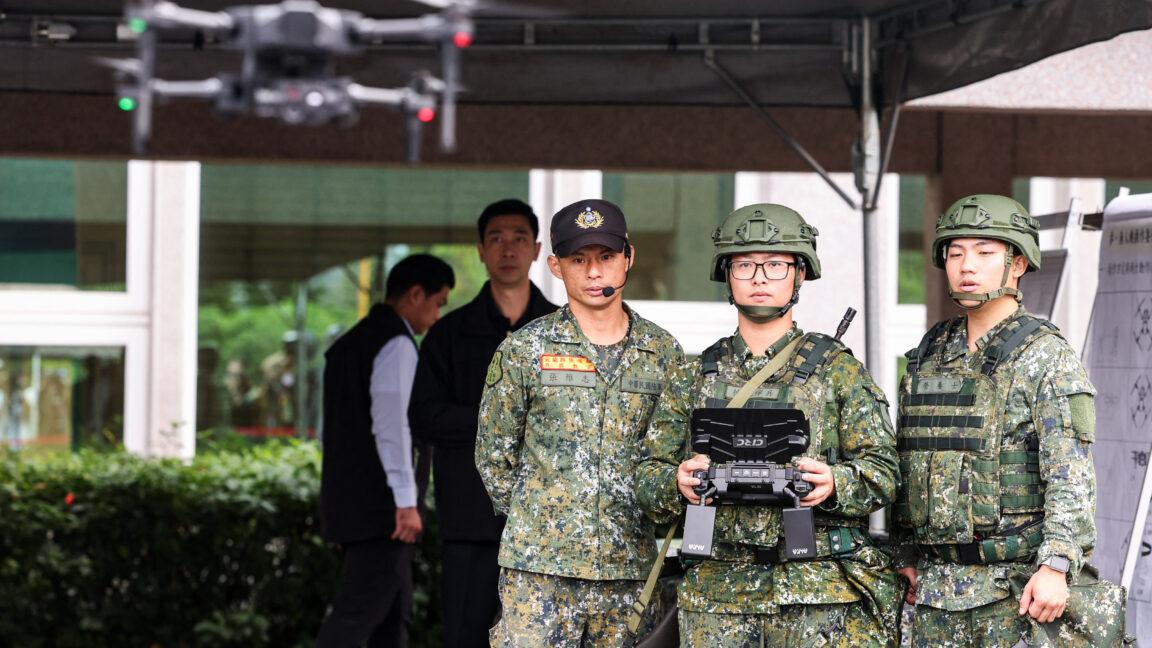
The Guardian described Taiwan’s civil defence drone training programme in Taipei, where Pan Chien-chin, 48, said, "The war in Ukraine has really changed how drones are used," as he steered a drone around a course marked by traffic cones.
The Guardian also quoted Tang Tsung-yi, a spokesperson at Kuma Academy, saying the course helps beginner drone pilots understand the capabilities of drones on the battlefield.
Together, the two strands of coverage placed Taiwan’s drone training and China’s live-fire drills in the same broader escalation between Beijing and Taipei.
Defense stakes and budgets
Ars Technica said Taiwan’s Ministry of National Defense proposed a special budget that would spend $6.6 billion over six years on buying drones made in Taiwan, according to the Central News Agency.
“Taiwan’s existence as a self-governing democracy may depend heavily on having enough military drones to discourage any attempted invasion by China’s military”
Ars Technica reported that the proposal would allow the government to buy more than 208,000 coastal attack drones, along with more than 1,400 coastal reconnaissance drones and 1,320 uncrewed surface vessels, between 2026 and 2031.
The Guardian said the number of registered drones in Taiwan surpassed 39,000 in December, according to Taiwan’s Civil Aviation Administration, which lowered the minimum age for drone registration to 14 in 2024.
Ars Technica added that Taiwan has exported $115 million of fully assembled drones between January and March 2026, exceeding the $93 million in total drone exports for the entire year of 2025, according to Taiwan Premier Cho Jung-tai.
In the Guardian’s account of civil defence training, Tang Tsung-yi said the main goal was not to arm civilians, but to help people "move from passive defence like sheltering to a more active role in observing risks and sharing information."
More on China

Mobileye Plans US Robotaxi Service With 100 Vehicles Starting 2027
11 sources compared
China Arrests U.S. Citizen Min Zin Suspected of Spying in Yunnan
17 sources compared

Xi Jinping Travels To Pyongyang For Two-Day Meeting With Kim Jong-un
11 sources compared

Five Eyes Warn China Targets Australia, Canada, New Zealand, U.K., U.S. Personnel on Job Sites
46 sources compared