
CLARITY Act Advances After Senators Thom Tillis and Angela Alsobrooks Release Stablecoin-Yield Compromise
Key Takeaways
- New CLARITY Act text bans passive yield and allows bona fide rewards.
- Agreement requires shifting reward programs from buy-and-hold to buy-and-use.
- Movement toward a Senate vote with markup push; industry generally backs compromise.
CLARITY Act Near Vote
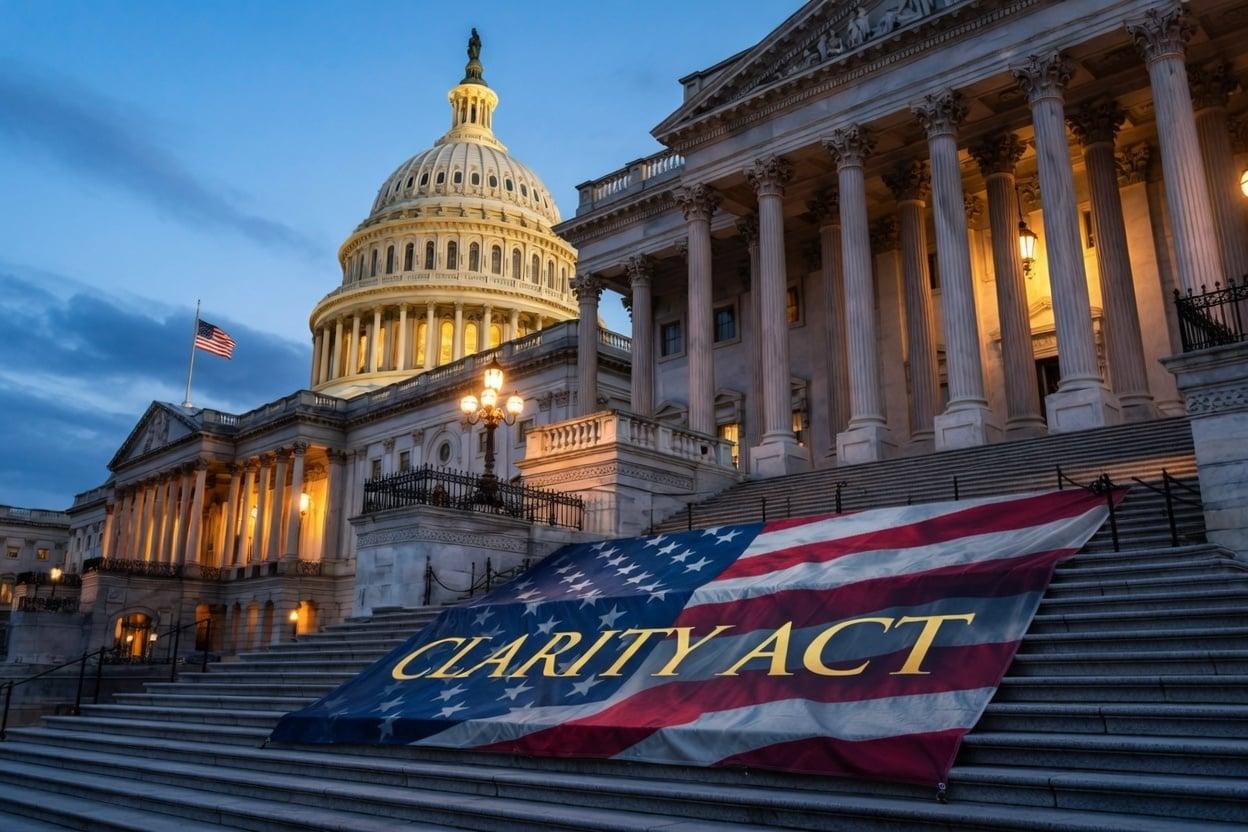
The U.S. Digital Asset Market Clarity Act, or CLARITY Act, moved closer to a Senate vote after lawmakers released compromise stablecoin-yield language that industry groups immediately backed, while still leaving other issues unresolved.
“The CLARITY Act is moving closer to a Senate vote after lawmakers cracked one of its toughest nuts — how to handle stablecoin yield”
The compromise text, released by Senators Thom Tillis and Angela Alsobrooks, bars crypto firms from paying interest or yield on stablecoin balances in a manner “economically or functionally equivalent to a bank deposit,” according to CoinDesk’s account of the bill language.
CoinCentral similarly described the new Senate text as blocking crypto firms from paying yield “simply for holding stablecoins in a bank-like manner,” while still permitting “bona fide” rewards tied to platform activity and transactions.
The dispute has been framed as a stablecoin-yield problem that sits at the center of broader questions about how digital assets fit under existing regulatory structures.
CoinDesk reported that the text “directs Treasury and the CFTC to write rules within a year of enactment,” tying the compromise to a defined timeline for implementing regulations.
In the background, Cointelegraph and CoinCentral both pointed to delays in the Senate Banking Committee since January 2026, with CoinCentral noting that the committee had previously postponed a markup in January.
Even with the yield provision resolved, the question of whether the full bill clears the Senate remains open, but multiple outlets described the stablecoin-yield language as the “final major sticking point” in the negotiations.
Buy-and-Hold vs Buy-and-Use
At the center of the compromise is a requirement that firms restructure how they reward users, shifting from a “buy and hold” model to a “buy and use” model.
CoinDesk reported that “The agreement necessitates firms restructure reward programs from a "buy and hold" to a "buy and use" model,” while also emphasizing that the carve-out allows rewards tied to “bona fide activities or bona fide transactions.”

CoinCentral described the same compliance shift more directly, saying firms “will need to shift reward programs from a “buy and hold” model to a “buy and use” model to comply with the transaction caveats.”
The logic of the compromise, as presented by the outlets, is that yield that functions like a bank deposit is barred, while rewards tied to actual activity remain permissible.
CoinDesk’s framing also noted that the ban applies to crypto firms paying interest or yield on stablecoin balances in a way “economically or functionally equivalent to a bank deposit,” which is the line the compromise is designed to draw.
CoinCentral added that the new language “bars crypto firms from paying interest or yield on stablecoin balances in a way that works like a bank deposit,” while still permitting “bona fide rewards tied to real platform use and transactions.”
CoinDesk also stated that the ban applies to fintechs and payment firms, “closing the back-end payment rail for cross-border flows,” while “individual crypto investors can still buy and hold assets,” which underscores that the compromise is not a blanket prohibition on stablecoin holding.
Industry Voices React
Reactions from crypto executives and trade groups were immediate and, in several cases, explicitly tied to the promise of regulatory certainty.
“Chris Perkins spoke to Cointelegraph journalist Ciaran Lyons on Chain Reaction on Friday”
Blockchain Association CEO Summer Mersinger called the deal “a step in the right direction,” telling CoinDesk, “We commend Senators Tillis and Alsobrooks for their leadership in reaching this agreement,” and warning that “Every day without a clear legal framework is an invitation for top-tier talent, capital, and innovative companies to locate elsewhere.”
Crypto Council for Innovation CEO Ji Hun Kim endorsed the bill while flagging concerns about how far the prohibition framework extends, writing on X that “CCI has been clear that we disagree with assertions about deposit flight concerns from stablecoin adoption,” and also stating that the new language “goes VERY FAR beyond” last year’s GENIUS Act.
Circle’s Chief Strategy Officer Dante Disparte backed the deal “without reservation,” with CoinDesk quoting him: “Today’s compromise on stablecoin yield marks meaningful progress in the CLARITY Act negotiations,” and adding, “The United States faces a clear choice in digital assets: lead or be led.”
Coinbase CEO Brian Armstrong posted “Mark it up” after the text dropped, and CoinDesk said Coinbase had “the most at stake” in the negotiations.
Cointelegraph added another Coinbase-linked statement, reporting that Coinbase chief legal officer Faryar Shirzad posted “It’s time to get CLARITY done,” after the final text was published.
Even as executives pushed for Senate action, Chris Perkins, CEO of 250 Digital Asset Management, told Cointelegraph’s Chain Reaction podcast that the industry would be “just fine” if the CLARITY Act doesn’t pass, while also saying that if it does become law, it would make it “much harder for future administrations to roll back the regulatory clarity.”
Perkins’s comments were tied to the idea that “It takes an act of Congress to do something,” and CoinCentral quoted him saying, “It takes an act of Congress to do something — and it is even harder to unwind a law.”
Where Coverage Diverges
While the outlets converge on the existence of a stablecoin-yield compromise and the “buy and hold” versus “buy and use” restructuring, they diverge in how they emphasize the stakes and the remaining disputes.
CoinDesk frames the agreement as a near-completion of the bill’s market-structure work, describing the stablecoin yield provision as “the final major sticking point in the bill,” and it highlights that the compromise “carves out rewards programs tied to "bona fide activities or bona fide transactions."”
CoinCentral, by contrast, foregrounds the regulatory certainty angle and includes a broader discussion of how being classified as a security has changed, quoting Chris Perkins on the shift from former SEC Chair Gary Gensler’s approach to a new posture under SEC Chair Paul Atkins and CFTC Chair Michael Selig.
CoinCentral also emphasizes that even if the bill fails, “at least one major crypto executive says the industry will survive,” and it ties that resilience to regulators “building policy and setting precedent every day.”
Cointelegraph focuses on the same Perkins theme but centers it in a conditional warning about rollback, quoting him that “What you’ve done is you’ve essentially enshrined policy for a very long time,” and that “as hard as it is to pass a law, it is even harder to unwind a law.”
The outlets also differ in how they present the market context: CoinCentral includes a “bitcoin price prediction” note tied to May 1 and 24/7 Wall St, while Crypto Briefing provides a specific prediction-market snapshot, stating that “The prediction market on Bitcoin reaching $200,000 by December 31, 2026, currently shows a 4.5% YES probability.”
Coin Briefing also reports a “volume in the last 24 hours stands at $490 in actual USDC,” which is not present in the other coverage.
Even within the policy story, CoinDesk notes that CCI endorsed the bill “while flagging concerns” over a “broad prohibition,” whereas CoinCentral’s account stresses that the new language “bans passive yield but allows ‘bona fide’ rewards,” presenting the compromise as a clearer line than a broader prohibition.
Next Steps and Timing
The compromise has also triggered specific timing expectations from lawmakers and a push for Senate Banking action, with multiple outlets citing dates and remarks.
“The CLARITY Act is moving closer to a Senate vote after lawmakers cracked one of its toughest nuts — how to handle stablecoin yield”
CoinCentral reported that Senator Bernie Moreno said he expects the CLARITY Act to pass by end of May, and it also quoted Senator Cynthia Lummis saying in April: “It’s now or never.”
Cointelegraph similarly cited Lummis’s April remark “It’s now or never,” and it added that Moreno “anticipates the CLARITY Act to “get done” by the end of May.”
CoinCentral also said the Senate Banking Committee had previously postponed an earlier CLARITY Act markup in January, placing the new stablecoin-yield text in a longer sequence of procedural delays.
CoinDesk described the immediate industry push as urging the Senate Banking Committee to advance the market structure legislation “within hours” of the compromise text release, and it reiterated that the yield language was the greatest obstacle.
CoinDesk also stated that the agreement directs Treasury and the CFTC to write rules within a year of enactment, which means the consequences of the bill would extend beyond the immediate vote.
In parallel, CoinCentral’s Perkins comments suggested that even without passage, the industry’s regulatory environment is moving toward “certainty, stability, and ultimately, a taxonomy,” with Perkins saying, “These guys are giving us the one thing we’ve needed for a very long time — certainty, stability, and ultimately, a taxonomy.”
Perkins also warned that a passed law would be harder to undo, saying, “It takes an act of Congress to do something — and it is even harder to unwind a law,” which ties the near-term vote to longer-term policy durability.
More on Crypto

Bitcoin Posts Best Monthly Gain in a Year as U.S. Spot ETF Inflows Hit $2.44 Billion
10 sources compared

Reuters Investigation Links Nobitex Founders Ali And Mohammad Kharrazi To Sanctioned Entities
11 sources compared

Covert Network Smuggles Starlink Terminals Into Iran During Internet Blackout
13 sources compared

Paradigm Proposes PACTs To Protect Satoshi-Era Bitcoin From Quantum Attacks
14 sources compared