Full Analysis Summary
Disappearance of Munich Surf Wave
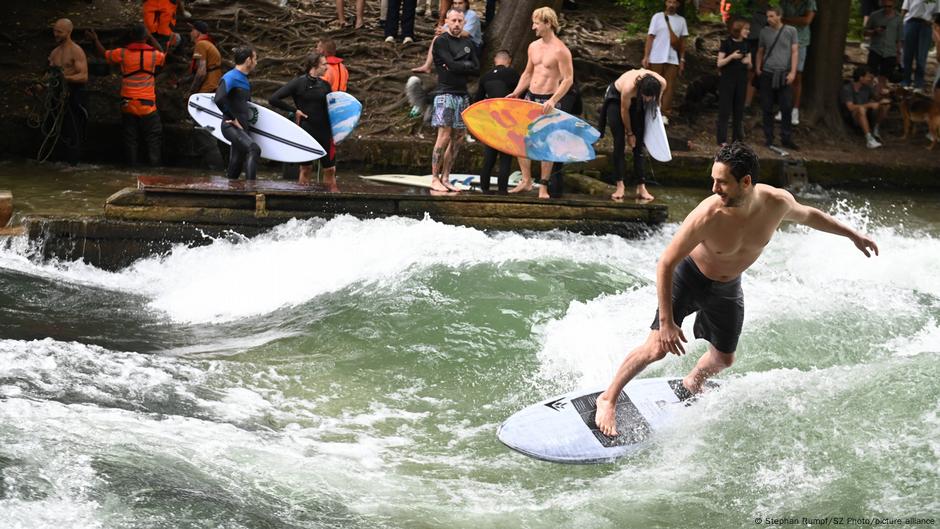
Munich’s Eisbachwelle is a famous man-made standing wave credited with pioneering freshwater river surfing since 1972.
The wave has abruptly vanished, leaving surfers and spectators without the city-center icon.
Western mainstream sources agree the disappearance followed routine maintenance.
DW reports the wave disappeared unexpectedly after routine cleaning and sediment removal and that authorities are now working to restore it.
The Associated Press highlights its status as the mother of all river waves and says it has mysteriously disappeared.
This underscores the shock to the local community that has gathered there for decades.
Both sources emphasize the site’s long history and magnetic draw for surfers.
However, they differ in emphasis between the procedural context reported by DW and the cultural loss highlighted by the Associated Press.
Coverage Differences
tone
DW (Western Mainstream) frames the event in procedural, municipal terms — emphasizing routine cleaning, monitoring, and restoration steps — whereas Associated Press (Western Mainstream) uses more emotive language, calling the Eisbach “the mother of all river waves” and stressing the shock of its disappearance to surfers and spectators.
narrative
DW (Western Mainstream) centers on the restoration process and ongoing monitoring, while Associated Press (Western Mainstream) foregrounds the wave’s iconic stature and the abrupt break in decades-long continuity for the surfing scene.
Loss of Standing Wave Explained
What triggered the loss remains unclear.
DW specifies that workers made no intentional changes to water flow during cleaning, yet the wave failed to reform when water was reintroduced.
Officials are testing water-level and flow adjustments to recreate the standing wave.
The Associated Press adds engineering context, explaining the wave is formed by concrete blocks controlling the river’s current and could reach up to 4 feet.
Despite this information, the cause of the wave's disappearance is still considered mysterious.
Together, the coverage points to a post-maintenance hydrodynamic change without a confirmed single cause.
Coverage Differences
missed information
Associated Press (Western Mainstream) supplies structural detail — concrete blocks and typical wave height — absent in DW, while DW (Western Mainstream) offers procedural specifics about cleaning, flow reintroduction, and iterative adjustments that AP does not detail.
narrative
DW (Western Mainstream) emphasizes uncertainty and ongoing monitoring, implying a methodical municipal response, while Associated Press (Western Mainstream) leans into the mystery and iconic status, focusing less on the step-by-step remediation.
Munich Surf Wave Loss
For Munich’s surf culture, the loss is immediate.
AP notes the community is without their iconic wave for the first time in decades.
DW underscores the site’s decades-long draw and the partnership between city officials and a local surfing group to get the wave back.
The coverage conveys urgency and cultural impact, even as neither source explicitly reports on protests or formal demands.
Instead, DW reports collaboration on technical fixes, and AP stresses the emptiness left for surfers and spectators.
Coverage Differences
tone
Associated Press (Western Mainstream) centers the community’s emotional loss and the first break in decades, while DW (Western Mainstream) adopts a pragmatic tone about coordination with a local surfing group and technical remediation.
missed information
Neither DW nor Associated Press (both Western Mainstream) reports explicit surfer 'demands' or protest actions; DW reports collaboration, and AP reports community impact, leaving any organized activism or petition details unaddressed.
Disappearance of Standing Wave
Both Western mainstream sources agree on key facts: the wave vanished after maintenance, the cause is unknown, and authorities are attempting restoration.
However, they differ in focus: DW highlights the municipal process and uncertainty, while the Associated Press emphasizes the site’s legendary status and the scale of the loss.
No other types of sources, such as local alternative outlets or engineering journals, have been provided, leaving some questions unanswered.
These questions include the exact hydraulic change that stopped the standing wave and the timeline for a fix.
DW reports that officials are closely monitoring water conditions.
Meanwhile, the Associated Press stresses the break in a tradition that lasted for decades.
Coverage Differences
unique/off-topic
DW (Western Mainstream) uniquely foregrounds monitoring and iterative fixes, while Associated Press (Western Mainstream) uniquely foregrounds legacy, superlatives, and community impact; neither explores detailed hydrodynamic analyses or environmental assessments that might appear in technical or local alternative sources.