South America02 May, 20269 min read
Delcy Rodríguez Raises Venezuela’s Minimum Income to $240 and Pensions to $70
This article is an automated aggregation of coverage from news outlets. Our editorials offer in-depth analysis curated by the NewsCord team.
Acting President Delcy Rodríguez announced increases to minimum income and pensions. Announcement occurred on May 1, 2026, International Workers’ Day.
Wage and pension hike
Venezuela’s acting president Delcy Rodríguez announced an increase in the country’s “comprehensive minimum income” to the equivalent of $240 per month and a rise in pensions to $70, speaking at a public event in the capital Caracas on Thursday, according to Anadolu Ajansı. The announcement came as Venezuela continues to face “prolonged inflation and currency depreciation due to ongoing US sanctions,” Anadolu Ajansı reported. Anadolu Ajansı said Rodríguez described the measure as the “most significant increase in recent years,” and added that the government clarified the adjustment refers to a broad income scheme that includes base salary and state bonuses rather than a purely wage-based increase.
Orinoco Tribune similarly reported that Rodríguez announced an increase in monthly income for public sector workers and pensioners on the eve of International Workers’ Day, and said the “integral minimum income” rose from roughly US $190 to $240, a 26% hike. Orinoco Tribune also said pensioners will receive $70 per month, up from $60, and described the change as part of a nationwide campaign launched on April 19 calling for the total removal of US economic sanctions.

Devdiscourse framed the same decision as a wage hike raising the monthly minimum income to $240 and pensions to $70, while describing employees protesting for better salaries amid soaring inflation. In parallel, El Mundo reported that the government announcement of wage and pension increases was moved forward by 24 hours and that Rodríguez said after the call the “Great Pilgrimage” that “It is the most important increase in recent years; we had not had an increment that would allow us to reach this level,” while also stating that the integral minimum wage would rise from 160 to 240 dollars.
Inflation, sanctions, and policy
The wage and pension increase was presented against a backdrop of economic strain tied to US sanctions and the knock-on effects of inflation and currency depreciation. Anadolu Ajansı said the announcement came “as Venezuela continues to face prolonged inflation and currency depreciation due to ongoing US sanctions,” and it described the measure as applying to both public and private sector workers. Orinoco Tribune expanded the context by tying the economic crisis to “crippling US sanctions on Venezuela’s oil industry, the country’s main source of foreign revenue,” and said the situation was “compounded by low oil prices and corruption.”
Orinoco Tribune also reported that Venezuela’s oil output fell from 1.9 million barrels per day (bpd) in 2017 to less than 350,000 bpd in the second half of 2020, and it said that from 2022 to 2025 oil exports amounted US $93 billion, almost the same as the US $93.6 billion earned in 2012 alone. It further stated that the US Treasury’s Office of Foreign Assets Control (OFAC) issued temporary licenses to allow operations in these sectors and authorized Venezuelan state banks’ reinsertion into the international financial system amid negotiations with Caracas. Radio-Canada described the political and economic pressure as part of a broader rupture after the “capture” of Nicolás Maduro by the United States, saying Venezuela has been waiting for elections promised in February and that protesters denounce “low wages and inflation.”

Radio-Canada also said Delcy Rodríguez has served as interim head of the country since January 5 under an emergency injunction issued after Maduro’s capture, and it reported that on April 1 the Trump administration lifted sanctions that had weighed on the country since 2018. El Mundo, meanwhile, focused on how the minimum wage increase sits inside a system of bonuses and social control, saying the integral minimum wage “would rise from 160 to 240 dollars” but that Rodríguez did not specify how that money was distributed. In that framing, El Mundo said the rest were bonuses distributed through the Homeland Card, and it added that the basic basket for a family of five stands at $700 in Venezuela.
Protests and competing claims
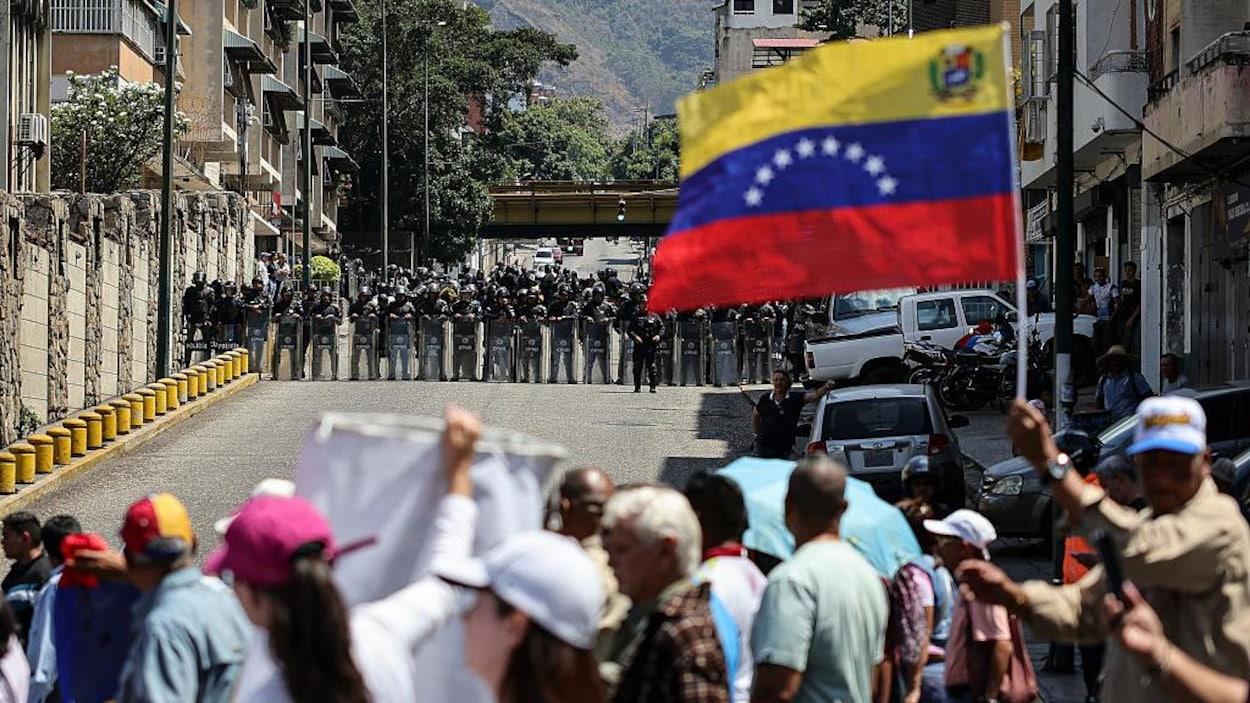
While Rodríguez presented the $240 minimum income and $70 pensions as a major step, the sources also describe ongoing protests and sharp criticism about whether the policy meaningfully improves workers’ lives. Devdiscourse said the acting president emphasized the need to restore wages and end U.S. sanctions, and it described “acting President Delcy Rodriguez announced a significant wage increase on Thursday amid ongoing protests by employees demanding higher salaries.” Radio-Canada reported that protesters denounce low wages and inflation, and it quoted María Corina Machado describing Venezuela’s social conditions, saying, “In Venezuela, there is hunger: our children suffer from cruel malnutrition and our elderly survive on a pension of 130 bolivars per month, said María Corina Machado.”
Orinoco Tribune said the nationwide campaign to demand an end to US economic sanctions was launched on April 19 and that the mobilization aimed “to build national unity against ongoing US coercive measures,” while also describing how workers and labor leaders staged protests in Caracas during the runup to May 1 to demand a “real salary increase rather than just higher bonuses.” Orinoco Tribune also described how the legal base salary for the public sector and pensioners has remained frozen since March 2022 at 130 bolívars per month, approximately US $0.27 at the current exchange rate, and it said retirement pensions and severance pay have been “virtually non-existent.” El Mundo added a further critique from within the policy mechanics, saying the minimum wage “did not reach even one dollar per month; the rest were bonuses that are distributed through the Homeland Card, the government's main tool of social control.”
It also reported that Rodríguez “hid from the country the final amounts of what would be the minimum wage and the bonuses,” and that the main beneficiaries would be retirees going from “less than one dollar to 70 green dollars per month (60 euros).” Radio-Canada described clashes in Caracas during a demonstration organized on April 9, saying “Clashes pitted police officers against some of the 2,000 protesters” and that police used tear gas to disperse the crowd, with “five people were arrested.” Radio-Canada also said Interior Minister Diosdado Cabello rejected a call for a presidential election filed by the opposition led by María Corina Machado, and it described the constitutional timeline for elections after a maximum period of six months.
How outlets frame the same move
The sources differ not only in the details they emphasize, but also in how they describe the meaning of the wage hike and the political environment around it. Anadolu Ajansı presented the policy as a broad income adjustment that includes base salary and state bonuses, and it said Rodríguez urged the private sector to apply the $240 minimum to cases where employee income is currently lower. Orinoco Tribune, while also describing the increase as an “integral minimum income,” framed it as part of a national campaign to demand the “total removal of US economic sanctions,” and it included a detailed account of how past attempts to raise the minimum wage backfired between 2018 and 2022.
Devdiscourse, by contrast, described the decision as a response to “soaring inflation” and “ongoing protests,” and it stated that “Workers have been receiving only a few cents in dollar terms from their minimum wage, supplemented by government bonuses previously taking their incomes to around $190 monthly.” El Mundo focused on the internal distribution mechanics and said Rodríguez “did not specify how that money was distributed,” while also asserting that the minimum wage did not reach even one dollar per month and that the rest were bonuses distributed through the Homeland Card. Radio-Canada placed the wage issue inside a broader political timeline, saying Venezuela is still waiting for elections promised in February and that Delcy Rodríguez has been interim head since January 5, while also describing the opposition’s demands for a new National Electoral Council and an update to the electoral register where “40% of Venezuelans of voting age are not registered.”
The same political tension appears in Orinoco Tribune’s account of Washington’s role, where it said the mobilization aimed to build unity against “Washington’s oil sales takeover following President Nicolás Maduro’s abduction on January 3.” Even when the numbers align at the top line—$240 and $70—the sources diverge on the starting point and the implied structure: Orinoco Tribune said the integral minimum income rose from roughly US $190 to $240, while El Mundo said it would rise from 160 to 240 dollars. Those differences shape how each outlet frames the policy’s credibility and impact, with some emphasizing the scale of the increase and others emphasizing how much of it is delivered through bonuses rather than a base wage.
What comes next
The sources portray the wage and pension increase as a step that could affect workers immediately, while also leaving unresolved questions about implementation and the political process. Anadolu Ajansı said Rodríguez urged the private sector to apply the $240 minimum to cases where employee income is currently lower, and it described the measure as applying to both public and private sector workers. Orinoco Tribune said the acting president urged private companies to adjust their salaries so that they equal or surpass the new minimum income, and it described how wages in the private sector are typically higher but that companies avoid legal obligations by paying workers informally in US cash.
It also said the legal base salary for public sector workers and pensioners has been frozen since March 2022 at 130 bolívars per month, and it described how bonuses paid in bolívars but pegged to the official exchange rate set by Venezuela’s Central Bank (BCV) have no impact on severance pay, vacation bonuses, or retirement pensions. Radio-Canada reported that the interim president has still not organized the elections promised in February, and it described the constitutional mechanism in which the vice president can assume the presidency for 90 days, renewable for another 90 days, after which elections must take place within 30 days. It also said opposition leader María Corina Machado called for a new National Electoral Council composed of people with no political affiliation and for an update to the electoral register.
In the economic sphere, Orinoco Tribune said Rodríguez has stressed that the long-term objective is to steady workers’ income sustained by economic growth and increased state revenues, leveraging renewed operations in the oil and mining industries. It reported that OFAC temporary licenses and authorizations for state banks’ reinsertion into the international financial system were part of the environment, and it said that since January the Trump administration has taken control of most of Venezuela’s oil-related exports with revenue deposited in the US Treasury. El Mundo added that Rodríguez said the new income will serve as a reference for the private sector, while also stating that the basic basket for a family of five stands at $700 in Venezuela.