Donald Trump at the Kennedy Center: the mob in power
Key Takeaways
- Kennedy Center renamed in Trump's name by his own decree.
- He defended triggering the war against Iran and claimed it yielded a major victory.
- The speech was increasingly incoherent, with disjointed anecdotes and remarks about allies' wives.
Kennedy Center speech tone
During an hour-long public address at the Kennedy Center—renamed in his name by his own decree—the American president Donald Trump defended triggering the war against Iran and proclaimed that its results already constituted a major victory.
“During an hour-long public address at the Kennedy Center—renamed in his name by his own decree—the American president Donald Trump defended triggering the war against Iran and proclaimed that its results already constituted a major victory”
In an increasingly incoherent speech, he rattled off disjointed anecdotes, digressions, remarks about the wives of his political allies, comments on the theater's acoustics, all punctuated by boasts about the annihilation of a nation of 93 million people.
Trump spoke like a character from a Martin Scorsese film.
His speech was that of organized crime: casual discussions about the assassination of leaders, loyalty tests, a mercenary view of alliances, barely veiled threats, self-satisfaction after acts of violence, a jovial indifference to the suffering of others.
Anyone listening to him for the first time would be forced to wonder: is this man really the president of the United States?
The conclusion is inevitable: the mob has taken power at the top of American politics.
Trump began his speech with a litany of the destructions that have befallen Iran.
'Our powerful military campaign,' he said, 'has continued with full force in recent days. They have been literally annihilated. The air force is destroyed. The navy is destroyed. Many ships have been sunk. They were warships, but I suppose they did not know how to use them. The air defenses are decimated. Their radars are out of service, and their leaders are dead. Apart from that, they’re doing fairly well.'
Iran war risk and consequences
These grotesque jokes testify to a jubilation over the human cost of the war he started.
Thousands of Iranians have been killed, and nearly a thousand Lebanese have died in Israeli bombardments—carried out with weapons supplied by the United States.
Thirteen American soldiers have also lost their lives.
Trump bragged that more than 7,000 targets across Iran had been struck in a little over two weeks, ranging from military installations to munitions and electrical component factories, as well as various government buildings.
He claimed to have sunk 100 Iranian navy ships and that American bombs and missiles had destroyed all military facilities on Kharg Island, Iran's main oil export hub.
'We left the pipelines,' Trump said, but the oil facilities could be destroyed 'in five minutes. It would be over.'
This bravado masks growing despair, as the American plan to annihilate Iran quickly by eliminating its leadership has clearly failed.
While labeling Iran a 'paper tiger,' Trump revived his call for European powers, Japan, and even China to guarantee the shipping of oil out of the Persian Gulf.
After more than a year of international pressure through the imposition of illegal tariffs, Trump notes that his neglected allies, notably rival imperial powers such as Germany, the United Kingdom, and France, are reluctant to send mine-hunters to take part in a U.S.-led operation to 'reopen' the Strait of Hormuz.
It is now widely accepted that Trump was totally unaware of the likelihood that Iran would close the Strait of Hormuz in response to an American military strike, even as, at his press conference, he boasted of having 'predicted everything,' including the September 11, 2001 attacks.
The most remarkable statement by the American president was surely his critique of the reluctance of many U.S. allies to engage in war against Iran.
Referencing an imagined conversation with such an ally, he said: 'You mean to tell me that we have protected you for 40 years and you refuse to get involved in a minor conflict where only a few shots would be fired because their ammunition is nearly exhausted, but they said they'd rather not intervene?'
Trump's approach to foreign policy resembles a protection racket orchestrated by a criminal organization.
As for this 'minor' conflict, it moves the world one giant step closer to triggering a nuclear war.
Pentagon military strategists are already drafting scenarios in which American Marines would attempt to secure the Strait of Hormuz by taking the rugged terrain along Iran's coast.
A large-scale ground war could then follow.
Speaking on a podcast on Friday, billionaire David Sacks, 'czar' of AI and cryptocurrencies within the administration and a fervent Zionist, said: 'Israel could be simply destroyed, or at least a very large part of its territory,' if the war continues, and hinted that the Netanyahu government could use nuclear weapons if Iran continues to resist.
Domestic politics and mobilization
After reveling in the violence of the criminal war against Iran, Trump launched into increasingly incoherent digressions, addressing his close political aides seated around the table, including White House Chief of Staff Susie Wiles and Speaker of the House Mike Johnson. He macabrely recounted the imminent death episode of an elderly Republican congressman, claiming credit for having persuaded Neil Dunn (Florida Republican) to seek treatment to preserve Johnson's three-vote majority in the House. 'I did it first for him, and then for the vote, but it was a hair,' Trump commented. Through his more or less coherent anecdotes, Trump offered a glimpse into the regime's social makeup: a ruling clique of billionaires, henchmen, and political operatives. At one point, he paused to praise the 'wealthy board of directors' of the 'Trump-Kennedy Center' and cited some plutocrats as examples. 'So, under the leadership of this exceptionally talented and wealthy board,' he said, 'it's a very wealthy board... most of you are well-heeled. Ike Perlmutter [whose wife, Laura, sits on the board] is immensely rich. Look at Ike Perlmutter. He ended up becoming the principal shareholder of Disney.' And he cited another businessman as a symbol of success in Trump's America: 'Anthony, for example. He started with a single truck... he ended with 4,000 trucks, and he sold his business for billions of dollars... He is a member of one of my clubs, and he has only cash.' At one point, Trump announced that the Ultimate Fighting Championship (UFC) would host a fight on the White House lawn on his birthday, at his invitation. The Pentagon also entrusted the UFC with training soldiers in the brutality displayed by UFC fighters in the ring. To which former president can we compare Trump? He stands apart from any democratic tradition. The White House has housed a number of unsavory individuals. But Trump represents a level of intellectual and moral degeneration such that even Richard Nixon would appear a model of integrity. The vile traits of Trump embody the historical decadence of the American ruling elite as a whole. All the corruption and dishonesty that characterize the tech and financial sectors, as well as the oligarchy he has spawned, converge in Trump's personality. As we have already noted, not all CEOs are Donald Trump. But there is a bit of Donald Trump in each of them. Mark Zuckerberg's motto, 'Move fast and break things,' finds its criminal culmination, on a much larger scale, in the unspoken war motto against Iran: 'Bomb countries, kill people.' There is a deep link between Trump's personality and the interests of the capitalist oligarchy. How else to explain that such an individual governs so closely one of the two main parties of the business class, after being named the Republican presidential candidate in three consecutive elections? The United States is waging a major war under the leadership of a man who, at the moment it erupts, is elsewhere—mentally, emotionally, morally. He is at a meeting of car dealership executives. He is at the opening of a golf complex. He is where his narcissism leads him at every moment, and the war is only the temporary backdrop to his ongoing personal performance. The American ruling class has built a political order where the presidency can be occupied by someone who views massacres as entertainment and a means of glorifying himself, in the manner of Caligula presiding over a gladiator fight in a Roman stadium. The Democratic Party's response to this crisis has been, as usual, a mix of procedural complaints and political impotence. Senator Adam Schiff appeared on television this weekend to point out that Trump had not 'told the American people the truth.' It is the political equivalent of noting that Hitler's Austrian-accented language left something to be desired. Democrats are unable to seriously oppose Trump's war or his assault on democratic norms because they themselves are deeply involved in the political, economic, and military structures that produced these two situations. In reality, they support his war and the policy behind it. They voted for military budgets. They approved the sanctions regime. They have maintained and strengthened the imperial presidency under Obama and Biden. They are no different from Trump in their attachment to American global hegemony, but they would rather wield it more politely and with more refined language. The collapse of the Democratic opposition is not a peripheral element of the crisis; it is an essential component. Trump's mafia presidency is possible precisely because the American two-party system offers no real alternative. The tens of millions of Americans horrified by what they see have no way to act politically. Their choice comes down to the party of the crime boss or the party that issues press releases voicing concern about him while funding his wars. Trump is the representative of a ruling class on its last days. The question is whether this class will drag the entire world toward catastrophe in its struggle to preserve the capitalist system, the foundation of its wealth and privileges. The working class of the United States and the world has not yet spoken out about this crisis. The millions of people horrified, the millions who cannot reconcile what they see with any legitimate conception of governance, the millions who feel that a fundamental system has broken down: these millions have not yet found their political voice or their organization. But the crisis itself creates the conditions for such a reaction. A war unleashed by a gangster president, approved by an impotent and dishonest opposition party, conducted in an atmosphere of surreal banality, destabilizing the global economy while its author boasts of having killed thousands of people while bragging about his talent for renovating ballrooms: this situation is untenable. To counter Trump's austerity, war, and attacks on democratic rights, we must first recognize that the working class—and no component of the capitalist class—is the indispensable social force capable of defeating this government. Independent political mobilization by the working class, by breaking with the capitalist bipartite system and fighting for a socialist and anti-war program, is the imperative of the moment.
“During an hour-long public address at the Kennedy Center—renamed in his name by his own decree—the American president Donald Trump defended triggering the war against Iran and proclaimed that its results already constituted a major victory”
More on Iran

Israel strikes Iran's Pars gas field as Tehran vows revenge
14 sources compared
Trump threatens to blow up South Pars gas field if Iran attacks Qatar again
10 sources compared
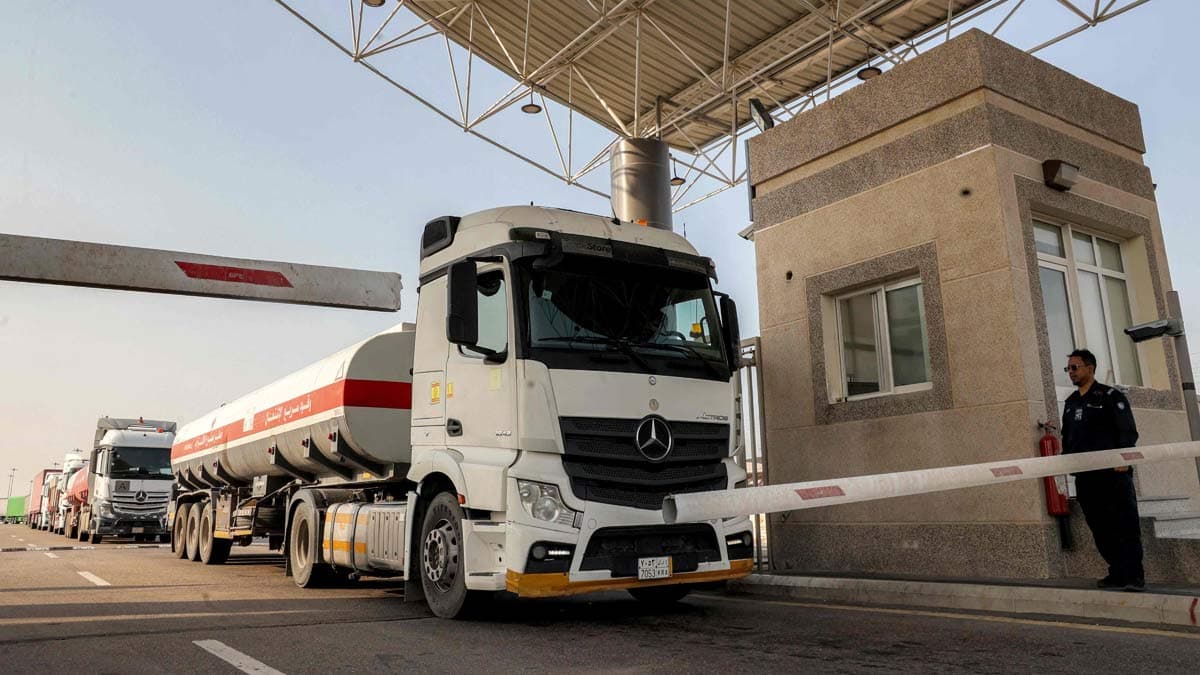
UAE Halts Habshan Gas Facility Operations After Debris From Intercepted Missiles
10 sources compared

Iran Threatens Gulf Energy Facilities After Israel Strikes South Pars Gas Field
11 sources compared