Full Analysis Summary
Venezuelan Migrant Return Crisis
Thousands of Venezuelan migrants who once hoped to reach the United States have been turned back into poverty as U.S. immigration enforcement tightened under President Donald Trump.
That enforcement has forced families like Mariela Gómez's to return to Venezuela and confront unemployment, scarcity and an uncertain future.
Firstpost documents Gómez's return to Maracay after detention in Texas, deportation to Mexico and a perilous weeks-long southward journey.
Firstpost situates her story within a larger displacement of more than 7.7 million Venezuelans over the past decade and a surge of returns to South America this year.
The Associated Press similarly frames the returns as a direct result of renewed U.S. enforcement after Trump's return to the White House and highlights the human cost for individuals and families.
The Los Angeles Times snippet provided here did not include article text to contribute additional details.
Coverage Differences
Tone and framing (Asian vs Western Mainstream)
Firstpost (Asian) emphasizes the broader migration trend and the structural hardships migrants face on return — citing millions displaced and official return statistics — while the Associated Press (Western Mainstream) foregrounds the role of U.S. policy under President Trump and the human-cost storytelling of individual families. The Los Angeles Times (Western Mainstream) did not supply an article text in the provided snippet and therefore offers no substantive account to compare.
Mariela Gómez's return journey
The story of Mariela Gómez - detained in Texas, deported to Mexico, then making a dangerous weeks-long journey back to Maracay - illustrates the personal trauma behind the statistics.
Firstpost traces her route and emphasizes the peril and uncertainty migrants face during these forced returns.
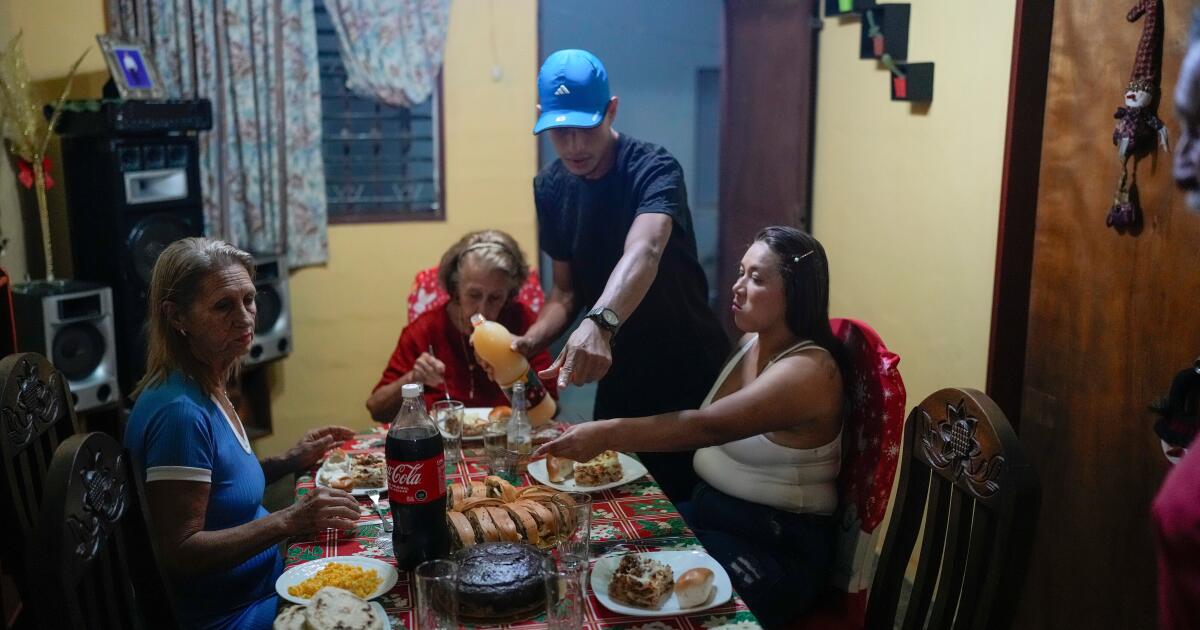
The Associated Press recounts concrete human details from her homecoming, including dressing up, cooking a modest lasagna-like meal, buying a scooter for her son, and a bittersweet reunion with family.
The Los Angeles Times did not provide an article to offer an alternative framing or additional details.
Coverage Differences
Narrative detail vs broader trend
Associated Press (Western Mainstream) emphasizes vivid personal details — meals, presents, family photos — to humanize Gómez’s return; Firstpost (Asian) includes those human details but situates them more directly within migration statistics and regional return figures. Los Angeles Times (Western Mainstream) supplied no article text to either corroborate or challenge these narrative choices.
Regional forced returns data
Beyond Gómez’s household, Firstpost provides regional figures that paint a larger picture of forced returns.
More than 7.7 million Venezuelans have fled the country over the last decade.
By September this year, Colombia, Panama and Costa Rica had reported over 14,000 returns to South America, while Venezuela accepted deportation flights carrying more than 13,000 migrants home.
The Associated Press echoes the policy cause — that tighter U.S. enforcement is driving people to abandon hopes of settling in the U.S. — but its provided snippet does not list the same run of regional statistics.
The Los Angeles Times snippet again did not contribute additional data.
Coverage Differences
Data emphasis vs policy emphasis
Firstpost (Asian) supplies specific regional and numerical data on displacement and returns that underline the scale of the phenomenon; the Associated Press (Western Mainstream) in these snippets focuses more on linking the trend to U.S. policy changes and the immediate human impact, and the Los Angeles Times (Western Mainstream) provided no article text to compare numeric reporting.
Media portrayals of returns
Both Firstpost and the Associated Press portray returns as plunging people into precarious economic conditions, repeatedly describing unemployment, scarcity, and poverty.
Firstpost explicitly highlights the hardship of forced returns and the ongoing uncertainty about work and future prospects for returnees.
The Associated Press frames those hardships as the human cost of the U.S. immigration crackdown.
The Los Angeles Times snippet provided no content indicating how it would present the socioeconomic consequences.
Coverage Differences
Severity and vocabulary
Firstpost (Asian) uses language stressing ongoing hardship and uncertainty — e.g., 'joblessness, scarcity and uncertainty' — to underscore structural deprivation; the Associated Press (Western Mainstream) uses similar humanizing language but frames it as the consequence of renewed U.S. enforcement policy. Los Angeles Times (Western Mainstream) supplied no article passage to assess its vocabulary or severity.
U.S. migration and returns
The two substantive sources — Firstpost and the Associated Press — converge on the core claim that tighter U.S. migration enforcement under President Trump has led thousands of Venezuelans to abandon hopes of the United States and return to precarious conditions at home.
Both sources use individual human stories and regional figures to make this point.
They differ in emphasis.
Firstpost foregrounds migration statistics and regional return figures.
The Associated Press foregrounds U.S. policy and the immediate human cost.
The Los Angeles Times snippet did not offer content to broaden or challenge these narratives in the material provided.
Where details are absent or ambiguous across sources — for example, additional policy mechanisms, timelines, or broader international responses — that ambiguity is reported here rather than assumed.
Coverage Differences
Convergence with differing emphasis and missing coverage
Both Firstpost and Associated Press report returns and hardships but differ in emphasis — Firstpost (Asian) on scale and regional statistics, AP (Western Mainstream) on policy-driven human cost. Los Angeles Times (Western Mainstream) provided no article text to add perspective, and therefore the overall account must note missing information rather than fill gaps.