Full Analysis Summary
Trump-Greene rift coverage
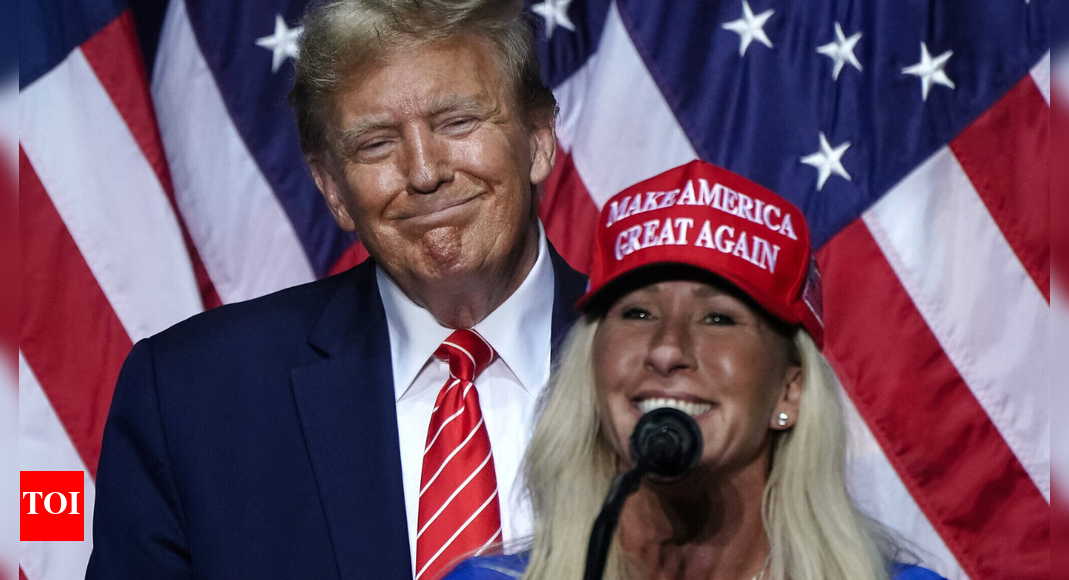
A sharp public rupture between former President Donald Trump and Representative Marjorie Taylor Greene has surfaced in recent headlines, with coverage highlighting derogatory language and political distancing.
The Times of India reports that Trump has publicly split with ally Marjorie Taylor Greene, calling her 'wacky' and declaring 'MAGA is dead,' framing the episode as a major rift within the Republican/MAGA sphere.
Together, these reports present the media narrative that Trump sought to signal a break from Greene even as she pushed back.
The coverage centers on the nicknames and political fallout as emblematic of wider intra-GOP tensions.
Coverage Differences
Tone/Emphasis
Times of India (Asian) foregrounds the personal insult—quoting Trump calling Greene “wacky”—and situates it among a list of headline items, emphasizing the sensational rift. The Times of India (also Asian in the provided list) presents a concise political framing—reporting Trump’s line “MAGA is dead”—which casts the split as a broader repudiation of the movement rather than only a personal insult. Both sources report the split but emphasize different quotes and framings; each report is reporting on the same developments rather than offering original partisan analysis.
Quarrel tied to policy
Both reports link the public quarrel to policy and controversy, noting disputes over H-1B visas and other contested topics.
The Times of India roundup explicitly cites the ongoing H-1B visa debate and related political fallout, saying the split is 'tied in headlines to disagreements over H-1B policy and Epstein-related issues.'
Another Times of India snippet likewise lists the H-1B debate among causes of heated exchanges within the GOP.
These reports therefore connect the nickname and personal attacks to substantive policy disagreements and prior controversies rather than portraying the rupture as purely personal drama.
Coverage Differences
Narrative Detail
Both sources mention H‑1B visa disputes as a context for the rift, but The Times of India (concise roundup) explicitly names Epstein‑related issues alongside visa disagreements, providing a slightly broader list of triggers. Times of India (roundup) places the H‑1B debate amid many other items in a multi‑topic roundup, which can make the political causes read as one thread among many headlines rather than the headline focus.
Differences in media coverage
Coverage differs in scope and context: one snippet appears in a larger headline roundup mixing international incidents, entertainment controversies, and sports retention lists, while the other frames the Greene–Trump episode in a focused political roundup alongside other US political and celebrity items.
The roundup-style Times of India article lists unrelated stories—such as an Iranian seizure of an oil tanker, a Meghan Markle photo controversy, and IPL retention lists—alongside the Trump–Greene item, which can dilute the perceived centrality of the GOP split.
By contrast, the Times of India concise summary separates the Trump–Greene matter with specific direct quotes and related political details.
Coverage Differences
Unique/Off‑topic Coverage
Times of India (roundup) places the Trump–Greene rift amid a broad mix of headlines—security incidents, pop culture clashes, sports—indicating a general news‑roundup tone where political stock‑and‑trade headlines coexist with lighter fare. The Times of India (concise) isolates the political rift with direct quotations and related political context, offering a more focused political narrative. This is a difference of framing and editorial placement rather than a contradiction over facts.
Political dispute reporting
Direct quotes from the principals reveal emotional intensity: The Times of India reports Trump calling Greene "wacky," while its synopsis quotes Greene saying "I don't worship or serve...", underscoring her combative rebuttal.
Both sources attribute these lines as reported speech rather than editorial endorsement.
Including verbatim quotes gives readers evidence of acrimony and lets the differing tones of the sources (one more sensational in list form, the other more focused) shape how audiences perceive the dispute.
Coverage Differences
Quotation vs. Reporting
Both sources are reporting quotes: Times of India reports Trump calling Greene “wacky,” and The Times of India reports Greene’s retort “I don’t worship or serve…”. Neither source frames these as their own opinions—they are presented as quoted speech from the involved figures. The difference lies in which quote each source foregrounds.
Limits of the reports
Limitations and ambiguity remain: both provided snippets are brief and part of roundup formats, so details about timing, fuller quotes, or responses from other GOP figures are not present in these excerpts.
The two Times entries overlap in subject matter but do not supply a comprehensive chronology or independent verification beyond quoted lines, so readers should treat these as initial reports that highlight a rupture without resolving all causes or consequences.
I can expand on particular aspects (legal or policy roots, Greene’s full statement, or GOP reactions) if you want, but I would need additional source material beyond these provided snippets.
Coverage Differences
Missing Information/Ambiguity
Both sources are summaries/roundups and therefore omit deeper detail—neither provides a full sequence of events, full transcripts, nor broader GOP reactions. This is a shared limitation rather than a contradiction; both sources report key quotes but leave context and follow‑up unanswered.