Donald Trump Says Iran Refuses Nuclear Demands Ahead Of Possible Second Conflict
Key Takeaways
- Trump said Iran negotiations were unsatisfactory and he hasn't ruled out a second conflict.
- Trump invoked the Monroe Doctrine to justify his attack on Nicolás Maduro.
- Trump discusses possible use of military force abroad.
Trump, Iran talks
Donald Trump said on Friday, February 27, that he was "not happy" with "the state of negotiations with Iran on the nuclear issue," while noting he had not yet made a final decision about the advisability of a second American military conflict in Iran within less than a year.
“The latest Ebola outbreak in the Democratic Republic of the Congo – Bundibugyo strain – 'is spreading faster than the workers of the' In Nogales, Sonora, federal security authorities detained Isaí 'N', nephew of Joaquín Guzmán Loera, alias Chapo, identified as a logistics operator for the Cartel of The reform to the General Law on Electoral Institutions and Procedures does not propose that the National Electoral Institute (INE) determine the viability of candidacies”
He told reporters in Washington, "I am not happy that they are refusing to give us what we need," referring to American demands regarding the dismantling of Iran's nuclear program.
The statements came a day after a third round of talks in Geneva, at the end of which the Iranian delegation hailed "new progress," and Oman’s Foreign Minister Badr Al-Busaidi said Americans and Iranians had made "substantial progress" in Geneva.
Badr Al-Busaidi, in an interview with CBS News, specified that Iran had pledged to never, ever possess nuclear materials capable of making a bomb, which he called a "great achievement," and he said Tehran had agreed not to stockpile enriched uranium.
In Tehran, CNN notes that "hardline regime supporters have repeatedly warned that renouncing uranium enrichment would amount to a national humiliation," while Sanam Vakil of Chatham House said the regime could survive a compromise that does not involve abandoning enrichment if it brings clear economic or strategic benefits.
Warnings to citizens
Concerns about the prospect of US strikes against Iran "have led several countries to issue warnings to their nationals in the region on Friday," BBC said.
The BBC reported that the United Kingdom had temporarily recalled its staff from its embassy in Tehran and updated its travel advice, dissuading any non-essential travel to Israel.

The BBC also said countries such as the United States, China, India and Canada "have urged their citizens to leave Iran as soon as possible," while France and Germany advised against all non-essential travel to Israel.
In the same reporting, The Washington Post described an aerial and naval deployment—"the largest since the 2003 invasion of Iraq"—that continued on Friday, including "the arrival of about a dozen refueling aircraft at Tel Aviv’s Ben-Gurion Airport."
L’Orient-Le Jour quoted a Western diplomat saying Israel would now be working "to persuade the United States to strike quickly," believing Iran was seeking to buy time by multiplying proposals and hesitations.
Monroe Doctrine revived
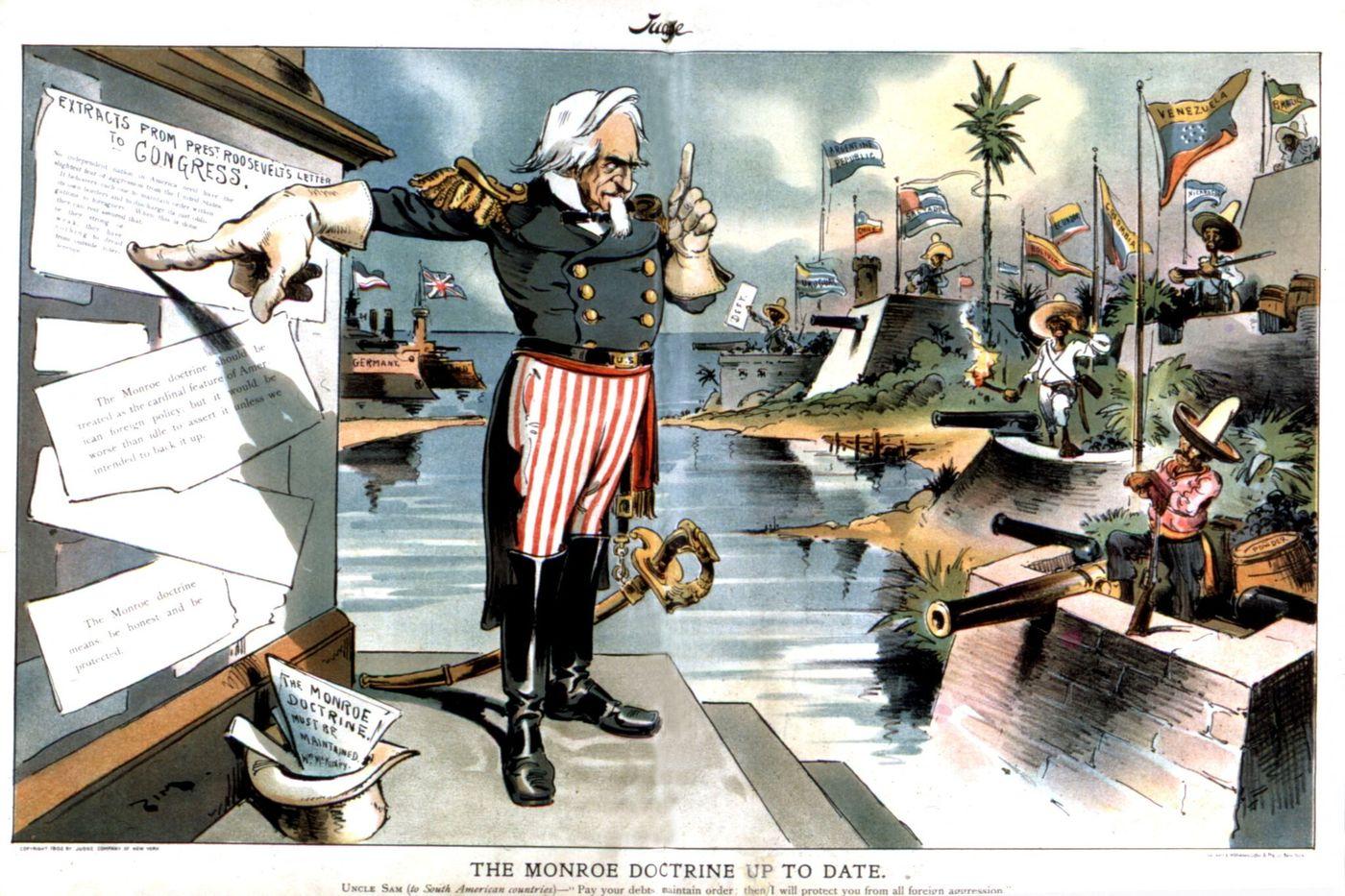
In a separate thread of U.S. foreign policy framing, Donald Trump cited the Monroe Doctrine to justify his country's attack on Caracas and the capture of its Venezuelan counterpart Nicolás Maduro, La Croix reported.
“As the famous quote 'history does not repeat itself, but it rhymes' suggests, Cubans remain in a waiting rhythm for what might happen to their country after what happened in Venezuela on January 3 with the capture of Nicolás Maduro by the US and, above all, after Donald Trump's announcement: 'I think I will have the honor of taking the island'”
The article says the doctrine takes its name from the United States' fifth president, James Monroe, and it quotes Monroe’s 1823 message to Congress: "The American continents, according to the state of freedom and independence they have acquired and in which they have maintained themselves, can no longer be considered in the future as subject to colonization by any European power."
La Croix adds that Monroe also stated that any European attempt to interfere in a country on the American continent would be perceived as a hostile act toward Washington, and that the United States could not remain an "indifferent spectator."
The article describes how the Monroe Doctrine was expanded in 1904 with the "Roosevelt Corollary," quoting Theodore Roosevelt telling Congress on December 6, 1904 that the United States' adherence "may, albeit reluctantly, in flagrant cases of injustice and impotence, compel it to exercise international police power."
La Croix concludes by saying Trump boasted after the Venezuela attack on Saturday, attaching his first name to the surname of his predecessor, calling it "It’s now called the Donroe document."
More on USA

7th Circuit Upholds Illinois Protect Illinois Communities Act Ban on Semiautomatic Guns
12 sources compared

Indiana State Police Trooper Justin Heflin Shot During Pursuit; Suspect Kevin W. Meyers Found Dead
10 sources compared

Donald Trump Fires Election Assistance Commission Members, Leaving No Commissioners
12 sources compared

Eight Accused Of Planning Terror Attack At Casa Blanca UFC Freedom 250 Event
18 sources compared