USA29 May, 20263 min read
Donald Trump Wants Guantánamo Naval Base To Imprison Foreign Criminals On U.S. Territory
This article is an automated aggregation of coverage from news outlets. Our editorials offer in-depth analysis curated by the NewsCord team.
Unprecedented high-level US-Cuban military talks take place at Guantánamo Bay amid tensions. Trump pressures Cuba as tensions rise surrounding Guantánamo dialogues.

Trump’s Guantánamo Plan
Donald Trump announced on Wednesday 29 January that he wants to use the U.S. naval base at Guantánamo to imprison “des criminels étrangers présents de manière illégale” on U.S. territory, framing the move as a new use for a site normally reserved for terrorism detainees. The La Croix report places the Guantánamo naval base on the south-east coast of Cuba, about 1,000 kilometers from La Havane, describing it as an enclave of 117 km² with only 49 km² of land, ceded by Cuba to the United States in 1903 after the 1898 war. La Croix says the United States created a high-security prison there in January 2002 after the 11 September 2001 attacks, and that “Les premiers détenus de Guantánamo sont enfermés dans des cages à ciel ouvert.”
The same report says that since 1959 Cuba has demanded restitution of the territory, arguing the 1903 agreement is illegal under international law, and it adds that the base operates in a closed circuit with its own electricity, a desalination plant, and supplies arriving by barges from Jacksonville in Florida. La Croix also ties the detention site to the Bush administration’s classification of detainees as “combattants ennemis,” and it says nine men died in detention, while the NGO “Close Guantanamo” says 15 prisoners are still incarcerated.

Cuba Rejects Normalization
Cuba’s position on Guantánamo is presented in Courrier international as a condition for any diplomatic rapprochement, with the Cuban President Raul Castro saying on January 28 during the CELAC summit that “This will not be possible until the blockade weighing on our country is lifted.” The same Courrier international account says Raul Castro also linked dialogue to the return of the land occupied by the Guantánamo Bay military base and to an end to violations of international law, adding that Havana would make no political concessions in the normalization process. In the Periodistas en Español account, the issue of Guantánamo’s return is described as part of CELAC discussions on normalizing relations between Cuba and the United States, and it notes that during CELAC’s Third Summit in San José, Costa Rica, the Guantánamo problem “will not appear” in CELAC’s resolutions due to lack of consensus among 33 delegations.
Periodistas en Español also states that a 1903 treaty grants exclusive sovereignty to the United States over an area of 117.6 square kilometers, and it says Cuba rejects the indefinite concession and considers the 1903 treaty null. The article further says that on July 21, 2015, Cuba’s Foreign Minister Bruno Rodríguez told a meeting of Cuban and U.S. diplomacy chiefs that “the return of the Guantánamo territory” is part of what normalization implies.
Guantánamo as a Flashpoint
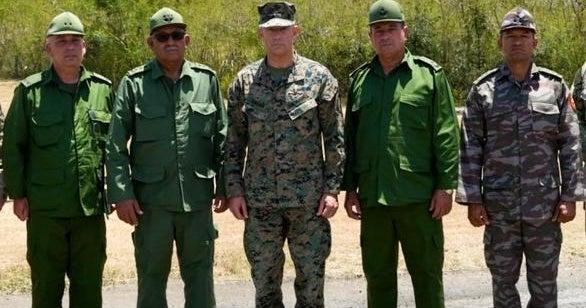
El Mundo describes a “unprecedented Friday summit” at the Guantánamo base between the head of the U.S. Southern Command and Raúl Castro’s strongman, naming General Francis L. Donovan and Cuban General Roberto Legrá Sotolongo as the two top-tier antagonists.
El Mundo says the U.S. side characterized the meeting as “a 'brief exchange on operational security matters'” and a “'perimeter security assessment of the naval base'” focused on protection of forces and operational readiness.
The same El Mundo report frames the summit as occurring amid Washington’s “maximum pressure against the Castro regime,” and it links Donovan to U.S. military exercises in Caracas and to an order for a bombing in the Pacific that it says killed “three narcoterrorists,” according to the Southern Command.
On the Cuban side, El Mundo says General Legrá Sotolongo is deputy minister of the Armed Forces and head of the General Staff of the Revolutionary Armed Forces since 2021, and it adds that he is sanctioned by the U.S. and on the Treasury Department’s blacklist.
La Croix, meanwhile, provides the longer legal and operational context for why Guantánamo remains central to U.S.-Cuba disputes, describing the base’s 1903 cession, the 1934 readjustment, and Cuba’s continued demand for restitution since Fidel Castro’s arrival in 1959.