Full story
Fire weather surges
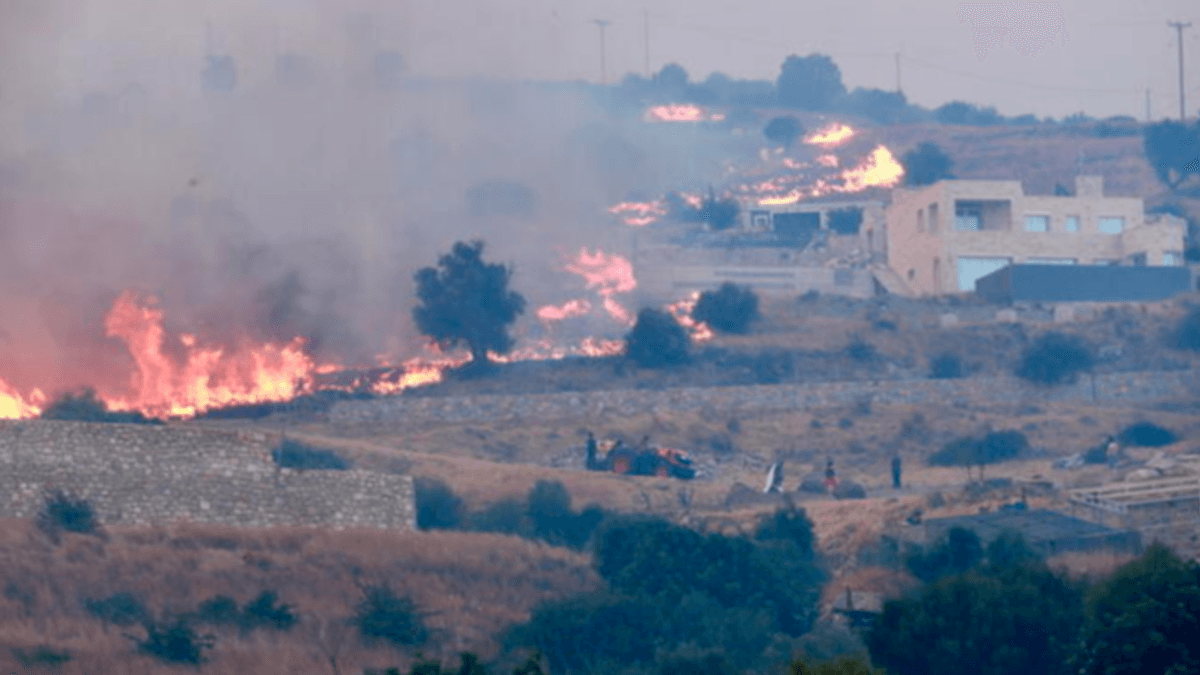
Western Europe is battling widespread wildfires with the most severe fires affecting southwestern France and central and eastern Spain as of July 30th 2026, after months of drought and periods of extreme heat.
“the most severe fires are affecting southwestern France and central and eastern Spain”
In France, fires that originated near the Atlantic coast on 22 and 23 July have spread inland and become particularly destructive in the Gironde department around Bordeaux, where the Gironde fire has so far burned approximately 40,000 ha.

The fire generated a pyrocumulonimbus, or fire-driven thunderstorm, creating abundant lightning and high winds that exacerbated the speed of fire propagation, and at least 240 homes have been destroyed while around 220,000 residents and tourists were evacuated.
In Spain, between 13 and 28 July 2026 around 140,000 ha were burnt, mainly as a result of three major fires including Ávila–Madrid–Toledo, Guadalajara, and Castellón.
The French Minister of the Interior, Laurent Nuñez, declared on 26 July that a record area of around 115,000 ha had burned in France since the beginning of the year.
Climate attribution numbers
World Weather Attribution calculated that human-caused climate change made the hot and dry conditions responsible for Spain’s record-sized inferno 20 times more likely to happen, and it doubled the chances of extreme fire conditions for the flames in France.
Friederike Otto, an Imperial College of London climate scientist who coordinates World Weather Attribution, said, "The change in these fire weather conditions in Spain is really extremely strong and is, I think, one of the largest changes that I’ve seen," while AP Science Writer Seth Borenstein reported the analysis was conducted while fires were still burning.
A separate study in Scientific Reports found that there were about 10 extreme fire weather days a year in Southern Europe in earlier decades, but it is now up to around 25 a year, said study author Raúl Cordero, a climate scientist at the University of Groningen in the Netherlands.
Cordero said the intensity of those conditions was about 50% more intense than they were from 1981 to 2010, and he warned, "It doesn’t matter how many resources or how much money you have, you just cannot stop the propagation of a fire when the weather is so extreme."
The World Weather Attribution analysis also projected that fire weather will become more frequent, intense and widespread with increasing global warming, and it described a pattern of unusually wet springs followed by hot, dry summers dubbed “weather whiplash.”
What’s at stake next
The World Weather Attribution analysis warned that the fires are threatening forests, highly touristic and iconic areas, as well as sensitive economic activities and surrounding communities, with around 220,000 residents and tourists evacuated as the blazes continue.
“further heat and dry conditions are expected in the coming days in both France and Spain”
It also said France declared another heatwave commencing the 29th of July, while further heat and dry conditions are expected in the coming days in both France and Spain, and it linked extreme heat and wildfire smoke to dangerous human health impacts.
The Associated Press reported that while wildfires are worsening in terms of size, intensity, speed and frequency, key worldwide burning statistics are at a record low because fires in Africa and Asia are way down, and it quoted fire scientist Mike Flannigan saying, "It does seem like a paradox because we’re talking increases in fires, yet the global numbers have been going down and down."
Carbon Brief said the area burned by wildfires across the European Union in 2026 is second only to 2022 for this time of year, and it quoted research fellow Dr Calum Cunningham saying such claims are "highly misleading" because they rely on aggregating fire activity across an enormous and climatically diverse region.
In the World Weather Attribution assessment, the combination of extreme heat and wildfire smoke was described as making the work of firefighters even more dangerous and difficult, and it framed the coming days as a test of containment as heatwave conditions persist.