Full Analysis Summary
Early dog cranial traits
New analyses of ancient canid skulls show the physical split between wolves and dogs began much earlier than long assumed.
Clear dog-like cranial traits appear shortly after the last Ice Age.
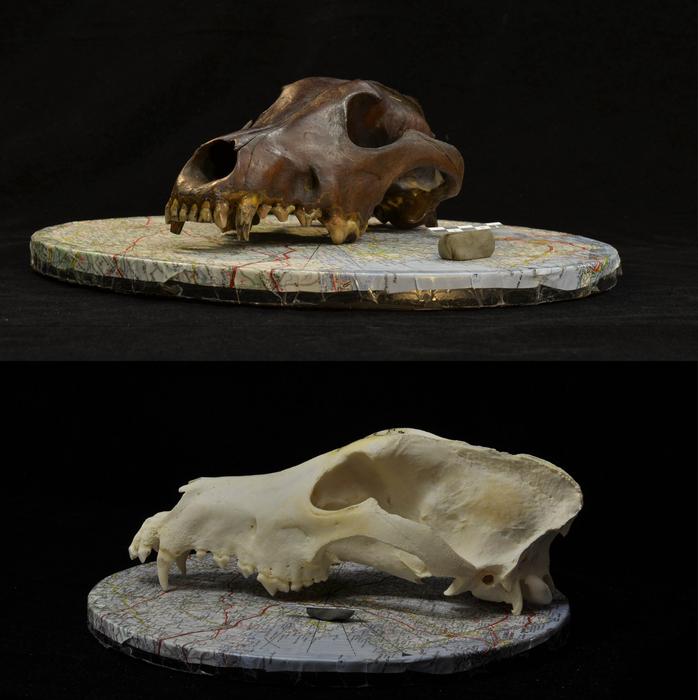
Researchers used large samples spanning roughly 50,000 years and report that distinctively dog-like skull traits first emerge in the early Holocene, around 10,800–11,000 years ago.
The BBC summarizes this timing as 'dogs began to diverge physically from wolves far earlier than previously thought — around 11,000 years ago.'
Popular Archaeology notes the researchers analyzed 643 canid skulls spanning 50,000 years using 3D morphometrics (laser scanning and photogrammetry) to trace how dog skull shapes changed through time.
Coverage Differences
Tone / emphasis
BBC (Western Mainstream) frames the result as a clear new timing shift — “dogs began to diverge physically … around 11,000 years ago” — and highlights the Science paper and lead authors; Popular Archeology (Other) emphasizes dataset details and frames domestication as a complex, drawn-out process with multiple contributing factors, stressing gradual change rather than a sudden event.
Canine skull study methods
The study combines extensive sampling with 3D morphometric techniques to quantify skull shape change through time.
BBC reports the international team scanned and made 3D models of more than 600 canine skulls spanning 50,000 years.
Popular Archeology adds that the researchers used laser scanning and photogrammetry to build models and compare forms across epochs.
These methodological details support the claim that morphological divergence in dogs is detectable far earlier than the Victorian-era selective breeding often blamed for most modern variation.
Coverage Differences
Detail emphasis / methods
BBC emphasizes the international team and the headline result about timing and cranial forms being present in the Middle Stone Age, whereas Popular Archeology gives more granular methodological detail (exact sample size 643 and explicit mention of laser scanning and photogrammetry), showing an Other-type source focusing on technical evidence.
Ancient dog skull diversity
Quantitatively, the study finds much of the skull-shape diversity seen among today's dog breeds was already present thousands of years ago.
Popular Archaeology reports that Early Holocene dogs already showed substantial diversity, about half the morphological range of modern dogs and roughly twice the range seen in Pleistocene wolves.
The BBC similarly notes that nearly half the cranial diversity seen in modern breeds was present thousands of years ago.
Pleistocene (Ice Age) canids in the sample closely resembled wolves, reinforcing a view of domestication as a gradual accumulation of changes rather than a sudden replacement of wolf morphology.
Coverage Differences
Narrative nuance
Both sources agree on the broad finding of early diversity; the BBC foregrounds the headline (nearly half the cranial diversity was present early) and names lead authors and the Science venue, while Popular Archeology provides comparative numerical context (twice the range of Pleistocene wolves) and explicitly contrasts ancient wolves’ variation with modern breeds.
Canid domestication findings
Both sources draw implications for how we understand domestication.
The BBC reports the authors' interpretation that the dramatic head-shape changes often blamed on Victorian selective breeding actually began much earlier.
Popular Archaeology stresses that domestication was shaped over millennia by human influence, environment, and diet, describing it as a long, gradual, and complex process.
Together they portray a picture in which early human-canid interactions generated substantial morphological variety well before modern breeding.
They differ in emphasis: the BBC focuses on overturning a specific historical assumption, while Popular Archaeology emphasizes the multifactorial, protracted nature of change.
Coverage Differences
Focus / implication
BBC (Western Mainstream) highlights that the study overturns the specific idea that most shape change is Victorian-era, quoting the authors directly; Popular Archeology (Other) broadens the implication into a multifaceted narrative involving environment, diet, and human behavior, giving a more process-oriented framing.
Coverage and source limits
Limitations in available coverage must be acknowledged: the two provided sources (BBC — Western Mainstream; Popular Archeology — Other) converge on the same core conclusions but emphasize different aspects, with one focusing on methodological detail and complexity and the other on a headline overturning of Victorian-breeding assumptions.
I cannot draw on additional regional, scientific, or alternative media perspectives because only these two snippets were provided, which makes it impossible to supply the wider multi-source comparison that is usually desirable.
Where the sources differ, I have reported each source's framing or quoted the authors as reported by the BBC, rather than attributing those statements directly to the articles themselves.
Coverage Differences
Source availability / coverage gap
Only BBC (Western Mainstream) and Popular Archeology (Other) were provided. BBC focuses on the Science paper and headline finding; Popular Archeology emphasizes sample size, methods, and long-term, multifactorial domestication. The lack of additional sources limits cross-type contrasts (e.g., West Asian, Western Alternative).