Technology and Science22 April, 20267 min read
Earth Day 2026 Climate Advocates Urge Communities to Mobilize Against U.S. Climate Rollbacks
Earth Day 2026 mobilizes global action against fossil fuels, urging renewables and climate justice. Theme 'Our Power, Our Planet' emphasizes collective action by communities, businesses, and governments.
Earth Day’s climate backdrop
Earth Day 2026 is being framed by climate advocates as a moment to mobilize communities while national policy shifts make climate action feel “dangerous.” In a Climate Home News piece, Ilka Vegais, described as “the executive for economic and environmental justice at United Women in Faith,” said “we cannot allow bad actors at the national level to shake our spirit,” and urged readers to “mobilize our communities for change.” Vegais tied that call to specific U.S. rollbacks, writing that “In January, the US withdrew from several international climate organizations and treaties, including theUnited Nations Framework Convention on Climate Changeand theParis Agreement.”
She also said that “In February, the Environmental Protection Agency (EPA)repealed the Greenhouse Gas Endangerment Finding,” adding that this “will make it more difficult to regulate greenhouse gas emissions and pollutants.” The article also anchored the urgency in quantified climate impacts, stating that “In 2025, the mainland United States experienced thefourth hottest year on record.”

It further cited NOAA reporting “an average surface temperature 2.12° F higher than the 20th-century average,” and described tornadoes, tropical cyclones, floods and other natural disasters as “devastat[ing] communities around the world.” Vegais’ argument for action emphasized that “change must always begin at the local level,” while also pointing to community projects that use solar power, energy-efficient stoves, and training programs to reduce emissions and protect livelihoods.
Conservation models in Uganda
While U.S. policy changes are described as undermining climate action, The Independent Uganda highlights a conservation approach in Kampala that it says has operated for “over 27 years.” The article says the Environmental Conservation Trust of Uganda (ECOTRUST) “has helped to protect the country’s environment by working closely with communities through conservation and nature-based financing approaches.” It links that model to the Earth Day theme, quoting that the day’s theme “Our Power, Our Planet” reminds nations that “people have the power to protect the environment.”
ECOTRUST’s work is described as using a “landscape approach to conservation,” with operations across major ecological landscapes including “Queen Elizabeth, Murchison Falls, Rwenzori Mountains, Mount Elgon, Mpologoma and Agoro-Agu.” The piece says the program covers “more than 40 districts like in; Kasese, Lamwo, Masindi, Kiryandongo, Mbale, Namutumba,” and it sets a restoration target of “over 50,000 hectares of forest.” It also reports a community-led restoration outcome, stating, “So far, more than 2,000 farmers have already restored 60 hectares of land.”
The article further describes ECOTRUST’s Trees for Global Benefits (TGB) programme, saying that “Since 2003, TGB has connected over 40,000 smallholder households to the voluntary carbon market” and “bringing in more than USD 6 million in foreign direct investment.” It adds that the program “helping remove over 6 million tones of CO₂ from the atmosphere,” and frames the conservation logic as paying farmers and communities “for protecting nature.”
UN chief and global push
Earth Day 2026 is also presented as a global push for climate action, with Anadolu Ajansı describing the day as being observed on April 22 under the theme “Our Power, Our Planet.” The Anadolu Ajansı report says Earth Day 2026 is marked “on Wednesday worldwide with calls for stronger action to tackle climate change and environmental degradation,” and it situates the theme within “global policy uncertainty” while emphasizing “innovation, education, and community action.” It adds a quantitative estimate from the UN about plastic pollution, stating there is “an estimated 19-23 million tons of plastic waste entering aquatic ecosystems each year” and “the equivalent of 2,000 truckloads of plastic dumped into waterways daily.”
The report quotes UN Secretary-General Antonio Guterres, writing that his message for International Mother Earth Day 2026 urged urgent action and called Earth Day “a reminder of “the fragility of our world,” urging urgent global action to confront the climate crisis.” Guterres’ social media message is quoted directly, saying, “We know what must be done: end our addiction to fossil fuels, accelerate the renewables revolution, protect and restore nature, and deliver climate justice for the most vulnerable,” and it adds “Let’s #ActNow – for people & planet.”
The same Anadolu Ajansı piece says local systems like “cities, schools, and communities” play a key role in “strengthening energy reliability, conserving resources, and reducing environmental risks.” In a separate Earth Day explainer from NBC4 Washington, the Earth Day theme is also described as “Our Power, Our Planet,” and the story ties the day to collective action against environmental impacts.
How communities are urged to act
Beyond high-level messaging, multiple outlets describe specific ways people can participate in Earth Day 2026 through local action, education, and voting.
ABC News frames community conservation and climate action around the Earth Day theme “Our Power, Our Planet,” and it cites the U.S. Environmental Protection Agency for the claim that “about 75% globally” of greenhouse gases come from “the burning of fossil fuels for energy.”

The ABC News report also gives a beach cleanup rationale, stating “Every year, up to 23 tons of plastic waste leaks into aquatic systems around the world, including lakes, rivers and seas,” and it attributes the figure to the “United Nations Environmental Programme.”
It then quotes Vishnu Chandran, CEO of Wild Republic, saying, “It creates collaboration, and I think it helps us learn more about what we’re doing and why we need to leave the planet better,” and it adds that volunteers report the experience as meaningful and that it can increase pro-environmental behaviors.
For political engagement, ABC News urges people to “Vote in your local elections,” and it says local elections often garner “less than 20% of voters,” citing the University of Chicago’s Center for Effective Government.
The report also quotes Adam Met, executive director of climate nonprofit Planet Reimagined, saying, “The ‘number one’ thing voters can do is look up their next local election and bring 10 friends with them to vote.”
In a different approach, Open Access Government says “Major events begin on Saturday, April 18” to extend participation through “Earth Week,” and it describes the European Commission and European External Action Service launching the “#ForOurPlanet campaign.”
That campaign is described as focusing on “restoring nature and protecting biodiversity,” and it says the goal is to highlight ecosystems that provide “clean air, fresh water, and food.”
Taken together, the reporting portrays Earth Day 2026 as a blend of practical tasks, civic participation, and structured campaigns that extend beyond April 22 itself.
Science, education, and measurable goals
Earth Day 2026 coverage also ties climate action to measurable institutional targets and to climate education for young people.
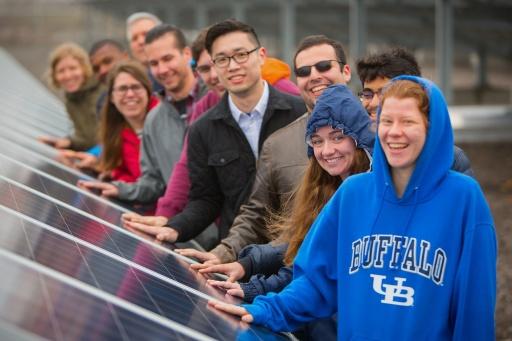
University at Buffalo’s Earth Day milestone report says UB President Satish K. Tripathi announced that “The University at Buffalo has achieved climate neutrality for the emissions we directly control,” and it specifies that the university achieved the goal “five years ahead of schedule.”

The report says UB’s direct emissions carbon neutrality is for “Scope 1 and Scope 2,” with Scope 1 described as emissions from “the burning of natural gas to heat campus buildings” and Scope 2 as emissions from “electricity purchased.”
It quantifies progress, stating UB “reducing its greenhouse gas emissions by 66% since 2007,” and it says UB now “generates and purchases 100% of its electricity from clean sources,” leading to “an approximately 30% decrease in UB’s overall carbon footprint.”
The same UB report describes a solar expansion, saying the project “has increased campus capacity by 15 times current levels,” and it adds that “more than $80 million in funding was secured in 2025” to advance decarbonization work for “more than 200 campus buildings totaling 13 million gross square feet of space.”
In parallel, South Asian Herald argues that “Climate education is our most powerful climate solution,” saying young people are “among the least equipped to respond” because they “often lack the opportunity to learn, and the resources to support them.”
It reports that “we have worked with over 3.3 million children and youth across 19 countries to advance what we call “Education for Climate Action.””
The piece also says “Globally, studies suggest that less than half of national education systems meaningfully integrate climate change into curricula,” and it describes youth expressing concerns in countries including Pakistan, Tanzania, Kenya, Jordan, Egypt, and Lebanon.
It quotes the need for education to be “practical, participatory, and rooted in local contexts,” and it says “It must equip young people not only with knowledge, but with practical skills.”
Together, the science-and-education framing in these reports links Earth Day’s theme “Our Power, Our Planet” to both institutional decarbonization and youth-led capacity building.