USA10 December, 20253 min read
Eileen Higgins Defeats Trump-Backed Emilio González, Becomes Miami's First Democratic Mayor in Nearly 30 Years
Eileen Higgins defeated Emilio González, who was endorsed by former President Donald Trump. Higgins won the runoff with roughly 59% of the vote versus González’s 41%.

54 outlets told this the same way.
Outlets did split on Trump Interrupted by Protesters at San Antonio Rally for Ken Paxton →
Miami mayoral runoff 2025
Democrat Eileen Higgins won Miami’s mayoral runoff on Dec. 9, 2025, defeating Republican Emilio González by roughly 18 to 19 percentage points (about 59% to 41%).
“Higgins is the first Democrat elected mayor of Miami in nearly 30 years, the city’s first woman mayor ever and the first non‑Hispanic to hold the post since the 1990s. ... The off‑year contest drew low turnout (around 20% of registered voters) and has been framed as another sign of Democratic momentum and a possible weakening of Trump’s influence after he backed Gonzalez.”
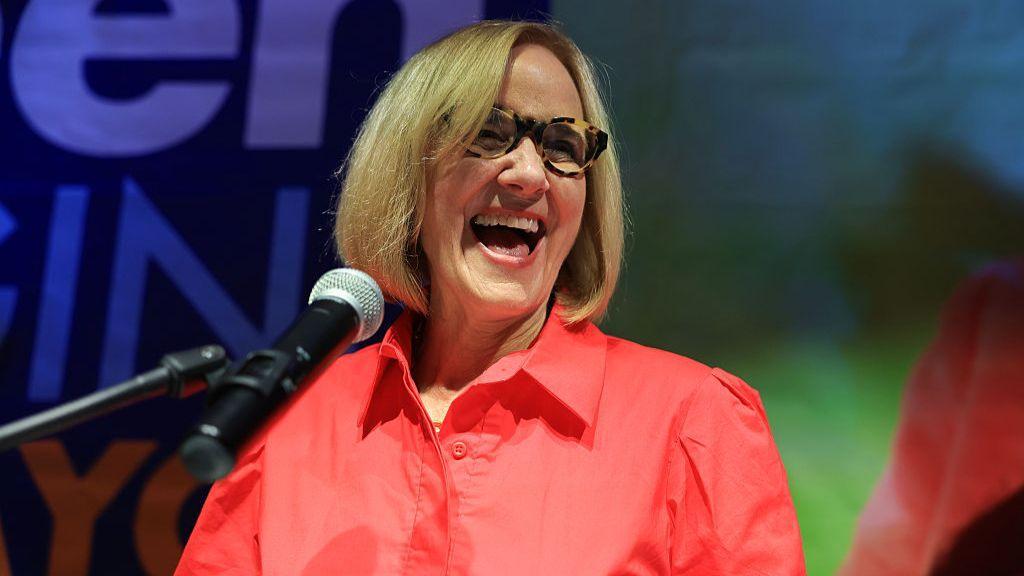
Higgins becomes the city’s first Democratic mayor in nearly 30 years and its first woman to hold the post.

Turnout in the off‑year contest was low, around 20–21% of registered voters, with CBS reporting 21.3% (37,496 of 175,692 registered voters).
Several outlets reported similar margins and milestones, with AP noting she won by about 19 percentage points and will be the city’s first woman mayor, and BBC saying she secured 59% to González’s roughly 41%.
Other sources also documented the margin and historic nature of the result, with Arise News describing the win as about 18 percentage points and WION calling Higgins the first Democrat elected mayor of Miami in nearly 30 years, the city’s first woman mayor ever and the first non‑Hispanic to hold the post since the 1990s.
Mayoral race platforms
Higgins ran an explicitly Democratic campaign in the officially nonpartisan race, focusing on affordable housing, anti-displacement policies, infrastructure and restoring public trust.
González, a former city manager backed by high-profile Republicans, emphasized public safety, regulatory relief and immigration enforcement.

CBS News reported Higgins campaigned on restoring public trust, calmer and more collaborative leadership, and prioritizing affordable housing, proposing use of city land for workforce housing.
Firstpost noted she criticized federal immigration enforcement as harmful to immigrant communities while advancing housing and infrastructure priorities.
UPI summarized her platform as affordable housing, anti-displacement policies and climate adaptation, and described González as emphasizing strong policing, public safety and immigration enforcement.
NBC News likewise noted Higgins ran on affordability, infrastructure and streamlining city processes, while González highlighted local priorities like fighting overdevelopment and backed Gov. Ron DeSantis' homestead tax proposal.
Nationalized election media coverage
The contest was nationalized: both parties invested resources and prominent figures weighed in, and many outlets treated the result as a test of President Trump's influence and a bellwether for the 2026 midterms.
“The outcome is being watched as a bellwether for the 2026 midterms in a diverse, competitive county that narrowly backed Democrats in 2024 even as it swung toward Trump.”
Newsweek described the outcome as 'being watched as a bellwether for the 2026 midterms.'
Washington Examiner and many local outlets noted heavy Republican involvement, including Trump and Gov. DeSantis' backing for González.
Arise News framed the race as 'a high-stakes test in a Hispanic-majority city that was a strong Trump base in 2024.'
WION explicitly reported the race 'has been framed as another sign of Democratic momentum and a possible weakening of Trump's influence after he backed Gonzalez.'
The Guardian highlighted aggressive GOP intervention, noting 'Republicans, including former president Donald Trump... had aggressively backed González.'
Miami election context
Local demographics, turnout and Miami’s political history were central to reporting. Numerous outlets, including Times of Malta and NST Online, highlighted that Miami is a Hispanic‑majority city long dominated by Republicans of Cuban descent. The mayoralty has been held by Republicans since the late 1990s.
The Guardian pointed out Miami‑Dade’s recent GOP swing in 2024 and that the city is about 57% foreign‑born. CBS News and The Globe and Mail noted the race grew out of a crowded 13‑candidate field and focused on immigration, housing and growth. Several local outlets also stressed that low turnout (roughly 20%) shaped the result’s interpretation.
Election reactions and analysis
Reactions were immediate and varied. Higgins described the win as a break from years of "chaos and corruption" and a mandate for ethical, accountable leadership. González conceded and called to congratulate Higgins.
“In her victory message she focused locally, saying Miami had ‘turned the page on years of chaos and corruption.’”
Democrats hailed the result as momentum heading into 2026, while some analysts cautioned against overgeneralizing from a local race. News outlets reported these responses: Arise News quoted Higgins, CBS News and WMYD noted González's concession call, and AP and NPR highlighted both Democratic praise and the caveats about national predictions.