Full Analysis Summary
Jabrona camp fire report
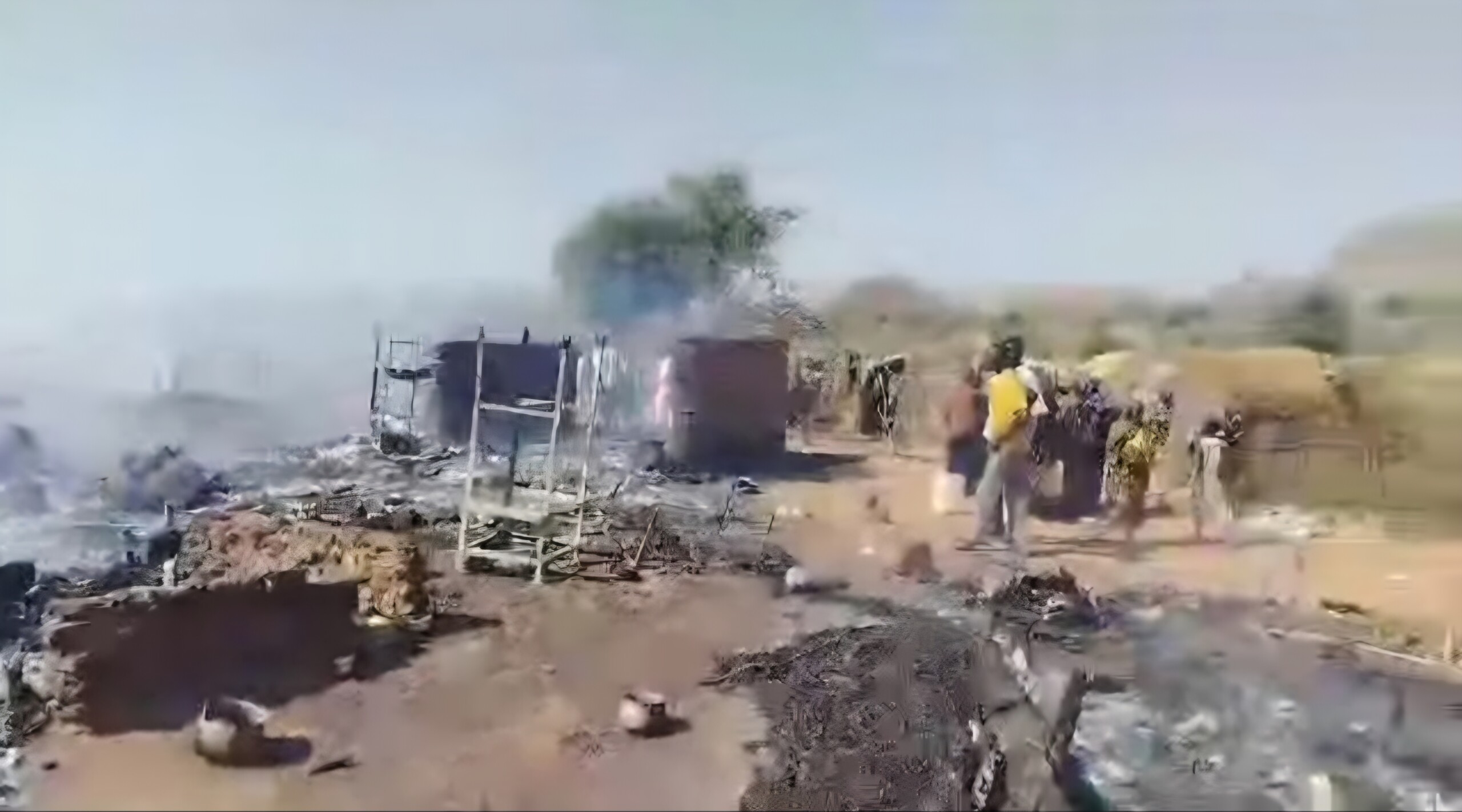
A fire tore through the Jabrona displacement camp in El Rashad locality, South Kordofan.
The incident killed "a young girl" and destroyed 42 shelters while damaging five others.
The damage left 42 families homeless.
Reporting that cites the International Organization for Migration (IOM) and the two available reports restate these core facts: the casualty, the scale of structural loss, and the resulting displacement.
Coverage Differences
Tone
Both sources report the same factual details but differ subtly in phrasing: Dabanga Radio TV Online frames the casualty and shelter losses as reported "the IOM said," while Radio Dabanga names the organization in full as "the International Organization for Migration said." This is a minor stylistic difference rather than a factual contradiction.
Fires displace families in West Kordofan
Nearby West Kordofan also saw a separate blaze in El Tabareeb (Keilak locality) that displaced about 20 families and destroyed roughly 20 shelters; affected households were reportedly moved to open areas locally.
Both sources present this West Kordofan incident alongside Jabrona, indicating simultaneous, localized fire emergencies affecting multiple displaced communities in the region.
Coverage Differences
Detail Emphasis
Radio Dabanga specifies the location as "El Tabareeb village (Keilak locality)," while Dabanga Radio TV Online uses the slightly shorter form "El Tabareeb (Keilak locality)." Both agree on the scale: roughly 20 families displaced and about 20 shelters destroyed, but phrasing varies slightly between the two reports.
Displacement-related camp fires
Both reports link the Jabrona and West Kordofan fires to a wider pattern of displacement-related blazes.
They recall a recent large fire at Tawila El Omda camp in North Darfur that killed a toddler and gutted hundreds of shelters housing families newly displaced by fighting between the Sudanese Armed Forces and the Rapid Support Forces.
The reporting credits Radio Dabanga for that earlier Tawila El Omda tragedy and notes that the causes of the Jabrona and El Tabareeb fires are unconfirmed or described as unknown.
Coverage Differences
Source Attribution
Dabanga Radio TV Online explicitly says "Last week Radio Dabanga reported" the Tawila El Omda camp fire and mentions fighting between specific forces (Sudanese Armed Forces and Rapid Support Forces). Radio Dabanga's own snippet notes the Tawila El Omda fire "— reported by Radio Dabanga —" and frames it alongside ongoing fighting around El Fasher. Both attribute the Tawila El Omda coverage to Radio Dabanga, but wording differs on the context around fighting and location references.
Clarity on Causes
Both sources explicitly state that the causes of the Jabrona and El Tabareeb fires are unconfirmed or "unknown," so neither attributes blame or offers a definitive cause in the available reports.
Limitations of current reporting
The available coverage is narrow in scope and largely restates the same IOM-sourced facts across the two reports.
There is no additional independent investigation, official explanation, or humanitarian response detail in either piece.
Because only these two 'Other' sources are provided, the article cannot incorporate broader perspectives.
Broader perspectives that are missing include statements from Sudanese authorities, independent humanitarian agencies beyond IOM, and eyewitness accounts.
This absence should be noted as a limitation of the current reporting.
Coverage Differences
Missed Information
Both sources omit independent cause determinations, in-depth survivor testimony, and detailed humanitarian response plans. The reports rely on IOM reporting and previous Radio Dabanga coverage for context, without adding new investigative detail or quotes from other agencies or officials.
Source Type Narrowness
Both items are classified here as 'Other' sources and largely mirror each other; because only these two sources are available to work from, this coverage lacks the diversity of "source_type" the user requested and therefore cannot highlight contrasts across wider source types.