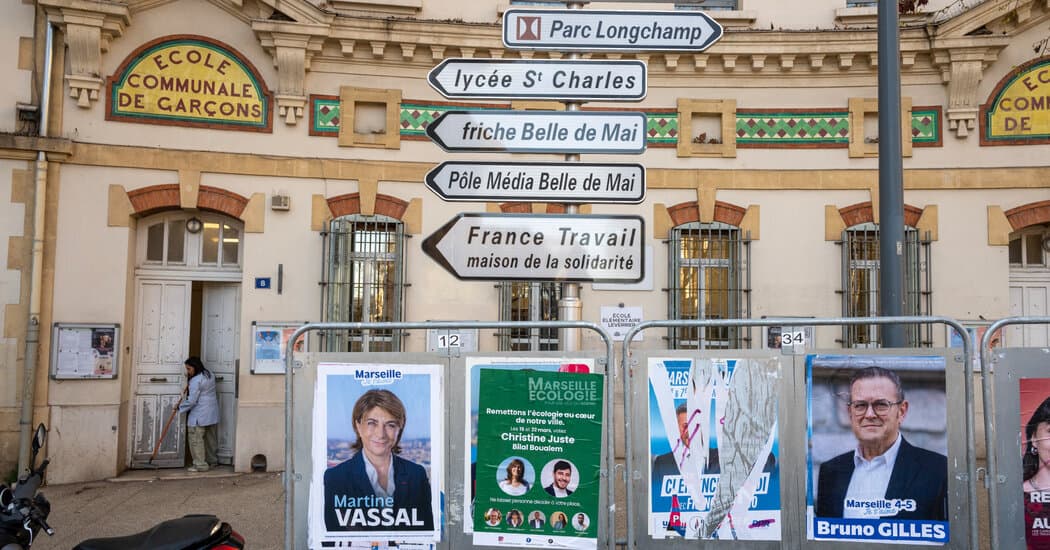
France's Far-Right Surges in Municipal Runoff, Testing 2027 Presidential Prospects
Key Takeaways
- Far-right gains momentum in Paris, Marseille, Lyon as runoff approaches.
- Mainstream parties fragment with tactical withdrawals and mergers shaping second-round contests.
- Election outcomes function as early test for 2027 presidential prospects across blocs.
Election Overview
France's municipal elections have emerged as a critical testing ground for the country's political landscape ahead of the 2027 presidential race.
“- Tactical withdrawals, mergers, and refusals to unite reshape contests in major cities like Paris, Marseille, Lyon - Analysts say municipal vote may offer early indication of how the French left, center, and right will position themselves ahead of the 2027 presidential race ISTANBUL As France heads toward the second round of municipal elections Sunday, mainstream parties find themselves squeezed between surging far-left and far-right forces, with no single political bloc dominating nationwide”
The far-right National Rally (RN) has made significant gains in the first round and set the stage for decisive runoff voting.

The election process follows France's unique two-round system where lists need 50% to win outright.
96% of communes elected mayors in the first round, but the remaining 4.4% of municipalities—representing 38% of the population or about 26 million voters—head to a crucial second round.
The vote has been characterized by historically low turnout, the lowest since at least the 1950s except for the pandemic-affected 2020 election.
This reflects deep disenchantment with traditional political approaches.
Analysts suggest French voters 'just don't like the old ways of doing politics.'
This electoral contest is widely viewed as a referendum on France's national political balance.
Parties across the spectrum are positioning themselves for the upcoming presidential battle.
Far-Right Momentum
The far-right National Rally has demonstrated its growing political strength, particularly in southern France.
The party has steadily expanded its local base over the past decade and posted its strongest results in the first round.

RN performed notably well in Marseille, securing 35% of the vote just behind a left-wing coalition at 37%.
The party reinforced its presence across the Provence-Alpes-Cote d'Azur region.
In the Var department, RN led in several towns including Toulon and made significant gains in municipalities such as Draguignan and Sollies-Pont.
Before this voting round, RN and its allies controlled around a dozen councils and just one city with a population of more than 100,000—Perpignan.
The party retained Perpignan with 50.6% of the vote.
RN President Jordan Bardella has signaled momentum for the far-right, declaring that 'Change will not wait until 2027, it begins next Sunday.'
This frames the municipal results as an early indicator of shifting political dynamics ahead of the presidential contest.
Left-Wall Dynamics
On the left, France Unbowed (LFI) has made notable gains across major urban centers.
“France heads to vote this Sunday to decide who will lead the country's major cities”
LFI candidates surpassed 10% of the vote in Paris, Lyon, and Marseille.
The party even outperformed Socialist candidates in cities like Limoges and Toulouse.
These gains translated into outright victory in Saint-Denis near Paris.
LFI candidate Bally Bagayoko surpassed the 50% threshold and unseated the Socialist incumbent.
The fragmented results have forced pragmatic cooperation among left-wing parties.
The Socialist Party and France Unbowed agreed to merge lists in key cities including Toulouse, Nantes, Limoges, and Clermont-Ferrand.
This aims to consolidate the progressive vote against strong challenges from both the far-right and center-right.
However, divisions persist in some areas.
Incumbent mayor Benoit Payan in Marseille ruled out an alliance with LFI candidate Sebastien Delogu.
Socialist candidate Emmanuel Gregoire in Paris rejected overtures from LFI candidate Sophia Chikirou.
This indicates ongoing tensions within the progressive camp.
Centrist Challenges
President Emmanuel Macron's centrist bloc faces significant challenges.
Parties aligned with his administration entered the race without a unified strategy.
They are struggling to maintain influence.
Renaissance leader Gabriel Attal acknowledged the presidential camp could secure 'over 100 mayoralties.'
This is a modest figure compared with the country's more than 35,000 communes.
It's far below the entrenched networks of traditional parties.
Centrist candidates face elimination in several key races.
Some barely cleared the threshold to remain in contention.
In Lille, centrist candidate Violette Spillebout received 11.14%.
Far-right RN candidate Matthieu Valet garnered 10.92%.
This indicates the squeeze Macron's party faces from both poles.
Mainstream right-wing parties have historically maintained a cordon sanitaire around the far-right.
French conservatives generally prefer ambiguity or abstention over formal alliances.
This creates a complex strategic landscape as the runoff approaches.
2027 Implications
The municipal runoff elections carry profound implications for the 2027 presidential race.
“- Tactical withdrawals, mergers, and refusals to unite reshape contests in major cities like Paris, Marseille, Lyon - Analysts say municipal vote may offer early indication of how the French left, center, and right will position themselves ahead of the 2027 presidential race ISTANBUL As France heads toward the second round of municipal elections Sunday, mainstream parties find themselves squeezed between surging far-left and far-right forces, with no single political bloc dominating nationwide”
Analysts suggest the outcome indicates a gradual return to a more traditional left-right divide.
This increasingly marginalizes Macron's centrist bloc.
Key contests are directly linked to potential presidential ambitions.
The closely watched race in Le Havre features former Prime Minister Edouard Philippe.
He secured a strong position with 44% of the vote heading into the second round.
In Bordeaux, the race remains tight after the first round.
Green incumbent Pierre Hurmic is neck and neck with centrist candidate Thomas Cazenave.
The elections reveal intensifying rivalry on the left.
The Socialist Party (PS) and La France Insoumise (LFI) compete over leadership of the progressive camp.
The Greens attempt to position themselves as a unifying force.
On the right, Les Republicains face mounting pressure from RN.
RN continues to draw both voters and candidates from the conservative base.
This could reshape France's political landscape for years to come.
More on Europe

Meloni Concedes Defeat After Voters Reject Judicial Reform
15 sources compared

Golob's Freedom Movement Narrowly Leads Jansa in Slovenian Election.
30 sources compared
Emmanuel Gregoire Wins Paris Mayor Race, Securing Socialist Victory
35 sources compared

Russian intelligence-linked hackers target Signal users, accessing thousands of accounts
10 sources compared