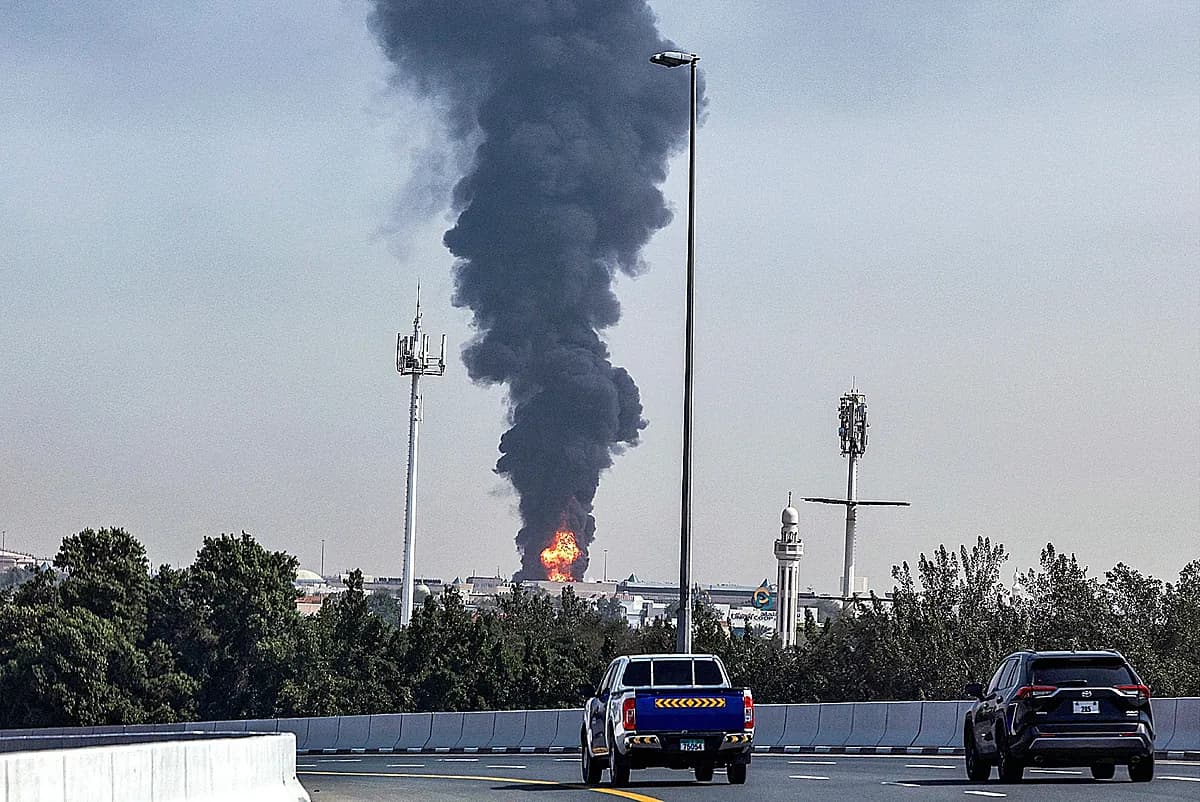
From Iran to Ukraine: wars force the redrawing of air and maritime routes.
Key Takeaways
- Conflicts from Iran to Ukraine are forcing new realignment of air and maritime routes.
- Trump threatens NATO, pressures China over Hormuz; Japan and Australia refuse warships.
- Cross-border movement is increasingly difficult amid broader wartime chaos.
Global disruption of air routes
The blitzkrieg hasn't worked for Vladimir Putin in Ukraine, nor is it working for Donald Trump in the Middle East.
“War in the Middle East: Trump threatens NATO and pressures China over the Strait of Hormuz as his allies Japan and Australia refuse to send warships”
Now we have a more chaotic world in which crossing borders is increasingly difficult.
Globalization promised global integration across economic, political, technological, social, and cultural realms, turning the world into an interconnected 'global village,' but that dream fades amid bombardments, sieges, and threats.
Navigation, whether by air or sea, has become increasingly complicated.
The movement of the United States and Israel against the ayatollahs' regime has triggered not only the closure of the strategic Strait of Hormuz but has also forced the creation of two narrow air corridors to avoid flying over war zones.
The war situation over the Persian Gulf and Iran has led to the closure of airspaces and the obligation to skirt the area to the south, but without flying over the Horn of Africa, a region made unstable by failed states like Somalia, civil-war countries like Sudan, or uncontrolled territories like Yemen.
The other available airspace is north of Iran, Lebanon, and Syria and passes right over Azerbaijan.
Why?
Because Iran is a war zone, but a bit further north lies the Ukraine conflict, which affects not only the territory controlled by the Kyiv government but also the areas held by Moscow and even Russia itself, which receives missiles and drones launched by Ukraine every day.
On that same territory, in 2014, pro-Russian rebels in Donetsk shot down Malaysia Airlines Flight MH17, a passenger plane with nearly 300 people on board, including the crew.
Aviation cost and detour dynamics
When a conflict forces the closure or avoidance of airspaces, the impact on commercial aviation is felt almost immediately in costs.
It's not a single factor; it's the sum of several chained effects.
The first is distance.
If a plane can't traverse a war zone, it has to detour.
That can add from 30 minutes to several hours of flight time depending on the route.
For example, after the Russian airspace was closed, many flights between Europe and Asia had to detour thousands of kilometers to the south or north.
The same happened in January with the operation to capture Nicolás Maduro in Venezuela: flights to the Caribbean had to bypass the zone.
The second is fuel.
Jet fuel is the largest operating expense for an airline, normally between 25% and 35% of the total cost of the flight.
Each additional hour of flight can mean several extra tons of fuel, which makes the operation more expensive.
The third is payload.
On very long routes, if the plane needs to carry more fuel to cover the detour, it must reduce passengers or cargo to avoid exceeding the maximum takeoff weight.
The fourth is aircraft utilization.
A longer leg means the aircraft takes longer to complete each rotation.
That means fewer flights per day with the same aircraft, reducing fleet efficiency and forcing crew changes.
The fifth is insurance and risk, and this may be what could ruin airlines that must continue flying to the Gulf.
When a conflict intensifies near a flight path, insurers apply war risk premiums.
These special policies can significantly raise the cost of operating in certain regions or near them.
In the case of Etihad, Emirates, or Qatar Airlines, the premium has tripled.
And the sixth is the domino effect on the air system.
Detours tend to concentrate traffic in alternate corridors, leading to more congestion, delays, and air traffic control costs.
Globally, it only takes a few strategic airspaces to close to disrupt routes between entire continents.
Alex Macheras, an aviation expert, says that 'when a war closes key airspaces, airlines have to redraw their route maps overnight.'
Raúl Medina, head of Eurocontrol, notes that 'the closure of airspaces due to conflicts forces airlines to detour via longer corridors, which creates congestion in the airspace.'
Maritime routes and insurance risk
In the case of maritime navigation, the situation is not much better.
“War in the Middle East: Trump threatens NATO and pressures China over the Strait of Hormuz as his allies Japan and Australia refuse to send warships”
Iran's closure of the Strait of Hormuz forces almost all traffic to detour through the Red Sea to the Suez Canal, a place that is also dangerous: the Houthi militia, financed by Iran, has already warned that it has 'its finger on the trigger' to begin attacking oil tankers in the area.
Currently, a long line of these tankers extends into the Bab el Mandeb Strait to load crude at the terminal that Saudi Arabia (called East-West) built across the desert to avoid total dependence on the Persian Gulf.
Although it has the capacity to transport five barrels per day, it relieves the situation but does not solve it.
The problem for insurers is the same as with airplanes: it's not only that oil tankers may be attacked, but that a blockade or a war in the Strait of Hormuz makes all navigation a war-risk area, something that completely changes marine insurance.
The first problem is war risk insurance.
In peacetime oil tankers have standard policies that cover accidents, collisions, or spills.
But acts of war are excluded from those policies.
To navigate in zones like the Gulf during a conflict like the current one, in which Iran has already attacked 16 ships, shipowners have to buy very expensive additional cover.
The second problem is the risk of total loss of the ship and its cargo.
A VLCC can carry two million barrels of crude oil and have a total value—ship plus cargo—easily exceeding $200 million.
If a naval mine, a missile, or a drone destroys the vessel, the insurer will pay enormous indemnities.
David Smith, head of marine insurance at McGill and Partners, says: 'Getting war risk insurance is one thing. Crossing the Strait of Hormuz is another altogether.'
More on Ukraine War
Russia Agrees to Stop Recruiting Kenyans to Fight in Ukraine
11 sources compared
Russia Advises Iran on Drone Tactics to Hit US and Gulf Targets
11 sources compared
US Eases Russian Oil Sanctions Despite Allies' Warnings It Could Boost Kremlin War Chest
10 sources compared
Ukraine Strikes Bryansk Microelectronics Plant With Storm Shadow Missiles, Killing Six
13 sources compared