Full Analysis Summary
German president visits Guernica
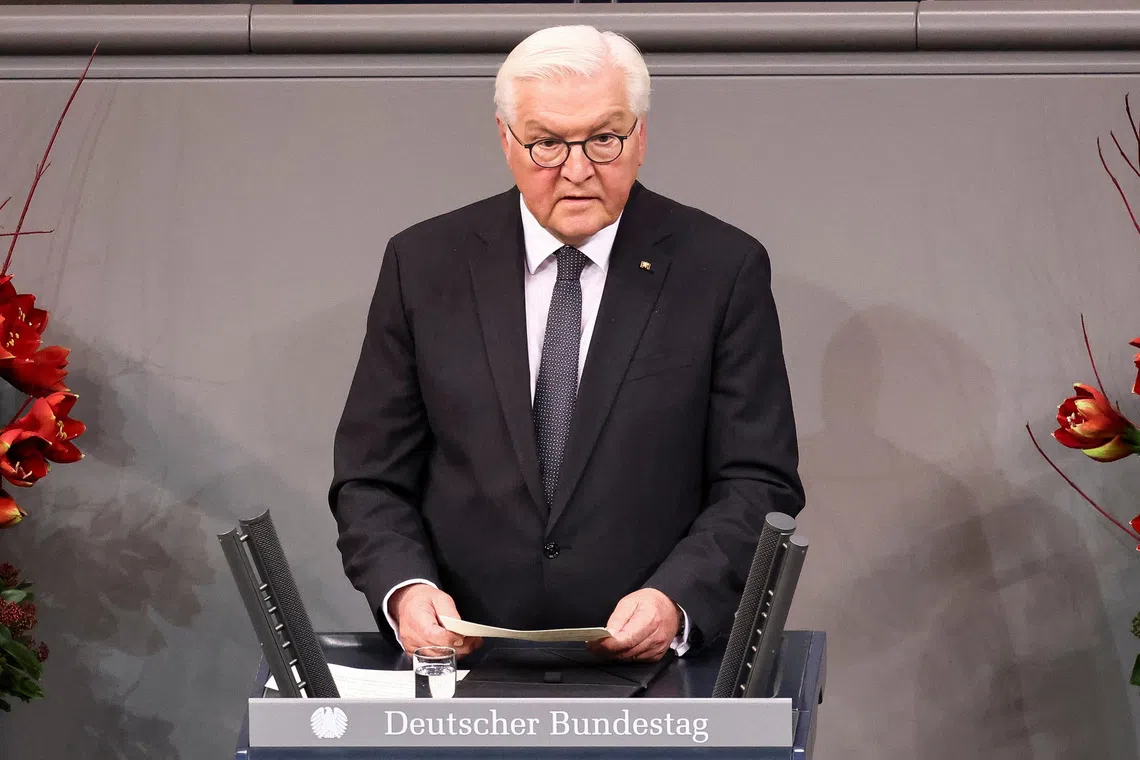
German President Frank-Walter Steinmeier visited Guernica on Friday, becoming the first German head of state to go to the Basque town devastated by a Nazi air raid during Spain’s civil war.
That attack has been described as one of the first modern bombings of civilians.
The Straits Times reports that Steinmeier was accompanied by Spain’s King Felipe VI and Basque regional president Imanol Pradales.
He laid a wreath at a cemetery mausoleum built in 1973 for hundreds of victims.
Available material indicates the visit was explicitly framed as a historic and symbolic act of remembrance by Germany’s head of state.
A cited note from @globaltimesnews said it only had the credit "(Xinhua/Cheng Min)" and requested the article text or a link.
Coverage Differences
Coverage detail / availability
The Straits Times (Asian) provides a full, specific account of the visit — naming participants, the mausoleum and framing Guernica as an early modern civilian bombing. In contrast, @globaltimesnews (Other) does not provide its own article text and only shows a photo credit for Xinhua ("(Xinhua/Cheng Min)"), signaling no independent report is available from that source in the provided material. This difference reflects that the Straits Times supplies substantive reporting while @globaltimesnews currently lacks content to offer an alternate narrative or additional details.
Steinmeier on Guernica
In Madrid, Steinmeier emphasized German responsibility and issued a moral message.
He said Germans bear 'a heavy burden of guilt in Guernica,' called the bombing 'a warning to stand up for peace, freedom and the protection of human rights,' and urged his compatriots not to forget what happened.
The Straits Times presents these phrases as framing the trip both as an acknowledgment of historical guilt and as a call for contemporary vigilance about human rights and peace.
The other provided source did not include alternative quotes or counter-views, instead listing only a photo credit.
Citations include The Straits Times' quoted phrases, a Global Times entry noting only the credit '(Xinhua/Cheng Min),' and the same Xinhua/Cheng Min photo credit.
Coverage Differences
Tone / moral framing
The Straits Times (Asian) relays Steinmeier's direct moral language — quoting him about a "heavy burden of guilt" and urging remembrance and the defence of human rights. There is no competing framing or alternative tone in @globaltimesnews (Other) because it lacks article text and only shows a photo credit (Xinhua). The result is that the available coverage is dominated by the Straits Times' moral framing, while other listed material cannot be assessed for tone or commentary.
Guernica visit coverage
Reporting places the visit in the context of the 1937 raid on Guernica.
The Straits Times explicitly calls Guernica the Basque town devastated by a Nazi air raid during Spain’s civil war and describes that attack as one of the first modern bombings of civilians.
The article notes a physical memorial — a mausoleum built in 1973 — where Steinmeier laid a wreath, emphasizing the trip’s commemorative and historic purpose.
The other provided sources, in the snippets supplied, do not include local voices, alternative historical framings, or additional international perspectives.
Cited material includes Straits Times references to the raid and the mausoleum, plus a Global Times credit line that did not supply the article text.
Coverage Differences
Narrative / missing perspectives
The Straits Times (Asian) presents historical context and memorial detail. The provided @globaltimesnews (Other) entry contains no reporting, only a photo credit, which means perspectives such as local Basque voices, formal Spanish government commentary beyond the presence of King Felipe VI, or broader international reactions are not present in the available material. This is a gap (missed information) in the provided set of sources rather than a contradiction between accounts.
Steinmeier's Guernica visit
Taken together, the available reporting frames Steinmeier's Guernica visit as a symbolic act of remembrance and German reckoning with a violent past, with explicit moral language from the president about guilt and vigilance for human rights.
The source set provided here is limited.
Beyond The Straits Times' detailed report, @globaltimesnews only notes that its item was not available and provides a photo credit to Xinhua/Cheng Min.
This limitation prevents a fuller cross-source comparison of tone, local reaction, or differing national perspectives.
Because of that limitation, any fuller assessment of how different media types (for example, Western mainstream, Western alternative, and West Asian outlets) covered the visit is constrained by the lack of additional articles in the supplied material.
Citations: The Straits Times: "Steinmeier said Germans bear 'a heavy burden of guilt in Guernica'..."; @globaltimesnews: "I don't have the article text — just the credit \"(Xinhua/Cheng Min)\"."; (Xinhua/Cheng Min): "(Xinhua/Cheng Min)".
Coverage Differences
Missed information / constraints
The Straits Times (Asian) offers a concrete narrative and quotes; @globaltimesnews (Other) lacks its own reporting, showing only a photo credit to Xinhua/Cheng Min, which limits cross-source comparison. This is an instance of missed information (absence of alternative coverage) rather than direct contradiction. The available set therefore skews toward the Straits Times' framing, and readers should note the absence of other national or local outlets in the supplied content.