Full Analysis Summary
Rheinmetall Lynx delivery details
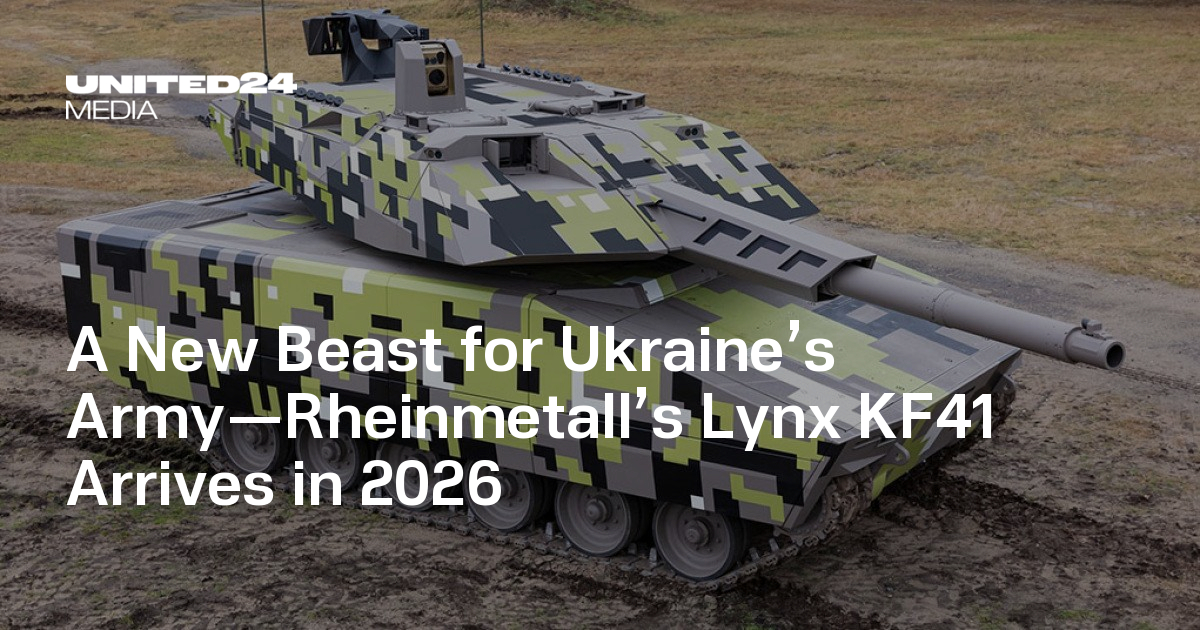
Germany will receive and deliver five Rheinmetall Lynx KF41 infantry fighting vehicles to Ukraine, with the first vehicles expected in early 2026.
Rheinmetall said in a January 12 press release that it will supply Ukraine with additional national-defense equipment, including Lynx KF41 infantry fighting vehicles, and that the first KF41s are expected as early as 2026 under an initial-delivery agreement signed in December 2025.
DIE WELT likewise reported that Rheinmetall will deliver five Lynx KF41 infantry fighting vehicles to Ukraine, confirming the number and timing in Rheinmetall’s announcement.
Coverage Differences
Tone/Narrative
UNITED24 Media (Other) presents the delivery as a straightforward report of Rheinmetall’s press release, focusing on the company’s statement about equipment and timing. DIE WELT (Western Mainstream) repeats the delivery details but places them inside a broader story about continuing Russian air strikes and European security concerns, which frames the delivery within heightened tensions. Each source is reporting the same delivery facts, but DIE WELT adds conflict context and regional security reaction that UNITED24 does not include.
KF41 delivery schedule
UNITED24 Media reports that Rheinmetall issued a January 12 press release referencing an initial-delivery agreement signed in December 2025.
The agreement sets the earliest expected arrival of the KF41s in early 2026.
DIE WELT corroborates the delivery schedule and specifies five vehicles, and together the sources point to an official company statement and a clear Germany-to-Ukraine delivery timetable.
Coverage Differences
Specificity/Detail
UNITED24 Media quotes Rheinmetall’s press release and highlights the timing and the contractual reference to an initial-delivery agreement signed in December 2025; it focuses on the company’s own wording. DIE WELT supplies the explicit number of vehicles (five) and emphasizes the delivery date but situates it as part of its wider news roundup. The difference is one of emphasis—UNITED24 foregrounds the press release language and contract timing, while DIE WELT foregrounds the number and places it among other security developments.
Rheinmetall delivery context
DIE WELT places the Rheinmetall delivery within a tense security context.
The report mentions continuing Russian air strikes, explosions in eastern Ukraine, and a claimed use of an Oreschnik hypersonic missile that struck a repair plant near Lviv.
It notes Western governments reacted angrily to the hypersonic weapon's use so close to EU borders.
That framing links the announced KF41 delivery to a broader narrative of escalation and Western concern, suggesting the vehicles are part of ongoing support amid intensifying threats.
Coverage Differences
Context/Framing
DIE WELT (Western Mainstream) links the Rheinmetall delivery to ongoing Russian attacks and European security responses, using words like 'angrily' to describe Western governments' reaction; UNITED24 Media (Other) reports the Rheinmetall press release without situating it amid the same level of conflict-driven framing. The difference underscores that DIE WELT frames the delivery as part of a security response, while UNITED24 sticks to reporting the procurement and schedule details.
Media framing comparison
The two sources differ in editorial emphasis.
UNITED24 Media presents the Rheinmetall announcement primarily as a company press release and adds little geopolitical context.
DIE WELT places the delivery within a narrative of escalation and Western condemnation of Russian actions, signaling a stronger security framing.
There is no contradiction on the core facts: Rheinmetall’s announcement that five KF41s are due, with the first expected in early 2026.
However, the outlets diverge in what they choose to emphasize and the surrounding context they provide.
Coverage Differences
Emphasis/Missed Information
UNITED24 Media (Other) focuses narrowly on the Rheinmetall press release wording and delivery timing; DIE WELT (Western Mainstream) does not dispute those facts but adds reporting on Russian strikes and the alleged hypersonic missile use, which UNITED24 does not mention. Thus DIE WELT’s coverage may lead readers to view the delivery as a response to heightened threat, whereas UNITED24 leaves that causal frame implicit.
Source limitations and facts
The supplied sources are limited to a Rheinmetall-related press item (UNITED24 Media) and a broader news article that mentions the delivery alongside security developments (DIE WELT).
With only these two snippets, additional details such as delivery logistics, operational plans, training, or whether the five vehicles are part of a larger tranche cannot be cross-checked.
Readers should treat the core facts — five Lynx KF41s and earliest delivery in early 2026 — as supported by the provided sources while recognizing that broader context and additional details are not present.
Coverage Differences
Coverage Limitation
Both supplied sources confirm the delivery timing and vehicle type, but neither provides operational detail like logistics or broader program scope. Because only two sources are available, I cannot identify further corroboration or alternative framings beyond what UNITED24 Media (Other) and DIE WELT (Western Mainstream) offer.