Full Analysis Summary
Global South power shift
The Global South is increasingly portrayed as moving from the margins to a central role in 21st-century geopolitics, driven by rising economic strength, growing innovation, and expanding diplomatic influence.
CNN frames this as a systemic shift in global power that elevates countries across Africa, Latin America, and Asia into decisive roles shaping international politics and development, arguing the trend is already reshaping global agendas.
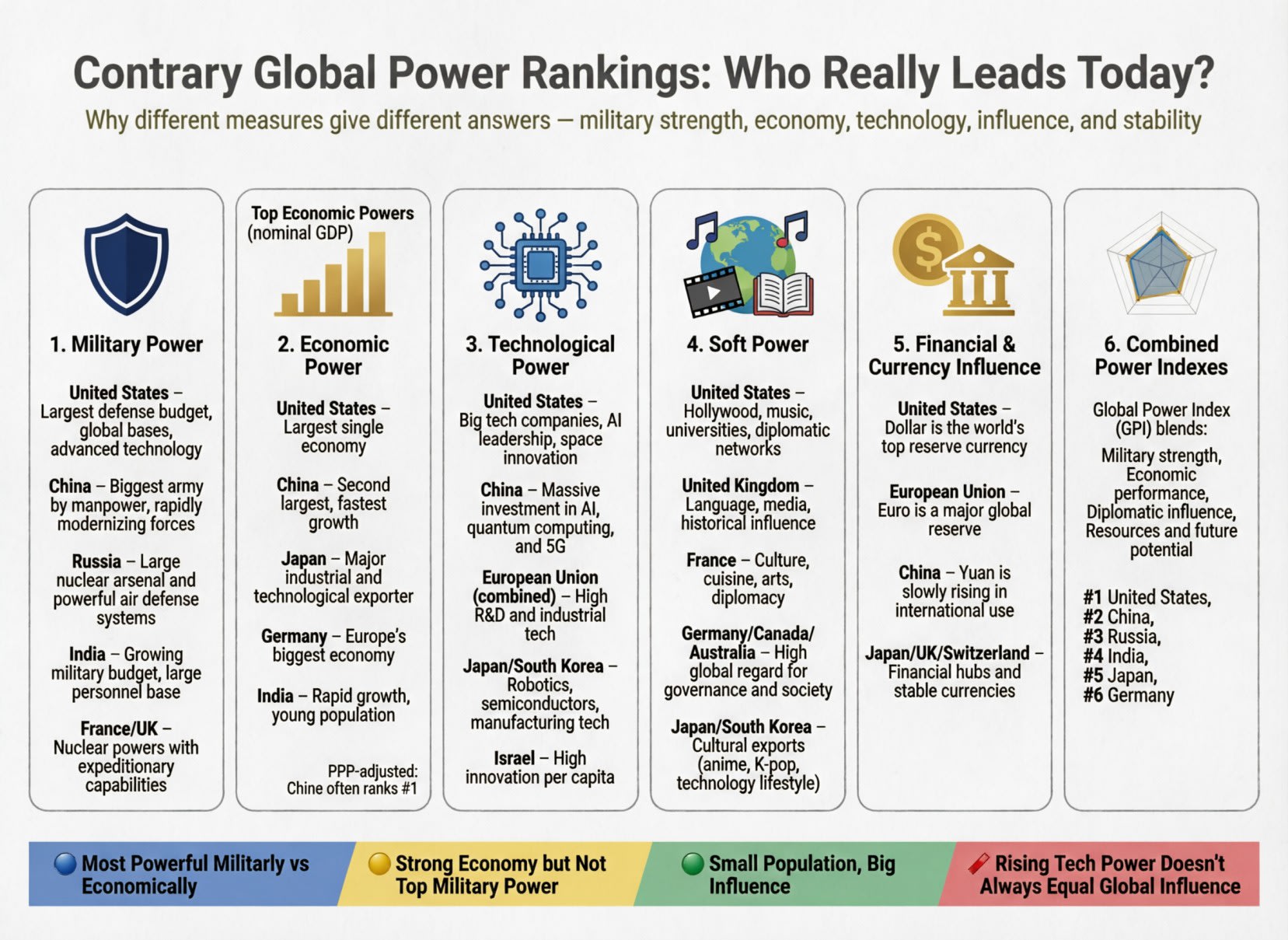
Analyses of power rankings show the picture is multidimensional, since combined power indexes weigh military strength, economic size, technology investment, and soft power differently.
As a result, gains in one area do not automatically translate into comprehensive dominance.
This dual framing—CNN's broad narrative of ascent and vocal.media's technical, metric-driven caution—suggests momentum for the Global South while warning that power is measured in distinct, sometimes conflicting ways.
Coverage Differences
Narrative Framing
CNN (Western Mainstream) presents a broad narrative that the Global South is moving from the margins to centrality, emphasizing rising economic strength, innovation, and diplomatic influence as a systemic shift. vocal.media (Other) focuses on how composite indexes like the Global Power Index (GPI) parse different dimensions (military, economic, tech, soft power), indicating that strengths are uneven and rankings can still place Western powers at the top. CNN's language is holistic and assertive about a geopolitical realignment, while vocal.media offers more technical nuance about what metrics capture and what they miss.
Global South economic and tech rise
Economic strength and technological investment are driving a shift in global influence.
CNN identifies rising economic power and growing innovation across the Global South as core drivers.
Vocal.media highlights China's rapid economic growth and heavy AI investment as especially notable.
These Chinese gains encounter Western mistrust that can limit technology adoption and global integration.
Most rankings still list the United States first and China second, showing influence is becoming more competitive rather than simply transferred.
Overall, the Global South is propelled by economic and tech advances, but the transition interacts with existing hierarchies and ideological barriers.
Coverage Differences
Contradiction
CNN depicts a broad shift toward the Global South driven by economic and innovation gains. vocal.media reports that despite those gains, major rankings still place the United States first and China second, revealing a tension: rising Southern influence coexists with enduring Western (and US) supremacy in many indexes. Additionally, vocal.media reports on Western mistrust limiting China's tech adoption — which is reported as a claim about external reactions rather than an assertion of fact by vocal.media itself.
Military and Economic Influence
Security and military capacity remain crucial delimiters of influence, and vocal.media emphasizes that military reach and hard power still constrain some economically large but strategically limited players.
It cites Japan and Germany as examples of large economies with constrained military projection, while noting that other actors combine significant hard and soft capabilities.
CNN frames the Global South's rise around economic, innovation, and diplomatic gains and does not foreground the same military caveats, highlighting a difference in emphasis between the sources about which levers of power matter most.
Coverage Differences
Missed Information
vocal.media (Other) explicitly notes that Japan and Germany have large economies but constrained military reach — a detail about military projection and constraint that is not emphasized in CNN’s (Western Mainstream) depiction of the Global South’s ascent. This shows vocal.media adds specificity on hard-power limits, while CNN foregrounds economic and diplomatic trends.
Soft power and diplomacy
Soft power, quality of life, and diplomatic reach are axes where less militarized states can punch above their weight.
Vocal.media highlights Canada, Australia, and Sweden as examples that score highly on soft power and living standards despite limited hard-power capabilities.
CNN’s account of broader diplomatic influence is consonant with this idea but tends to aggregate the Global South’s gains rather than enumerate which middle powers shine in soft influence.
Together these readings suggest a multipolar environment in which different regions and states exercise distinct mixes of economic, technological, diplomatic, and cultural influence.
Coverage Differences
Unique Coverage
vocal.media (Other) uniquely calls out smaller, high-quality-of-life countries — Canada, Australia, Sweden — as scoring highly on soft power despite limited hard-power. CNN (Western Mainstream) does not single out those countries in the same way, preferring a general narrative about the Global South’s growing diplomatic influence.
Shifts in global influence
Taken together, the sources portray a complex, uneven transition.
CNN emphasizes a broad realignment toward the Global South driven by economics, innovation, and diplomacy.
Vocal.media stresses that composite measures and existing rankings still reflect entrenched hierarchies and varied strengths across hard and soft power.
The 'dethroning' of Western hegemony is not a single event but a patchwork process of shifting influence, contested technologies, and persistent top-ranked actors, and the exact trajectory depends heavily on which metrics one prioritizes.
Both pieces warn against simple narratives: progress for the Global South is clear, but contradictions and limits are embedded in different measures of power.
Coverage Differences
Narrative vs. Metrics
CNN (Western Mainstream) frames the development as a sweeping geopolitical shift elevating the Global South, while vocal.media (Other) qualifies that view with metric-driven nuance showing enduring top positions for the US and China and a complex mix of strengths. The difference highlights how source type influences whether coverage emphasizes systemic narrative (CNN) or analytical caveats about measurements and rankings (vocal.media).