Full Analysis Summary
Greenland protests against annexation
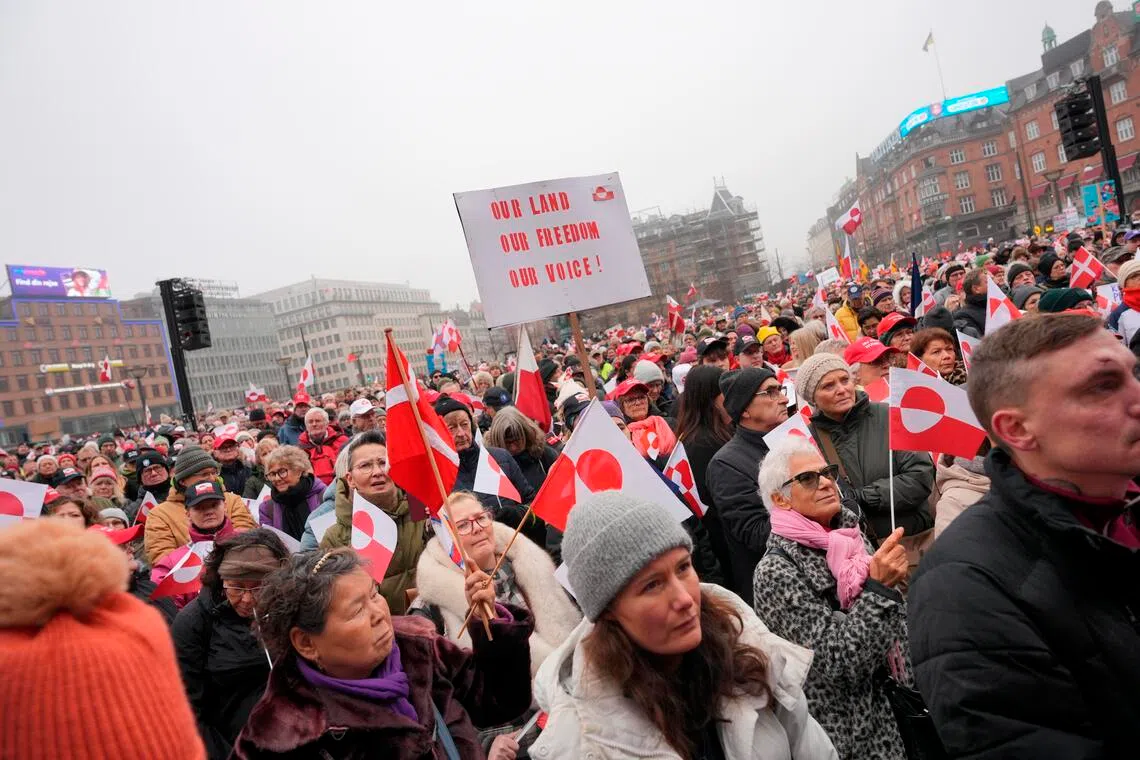
Thousands of Greenlanders rallied in Nuuk to condemn President Donald Trump’s public push to annex Greenland, gathering in the rain to wave flags, wear slogans and chant against the proposal.
France 24 reports that demonstrators, including Greenland’s prime minister Jens-Frederik Nielsen, chanted and sang under light rain, waved Greenlandic flags and wore caps reading Make America Go Away, and a nurse at the rally said they did not want Trump invading Greenland.
The protest in Nuuk was coordinated with demonstrations across Denmark as tensions rose after Trump warned he might impose tariffs on countries that oppose his plan.
Local, visually vivid coverage framed the event as a popular, organized rejection of the annexation talk.
Coverage Differences
Tone and focus
France 24 (Western Mainstream) emphasizes street-level imagery and local voices in Nuuk — naming the prime minister’s presence and direct protest slogans — while South China Morning Post (Asian) and MyNorthwest (Local Western) foreground the diplomatic context of a bipartisan U.S. congressional delegation visiting Copenhagen to reassure Denmark and Greenland that there is no security justification for the U.S. move. Siasat (Asian) centers U.S. security rationales that Trump has advanced (China/Russia interest in minerals) and U.S. political pushback. These sources therefore differ in whether they foreground local protest atmosphere (France 24) or diplomatic/political responses and motives (SCMP, MyNorthwest, Siasat).
Greenland protests and response
The demonstrations in Nuuk carried explicit political messages and symbolic apparel.
France 24 recorded protesters wearing caps that read "Make America Go Away" and noted that Greenland’s prime minister attended; one attendee told reporters bluntly, "We don’t want Trump invading Greenland."
That imagery underscores a grassroots rejection.
Other sources highlighted how the demonstrations coincided with U.S. political moves.
The South China Morning Post reported the congressional delegation’s visit coincided with protests after Trump warned he 'may put a tariff' on countries that oppose his plans to seize mineral-rich, autonomous Greenland.
MyNorthwest quoted delegation leader Sen. Chris Coons urging de‑escalation and respect for Denmark and NATO.
The juxtaposition of local anger and U.S. congressional reassurance frames the moment as both popular protest and diplomatic response.
Coverage Differences
Narrative emphasis
France 24 (Western Mainstream) spotlights local symbols and participants — caps, chants, the prime minister’s attendance and direct participant quotes — giving the story a protest-centered narrative. South China Morning Post (Asian) and MyNorthwest (Local Western) frame the same events in the context of U.S. political signaling and a congressional delegation’s diplomatic outreach, using terms like “saber-rattling” (SCMP reports the delegation and many Americans oppose Trump’s stance as saber‑rattling) and quoting Sen. Chris Coons urging de‑escalation (MyNorthwest). Siasat (Asian) adds the policy rationale Trump has offered and records U.S. officials’ meetings, which shifts attention to geopolitical motives and institutional responses rather than street imagery.
U.S. response to Greenland
U.S. political figures and diplomats moved to contain the fallout.
Multiple sources record a bipartisan congressional delegation visiting Copenhagen to reassure Denmark and Greenland.
The South China Morning Post reports the delegation said there is no security threat from Greenland that would justify President Trump's proposal to take control of the territory.
MyNorthwest conveys Senator Chris Coons's plea for de-escalation and reassurance about U.S. respect for NATO.
Siasat reports that Senator Chris Coons pushed back more explicitly, quoting him: "None of them is for sale" and "there are no current security threats to Greenland."
Those outlets also note President Trump's framing that China and Russia covet Greenland’s untapped minerals and that he suggested tariffs might be used to force cooperation.
The contrast between congressional reassurances and Trump's comments shows competing U.S. signals and international unease.
Coverage Differences
Contradiction and emphasis
Siasat (Asian) emphasizes the security rationale Trump has advanced — quoting that he argues China and Russia covet Greenland’s minerals — while South China Morning Post (Asian) and MyNorthwest (Local Western) emphasize congressional pushback that “there is no security threat” and label the president’s rhetoric as alarming or saber‑rattling. Thus Siasat reports Trump's stated motives, whereas SCMP and MyNorthwest stress institutional rebuttals and calls for de‑escalation, highlighting a contradiction between the administration’s public claims and bipartisan congressional statements.
Diplomacy and security responses
Diplomatic follow-up and institutional responses also featured in coverage.
Siasat notes Denmark and Greenland's foreign ministers met with U.S. officials including Vice President J.D. Vance and Secretary of State Marco Rubio and agreed to create a working group.
Siasat also says public descriptions of the working group's purpose diverged, and that European leaders stress decisions about Greenland should be made by Denmark and Greenland.
South China Morning Post and MyNorthwest focused on the congressional delegation's conciliatory mission to reassure allies and contrasted those congressional remarks with the White House's rhetoric.
Denmark said it will boost its military presence there with allied cooperation, indicating regional security adjustments in response to the controversy.
Coverage Differences
Missed information and narrative detail
Siasat (Asian) provides more detail on diplomatic meetings and procedural outcomes — naming U.S. officials and a working group and noting divergence in public descriptions — while South China Morning Post (Asian) and MyNorthwest (Local Western) focus on the congressional delegation’s on-the-ground reassurance. France 24 (Western Mainstream) foregrounds public protest and solidarity actions rather than the specific diplomatic meetings. This means Siasat adds institutional specifics that other pieces either summarize or omit, shifting the story from protest imagery to formal diplomatic response.
Greenland annexation responses
The incident exposed fissures in tone and messaging across outlets and actors.
Local Greenlandic protesters and France 24 presented an immediate, emotional rejection of annexation, while congressional voices (reported by South China Morning Post and MyNorthwest) sought to calm allies and denied a security rationale for takeover.
Siasat emphasized the administration’s stated rationale about minerals and recorded diplomatic steps and potential military adjustments.
All sources showed concern over Trump’s suggestion that he 'may put a tariff' or 'might impose tariffs' on opposing countries, language that appeared in several outlets.
They collectively documented that U.S. domestic politics, allied reassurance, and Greenlandic protests unfolded simultaneously.
The cumulative picture was one of popular resistance in Greenland intersecting with diplomatic damage-control and competing narratives about security and motive.
Coverage Differences
Tone and narrative synthesis
France 24 (Western Mainstream) and local reports focus on protest imagery and participant quotes; SCMP (Asian) and MyNorthwest (Local Western) center congressional reassurance and describe the president’s rhetoric as alarming or saber-rattling; Siasat (Asian) stresses the administration’s geopolitical justification (China/Russia and minerals) and the formal diplomatic meetings and military responses. These distinctions produce different emphases — protest legitimacy and emotion (France 24), diplomatic reassurance and alarm (SCMP/MyNorthwest), and geopolitical motive and procedural outcomes (Siasat).