
Guards of "التراب" and "الثورة".. Why does Iran run the war with two armies?
Key Takeaways
- Iran runs the war through two separate military forces.
- Mojtaba Khamenei became Iran's new Leader after Ayatollah Ali Khamenei's death.
- Iran's military establishment lost senior historic commanders during the conflict.
Leadership crisis and losses
In the midst of the ongoing war that erupted in late February, which claimed the life of the Iranian Leader Ayatollah Ali Khamenei, Iran found itself facing an unprecedented existential test under the leadership of its new Leader Mojtaba Khamenei.
“In the midst of the ongoing war that erupted in late February, which claimed the life of the Iranian Leader Ayatollah Ali Khamenei, Iran found itself facing an unprecedented existential test under the leadership of its new Leader Mojtaba Khamenei”
This political earthquake deepens what is described as the wounds of the military establishment, which lost its senior historic commanders — foremost among them Hossein Salami and Mohammad Bagheri — during last June's war, and the losses in the current confrontation continued with the departure of the new commander-in-chief of the Guard Mohammad Pakpour (who succeeded Salami in 2025) and the head of intelligence in the Emergency Command and chief intelligence officer of the General Staff Salah Asadi.
Two forces, different missions
Despite both institutions being subject to the authority of the Supreme Leader as Commander-in-Chief of the Armed Forces, the Iranian military structure is based on deliberate duality that creates differentiation in "combat identity" and objectives.
The Regular Army (Artesh) is a continuation of the Shah's army after its reorganization in 1979; its doctrine is classical and focuses on protecting the geographical borders of the Iranian state.
The Revolutionary Guard (Pasdaran) was established by decree of the Leader of the Revolution Ayatollah Khomeini in 1979; its doctrine is to protect the "regime and the revolution," and its loyalty is absolute to the Leader.
The Army carries out classical defense and suffers from an aging arsenal.
In contrast, the Revolutionary Guard commands strategic weapons (ballistic missiles and drones) and is responsible for asymmetric deterrence and external operations.
The Army is numerically the larger force with about 400,000 regular soldiers, according to estimates by the International Institute for Strategic Studies and Western military centers, while the Revolutionary Guard comprises around 190,000, but it controls millions of volunteers from the Basij mobilization forces.
Roles and specialised branches
Military experts agree on a guiding maxim of the Iranian system: "the Army for defense, the Guard for offense and exporting influence."
“In the midst of the ongoing war that erupted in late February, which claimed the life of the Iranian Leader Ayatollah Ali Khamenei, Iran found itself facing an unprecedented existential test under the leadership of its new Leader Mojtaba Khamenei”
The Regular Army acts as a classical defensive force to repel any external invasion and consists of four main branches: the Ground Forces, the Navy operating in deep waters (the Sea of Oman and the Indian Ocean), the Air Force, and Air Defense Forces, and its air strength relies on old Eastern and Western fighters which makes its role tactical and limited within Iranian geography, according to researcher Hussein Haqian.
The Revolutionary Guard appears as an arm of an ideology that crosses borders; unlike the Army, the Guard emerges as an ideological force not constrained by geography, as former Revolutionary Guard official Hussein Kananani Moghadam told Al Jazeera Net that the difference lies in the "essence of the mission."
The Guard's strength is evident in its specialized branches identified by a report from the Institute for the Study of War: the Aerospace Force described as the "crown jewel" and the locus of deterrence, the Quds Force as the external striking arm responsible for the regional "axis of resistance," and the Naval Force adept at "naval guerrilla warfare" with fast boats in the Strait of Hormuz.
Domestic, international, and current roles
Domestically, the Army's image is tied to its classical role in defending borders, while the Revolutionary Guard has a wide presence in the state's economic and political structures and the Basij mobilization forces under its command are tasked with internal security.
Internationally, the position of the Revolutionary Guard became more complicated after the United States designated it in 2019 as a "Foreign Terrorist Organization," a step discussed or supported by European entities and blocs and accompanied by an expanding circle of sanctions.
To prevent collision between the two forces, the leadership established the Armed Forces General Staff for strategic coordination and the Khatam al-Anbiya headquarters to manage operations in wartime, but these centers suffered a severe blow during the June 2025 war with the killing of Chief of Staff Mohammad Bagheri and the commander of the Khatam al-Anbiya headquarters Gholam Ali Rashid in Israeli strikes, which forced the Iranian leadership to fill the void with rapid appointments.
With his assumption of the position of Supreme Leader amid the dust of the current battle, Mojtaba Khamenei inherits a system historically designed to empower the Revolutionary Guard, but it is burdened by a cumulative leadership vacuum.
In the blazing war today the Regular Army stands ready in its barracks as a reserve force to protect the territory in case the conflict develops into an American-Israeli ground invasion, while the Revolutionary Guard leads the actual fighting with tools of "asymmetric deterrence," beginning with the Aerospace Force launching intense waves of ballistic missiles and drones, continuing with the new Leader's instruction to the Guard to close the Strait of Hormuz to strike the global economy, and culminating in the activation of the Quds Force for the hot fronts in the region.
More on Iran
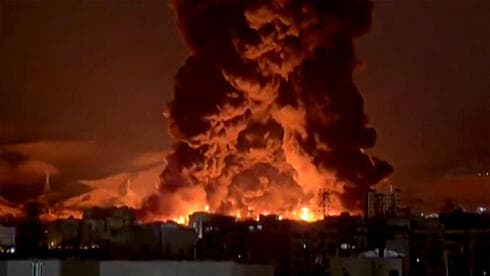
US obliterates military targets on Iran’s Kharg Island, Trump warns
13 sources compared
US Deploys About 2,500 Marines to Middle East After Iran Attacks Gulf Shipping
33 sources compared
FBI Warns of Iranian Drone Plot Based on Unverified Tip; California Says No Credible Threat
10 sources compared

White House Demands ABC Retract Report Claiming Iran Sought To Launch Drone Attacks On California
11 sources compared