Syria09 December, 20253 min read
Hayat Tahrir al-Sham Storms Toward Damascus From Idlib
This article is an automated aggregation of coverage from news outlets. Our editorials offer in-depth analysis curated by the NewsCord team.
Rebel forces from Idlib, led by Abu Mohammed al‑Jolani, advanced toward Damascus The offensive overturned Assad's apparent victory, dramatically altering Syria's power balance
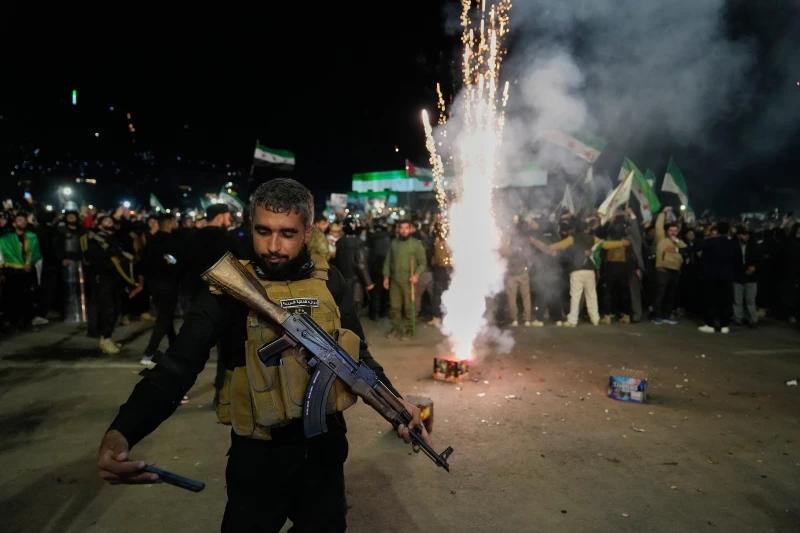
9 outlets told this the same way.
Outlets did split on Asad Al-Shaibani Meets Saddam Haftar in Benghazi Over Syrian Consulate And Missing Syrians →
Idlib offensive aftermath
A year ago, a rapid offensive launched from Idlib upended what had seemed like a settled Syrian war when rebel forces pushed toward Damascus, led by Hayat Tahrir al-Sham (HTS).
“Assad’s regime collapsed after Turkish-backed rebels took Aleppo on Dec. 1, 2024; eight days later Shara’s forces seized most of Syria, ending Assad’s 24‑year rule.”
Jeremy Bowen of the BBC frames the assault as a dramatic rupture, noting that a year earlier Syria's apparently settled war was upended when a rebel force from Idlib pushed toward Damascus and identifying the offensive leader as Abu Mohammed al-Jolani, the nom de guerre of Ahmed al-Sharaa, who leads HTS.

Khaama Press records rapid regime change after Turkish-backed rebels took Aleppo on Dec. 1, 2024, saying Sharaa's forces seized most of Syria, ending Assad's 24-year rule and describing large public events marking the change.
Rudaw reports the offensive as the trigger for a late-year escalation that reshaped front lines, noting the SDF lost Manbij even as it held other fronts.
Security and governance shifts
The military and security consequences have been uneven across Syria: while some fronts held, the offensive and subsequent fighting worsened fragmentation and raised questions about who controls armed groups. Rudaw records the SDF's warning that recent violence — which it attributed either to an official policy of "rhetorical chaos" or to "a deliberate inability to control armed groups" — is reviving the incitement Syrians rejected in the uprising. Rudaw also notes the SDF lost Manbij amid the late-year clashes.
The BBC highlights the paradox that areas may feel relief from the Assads' "crushing weight" even as the rise of HTS "brings new problems." Khaama Press documents large state-style displays, including celebrations in Umayyad Square and planned military parades, suggesting the new authorities are consolidating public legitimacy even amid security questions.

Responses to Syrian offensive
Different actors portray the offensive and its aftermath in contrasting ways. The SDF's statement, reported by Rudaw, blames either systematic 'rhetorical chaos' or an inability to rein in militias for a return to divisive incitement and explicitly cites losses such as Manbij.
“A Syrian who fled years earlier because of al-Assad’s oppressive rule says he now feels at home for the first time after returning, crediting improvements in security, more reliable electricity and basic services.”
By contrast, Al Jazeera records returning Syrians who credit improved security, more reliable electricity and basic services, and new international partnerships for enabling a safe return and optimism about rebuilding. BBC reporting sits between these angles, warning that the fall of Assad may reduce some pressures while empowering problematic armed groups.
Media portrayals of aftermath
Public life and symbolism are central to how different outlets describe the aftermath. Khaama Press emphasizes visible state-style celebrations and the giving of gifts. It reports that Acting President Ahmad Shara attended ceremonies in uniform, pledged unity, and unveiled a gift from Saudi Arabia (a piece of the Kaaba's cloth).
Khaama frames these events as a government consolidating legitimacy and reorienting diplomacy. Al Jazeera's returnee account underscores warmer communities, easier ministry work, and hopes for rebuilding tied to new international partnerships. The BBC, however, stresses that these civic improvements may coexist with the dangers posed by stronger non-state armed groups such as HTS.
International reintegration perspectives
International alignments and the mechanics of reintegration are described differently across outlets. Khaama Press reports that since taking power Shara has shifted foreign policy, building ties with the U.S. and Gulf states, distancing from Iran and Russia, and seeing some Western sanctions eased, signaling tentative reintegration into international diplomacy.
“Shara has shifted foreign policy—building ties with the U.S. and Gulf states, distancing from Iran and Russia, and seeing some Western sanctions eased—signaling tentative reintegration into international diplomacy.”
Al Jazeera's reporting on returning Syrians stresses new international partnerships as part of improved services and jobs. Rudaw and BBC complicate this picture by documenting continuing security problems and warning that empowered militias and Ankara-backed groups have widened conflict dynamics despite some diplomatic openings.
