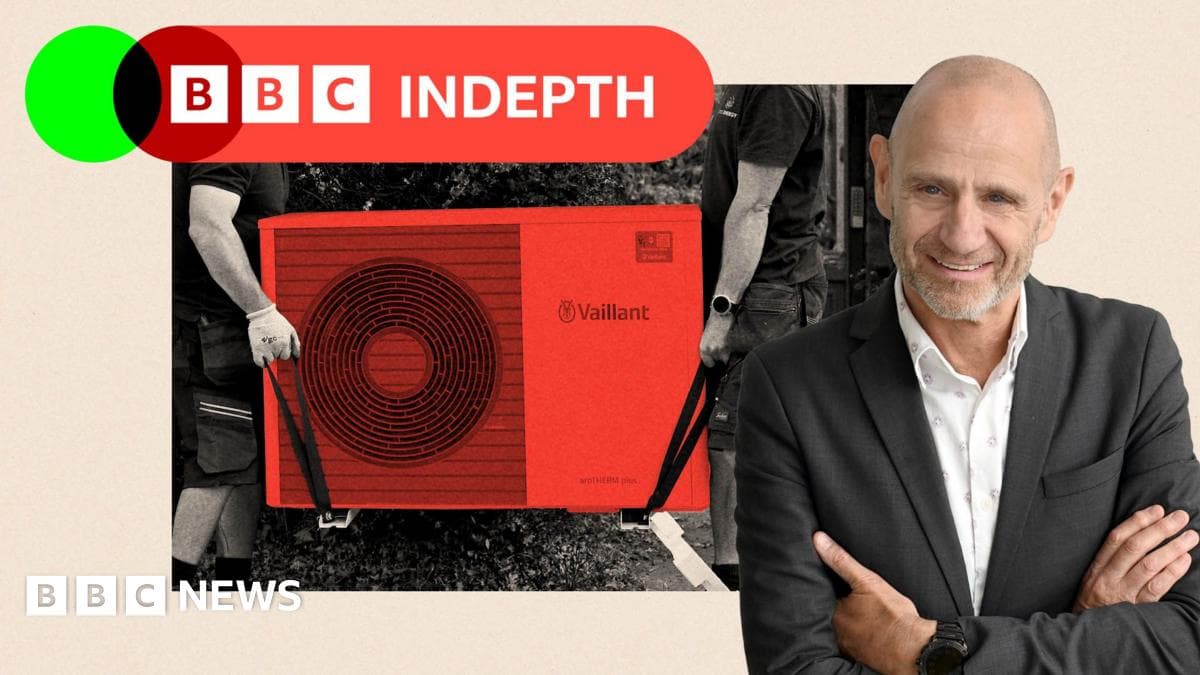
Heat pumps work for me - but they're not yet a money saver
Key Takeaways
- Old, leaky house in northern France had a heat pump installed.
- The heat pump effectively heats the home.
- It is not yet a money saver.
Household heat-pump investment
Emily and Stephen Boynton, a London couple, decided during the pandemic to install an air-source heat pump in their four-bedroom detached home.
“I know that not everybody is interested in the precise form of plumbing by which they heat their home, but it's a topic I've become obsessed with”
Emily, who had just turned 50, said that if you have the money and the space you should probably get on with it.
The installation typically requires new pipework and often new radiators, and it coincided with renovations to their kitchen.
Before installing, they were advised to improve insulation, which added about £5,000 to the cost.
They ultimately spent £17,000 in total, offset by a £5,000 government grant.
If financed on a 25-year mortgage at 4.5% interest, the extra monthly payments would be about £100.
In energy terms, their pre-install year used 28,000 kWh and the latest year 10,000 kWh, a reduction of almost two-thirds, which Emily attributes to the heat pump and the insulation.
Heat-pump operation and efficiency
Mechanically, a heat pump circulates a refrigerant in a closed loop, absorbing heat from outside air to warm water that runs through radiators and underfloor heating.
The cycle involves compressing the refrigerant gas to a high temperature, condensing it into a liquid, and then expanding it to a low temperature so heat can be drawn from outside air even when it's cold.
At Energy House 2 at the University of Salford, researchers test heat pumps in controlled conditions to measure input energy and heat output precisely.
Professor Richard Fitton says a well-configured unit can deliver about three kilowatt-hours of heat for every one kilowatt-hour of electrical energy put in, a contrast with gas boilers where efficiency is much lower.
The testing helps quantify the efficiency advantage of heat pumps under real-world conditions.
Limitations and economics
Despite the efficiency gains, heat pumps pose practical challenges.
“I know that not everybody is interested in the precise form of plumbing by which they heat their home, but it's a topic I've become obsessed with”
They provide gentler heat than gas boilers and may require larger radiators or underfloor heating to maintain comfort.
Dale Vince of Ecotricity cautions that heat pumps typically produce colder water, so without upgrading radiators a house may feel cold.
If users try to compensate by cranking up the system, much of the efficiency advantage is eroded.
In the UK, electricity costs around four times as much per kilowatt-hour as gas, complicating the economics of mass adoption.
By contrast, electricity is cheaper relative to gas in France and other countries, a point cited by Octopus Energy's Greg Jackson who notes policy barriers remain but the technology makes many customers very happy.
Policy and net-zero transition
Looking ahead, the article frames heat pumps within the UK's net-zero ambitions, arguing that electrifying heating will require making the economics work for average households.
The high upfront cost and policy barriers are obstacles to scaling, and some observers argue the country will struggle to replace fossil fuels without a viable approach to cheaper or more favorable electricity pricing.
Proponents describe electrification as an inevitable transition, likening it to the horse-to-car shift of the early 20th century, and contend that heat pumps will be central to reducing dependence on gas and tightening energy resilience in the long term.
More on Technology and Science

UN Says 2025 Heat Will Last Thousands of Years
11 sources compared

UN Warns 2025 Heat Record Will Endure for Thousands of Years
14 sources compared

Hawaii Suffers Its Worst Floods in Over 20 Years, Prompting Thousands to Evacuate
46 sources compared

Kona Low Storms Strike Oʻahu and Maui, Hawaii Faces Worst Flooding in 20 Years
24 sources compared