Asia14 January, 20262 min read
High-Speed Rail Contractor's Crane Collapses Onto Passenger Train in Thailand, Killing 22
Construction crane collapsed onto a moving passenger train in Sikhio district, Nakhon Ratchasima province Collision killed at least 22 people and injured dozens
31 outlets told this the same way.
Outlets did split on Avalanche Strikes Himlung Himal Base Camp In Nepal, At Least 10 Missing →
Train and crane collapse
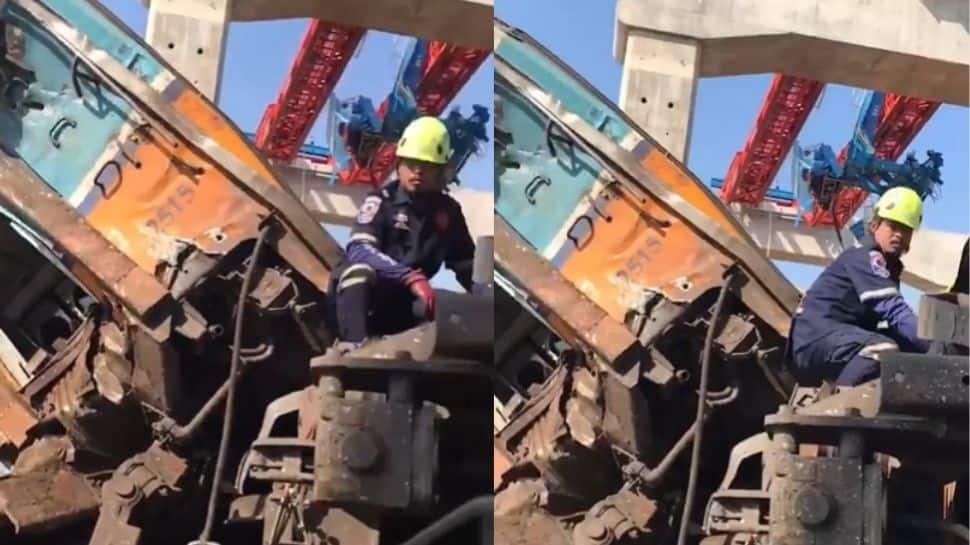
A large construction crane collapsed onto a moving passenger train in Sikhio district, Nakhon Ratchasima province in north‑east Thailand on the morning of Jan. 14, 2026, causing multiple carriages to derail, briefly catch fire, and leaving many dead and injured.
“A crane working on a rail-construction project toppled onto a three‑carriage passenger train in Thailand, slicing the middle carriage in half, killing at least 22 people and injuring about 80 more, authorities said.”
Officials and eyewitnesses said the collision occurred at roughly 9:00–9:05 a.m. as the Bangkok-to‑Ubon Ratchathani service passed beneath elevated works linked to a high‑speed or medium‑speed rail project.
The train was carrying about 195 passengers at the time.
Rescue teams used cutting equipment to free trapped people, extinguished fires at the scene, and authorities sealed the site while launching investigations into the crane’s failure and construction safety.
Varying casualty figures
Fatality and injury counts varied across reports as officials revised figures and different agencies quoted separate ministry numbers, with mainstream outlets generally citing about 22 dead and injuries ranging from dozens to around 80 while some tabloids and other reports put the toll higher or lower. The BBC and ABC cited public health ministry figures of 22 dead and dozens injured, noting infants and elderly among the seriously hurt, while Sky News and The Telegraph reported later revisions raising the toll to 25 in some counts and The Quint and JFeed recorded earlier, lower tallies in the immediate aftermath. This variation reflects the rapidly changing situation and reliance on multiple official sources and local police statements.
Thailand rail collision
The crane was working on an elevated rail project linked to Thailand’s major new high-speed or medium-speed railway plans, variously described as the Bangkok–Kunming high-speed link, the Bangkok–Nakhon Ratchasima phase, or part of the Thai–Chinese rail initiative. Some reports placed the section within the $4–5.4 billion China-linked development. Thai officials, including the transport minister and deputy prime minister, have ordered comprehensive investigations.
“The site is part of a $4 billion China-backed high-speed rail project intended to link Bangkok with Kunming by 2028.”
The BBC noted the project website lists the Italian-Thai Development Company for the Lam Takhong–Sikhio section, and Thailand’s prime minister demanded someone be 'punished and held accountable.' China’s foreign ministry said it was verifying details. The collision has renewed scrutiny over construction safety and oversight on the expanding rail projects.
Eyewitnesses and response overview
Eyewitness and survivor testimony underscored the violence of the impact, with witnesses recounting loud crashes, sliding noises, explosions, and a crane striking and slicing through carriages as passengers were thrown. Emergency responders cut through twisted metal to free those trapped, extinguished fires, and transported the wounded to nearby hospitals. Rail services were adjusted with cancellations, rerouting, and refunds for affected passengers.
Some reports included vivid survivor quotations and age-specific casualty details that tabloids emphasized. Mainstream outlets focused on the official rescue operations and logistical response.