Full Analysis Summary
Souda Bay protest
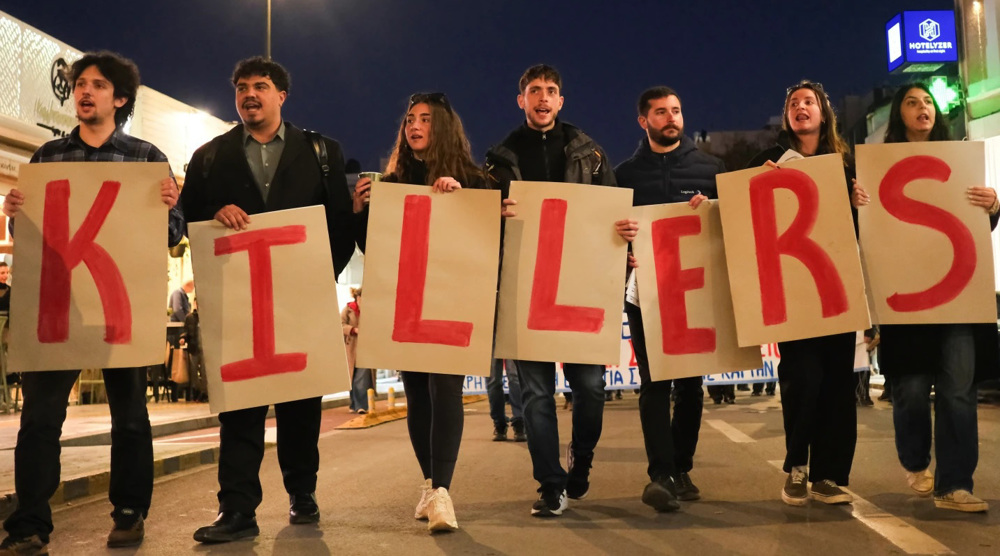
Several hundred anti-war protesters gathered in Chania, on the Greek island of Crete, after the US Navy's Carrier Strike Group 12 — led by the USS Gerald R. Ford — docked at the Souda Bay naval base.
Organizers included the Greek Communist Party and other left-wing groups.
Demonstrators held placards reading "Killers" and the rally was described as peaceful.
The visit and the protests took place amid heightened regional tension tied to Iran-related issues reported by the sources that covered the event.
Coverage Differences
Tone
PressTV (West Asian) emphasizes the protest as part of wider opposition to a U.S. military buildup in the region and highlights anti-war sentiment, while Associated Press (Western Mainstream) focuses on the factual sequence—docking and a peaceful rally—and situates it amid regional tensions without the same military-buildup framing.
Narrative Framing
PressTV links the docking explicitly to U.S. movements in the region and to Iran, whereas AP frames the event more around the carrier’s arrival, the protest, and broader tensions tied to Iran’s nuclear program and statements by U.S. leadership.
Greek protest reports
Both sources described the protest organizers and attendees as left-wing and tied to the Greek Communist Party.
Both reports emphasized that the demonstration was peaceful and noted the presence of activists from other parts of Greece.
Both outlets noted placards reading "Killers" verbatim.
The West Asian source reported the crowd as "several hundred", while the AP confirmed the rally was peaceful but did not provide a numerical estimate, leaving the exact crowd size unspecified.
Coverage Differences
Detail Omission
Associated Press reports the protest as “Greek Communist Party–backed” and peaceful but the AP excerpt does not give a headcount; PressTV provides a numeric phrase, “several hundred.” The difference reflects a concrete factual detail present in PressTV and not present in the AP excerpt.
Tone
Both sources call the rally peaceful, but PressTV’s broader narrative connects the protest to opposition to U.S. regional military posture, while AP frames it as a localized protest amid larger regional tensions tied to diplomacy and nuclear issues.
Carrier strike group deployment
The vessel at the center of the visit, USS Gerald R. Ford, is identified as the strike group leader and is described in AP as "the world's largest aircraft carrier."
PressTV reports that Carrier Strike Group 12 had been stationed in the Caribbean before being reassigned to the eastern Mediterranean.
PressTV frames the arrival as part of additional U.S. naval and air deployments and advanced systems to regional bases.
Coverage Differences
Unique Coverage
PressTV uniquely reports the carrier strike group’s previous stationing in the Caribbean and directly frames the movement as a reassignment within a wider U.S. deployment to the region; AP emphasizes the ship’s size and reports the docking along with high-level U.S. remarks.
Coverage differences on Iran visit
The two outlets diverge in emphasis on regional implications and immediate threats.
PressTV highlights Iranian official warnings that any attack would meet a decisive response and that U.S. assets could be targeted, and notes the docking coincided with scheduled indirect nuclear talks in Geneva.
AP highlights comments by U.S. leadership — quoting U.S. President Donald Trump warning of possible military action — and situates the visit amid tensions over Iran’s nuclear future without quoting Iranian threats in the excerpt.
These contrasting emphases lead to different tones: PressTV foregrounds regional escalation and Iranian responses, while AP presents the visit and protests as part of diplomatic and security tensions.
Coverage Differences
Contradiction
The sources do not directly contradict factual descriptions of the docking or the protest, but they present differing emphases: PressTV reports Iranian official warnings and frames the arrival as part of a U.S. military buildup, whereas AP reports U.S. political statements (Donald Trump’s warning) and links the visit to tensions over Iran’s nuclear program.
Tone
PressTV’s framing conveys a sense of a U.S. military buildup prompting Iranian warnings, while AP frames the same events amid diplomatic tensions and U.S. leadership statements; the two framings produce different perceptions of immediacy and threat.