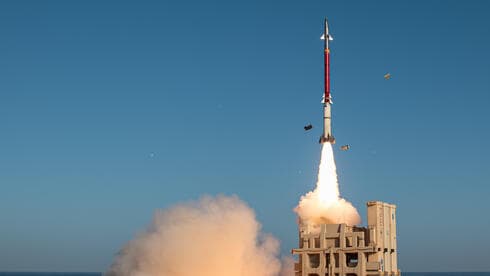
Interceptor production outpacing Iran’s missile output, expert says
Key Takeaways
- Israel's interceptor production surpasses Iran's missile production rate.
- Lebanese front's opening revived drone threats against Israeli civilians and IDF bases.
- Israel adopted vague reporting about weapon types used across different conflict fronts.
Israel drone defense update
The article reports that the war between Israel and the United States and Iran, along with the opening of the Lebanese front last week, has sharply revived the threat of drones targeting Israel’s civilian rear and IDF bases and facilities.
“The war between Israel and the United States and Iran, along with the opening of the Lebanese front last week, has sharply revived the threat of drones targeting Israel’s civilian rear and IDF bases and facilities”
Israel has adopted a policy of vague reporting about the types and scale of weapons used, countermeasures and interception success rates.
The IDF spokesperson no longer provides updates on the number of launches toward Israel or interception rates to make it harder for enemies to assess interceptor stockpiles.
Israel also received a new laser air defense system, Iron Beam, from Rafael in late December.
The system is designed to intercept drones and rockets at ranges up to 10 kilometers at minimal cost.
Calcalist reported that as of last weekend the system had not been used operationally and had not intercepted any threats.
Defense officials declined to explain its deployment or reasons for non-use.
Iran missile and drone strikes
According to data from the Institute for National Security Studies (INSS), since the war began last Saturday Iran has launched about 600 ballistic missiles and more than 1,500 drones toward 12 countries in the Middle East, most directed at the United Arab Emirates.
Israeli and U.S. officials say air defenses have significantly improved, noting that during the previous war with Iran last June 99% of drone threats were intercepted using kinetic and electronic systems.
Iran has threatened use of advanced ballistic missiles such as the Khorramshahr-4, which it says can carry a warhead of about one ton.
Iran claimed last week it launched such missiles toward Ben Gurion Airport, and the article states Arrow-3 interceptors produced by Israel Aerospace Industries are capable of intercepting them.
Analyses of recent launches have not revealed new weapons systems or the use of maneuvering missiles.
The piece also says Iran has at times launched missiles carrying cluster-type warheads, similar to earlier conflicts.
Air defense and Hezbollah estimates
Experts quoted in the article say interceptor production outpaces Iran's missile production.
“The war between Israel and the United States and Iran, along with the opening of the Lebanese front last week, has sharply revived the threat of drones targeting Israel’s civilian rear and IDF bases and facilities”
Pini Yungman, president of TSG and former head of Rafael's air defense division, told Calcalist that 'we have very strong successes in the field of air defense' and that interceptor production in Israel and the United States is higher than a year or two ago and 'satisfactory'.
He said Arrow, David's Sling, THAAD and Iron Dome are considered a single coordinated defensive array producing far more interceptors than Iran is producing ballistic missiles.
Separately, an analysis by Tal Beeri and Dana Polak of the Alma Research and Education Center assessed that Hezbollah has rapidly rebuilt.
Alma estimated Hezbollah's arsenal at about 25,000 rockets and missiles, mostly short- and medium-range.
Alma said Hezbollah has the ability to launch dozens per day and possesses several hundred more advanced missiles including cruise and anti-ship missiles.
Alma estimated about 1,000 suicide drones.
Alma assessed a fighting force of more than 40,000 regular fighters plus tens of thousands of reservists.
Alma also says Hezbollah has reestablished its Radwan force at about 5,000 members, roughly 3,000 combat fighters trained in anti-tank missile launches and sniper operations.
Alma said smuggling of weapons to Hezbollah continues, with emphasis on maritime routes and ongoing land smuggling through Syria.
More on Lebanon

Hezbollah Fires 200 Rockets at Israel From Lebanon
17 sources compared
Israel Pounds Tehran With Airstrikes
12 sources compared

Israel Bombs Central Beirut, Targeting Hezbollah Infrastructure
14 sources compared

Unidentified Attacker Plants Explosive at U.S. Embassy Entrance in Oslo; Oslo Police Investigate Possible Terrorism
12 sources compared