Full Analysis Summary
Iran and Belarus Summary
Requested topic was Iran and Saudi Arabia forging strategic cooperation, but the supplied article snippet discussed Iran and Belarus instead.
I will not invent or extrapolate beyond the provided material, so I cannot produce factual reporting about Iran–Saudi strategic cooperation.
Below is a factual, multi‑paragraph summary of the supplied PressTV (West Asian) snippet about Iran–Belarus cooperation.
The supplied snippet centers on cooperative ties between Iran and Belarus and does not contain material about Iran’s relations with Saudi Arabia.
Because the source did not address Iran–Saudi relations, any attempt to report on that topic would be speculative.
If you would like accurate coverage of Iran and Saudi Arabia, please provide relevant source material or allow me to retrieve reliable reporting to summarize.
Coverage Differences
Missing perspectives / source limitation
Only PressTV (West Asian) material was provided. There are no sources about Iran–Saudi relations in the supplied articles, so I cannot compare different outlets’ coverage, contradicting or corroborating narratives, or provide Western or alternative perspectives on Iran–Saudi cooperation. Any claim about Iran–Saudi ties would be unsupported by your supplied documents.
Iran Belarus Strategic Cooperation
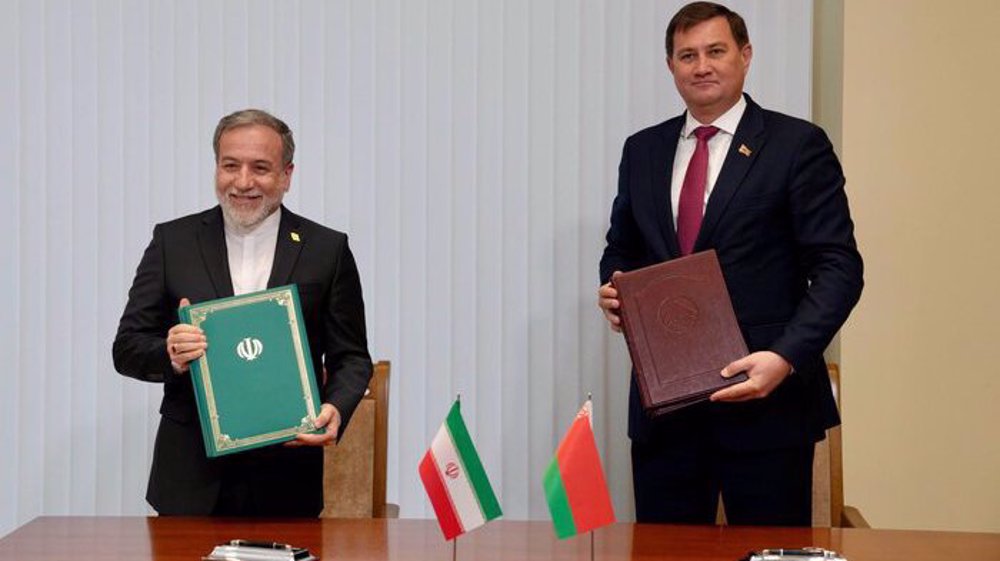
Iranian Foreign Minister Abbas Araghchi visited Minsk.
Iran and Belarus signed three agreements aimed at deepening bilateral cooperation.
The agreements were intended to coordinate resistance to Western unilateral sanctions.
Officials described the talks as reinforcing a strategic partnership between the two countries.
They said the visit was part of a longer-term effort to align positions on international law and in multilateral forums.
Coverage Differences
Narrow source coverage
PressTV frames the visit as a reinforcement of a strategic partnership focused on resisting Western sanctions and boosting cooperation in multilateral bodies. Because no other sources were provided, I cannot identify contrasting frames (for example, more transactional, security‑focused, or conciliatory depictions) that other source types might use.
Bilateral agreements summary
The signed documents reportedly include a declaration aimed at countering unilateral coercive measures.
They also include a declaration on strengthening the role of international law and a bilateral foreign ministry cooperation programme covering 2026–2030.
PressTV emphasizes coordination to resist Western unilateral sanctions and presents the agreements as tools to advance both countries' interests in international forums.
Coverage Differences
Focus and emphasis
PressTV highlights legal and diplomatic instruments (declarations, cooperation programme) and explicitly frames them as resistance to ‘Western unilateral sanctions.’ Without other outlets, I cannot show if other source types would have emphasized economic, military, or transactional aspects, or questioned the efficacy of such declarations.
Geopolitical framing and aims
The PressTV snippet places the agreements within a wider geopolitical project.
Both foreign ministers discussed enhancing ties within international organizations such as the UN, BRICS, SCO, EAEU, and NAM.
They stated an explicit goal to defend multilateralism and the rule of law.
The snippet's language is declarative and assertive, characterizing Western sanctions as unfair, unilateral, and illegal.
Coverage Differences
Tone and framing
PressTV’s tone is assertive and normative, explicitly condemning Western sanctions as ‘unfair, unilateral and illegal.’ Because only PressTV is available, I cannot contrast this with, for example, Western Mainstream outlets that might use more neutral or critical language, or Western Alternative outlets that might highlight different aspects. That absence limits cross‑source comparison of tone and terminology (e.g., ‘illegal sanctions’ vs. ‘unilateral measures’ vs. ‘punitive actions’).
Limitations and needed sources
Limitations, gaps, and what’s needed to address your original request: I cannot fulfill the original headline about Iran–Saudi strategic cooperation because the supplied material contains no reporting on Iran and Saudi Arabia.
Producing a multi‑source, comparative piece about Iran–Saudi relations that moves beyond de‑escalation would require additional articles from diverse source types, such as Western mainstream, Western alternative, and regional Gulf outlets.
If you provide those sources, I will summarize them and explicitly highlight differences across source types and include representative quotations.
For now, the factual record available to me is limited to the PressTV (West Asian) account of Iran–Belarus agreements.
Coverage Differences
Missing topic coverage
The supplied content does not mention Saudi Arabia at all; therefore any article asserting Iran–Saudi strategic cooperation would be unsupported by the provided sources. This is a clear omission in the dataset offered for this task.