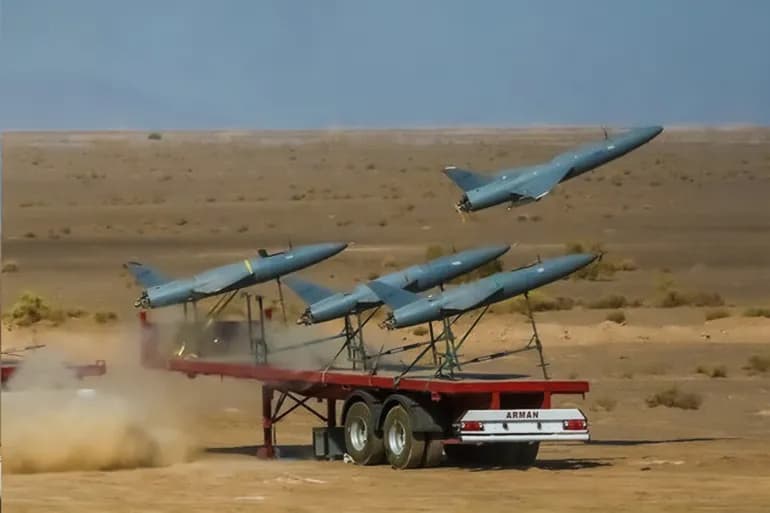
Iran Attacks Ben Gurion Airport with Arash-2 Drone, Escalates Strikes on Israel
Key Takeaways
- Iran claims Ben Gurion Airport was attacked using Arash-2 drones.
- Arash-2 described as advanced, longer-range (about 2,000 km) compared to Arash-1.
- The attacks are framed as retaliatory and part of escalatory Iran-Israel hostilities, per multiple outlets.
Attack Escalation
Iran has launched a significant escalation in the Middle East conflict by conducting drone and missile attacks targeting Israel's Ben Gurion Airport in Tel Aviv.
“BREAKING: Iran Strikes Ben Gurion Airport, Escalates Drone & Missile Attacks on Israel A major escalation in the Middle East conflict has been reported as Iran launched a drone and missile attack on Israel’s largest airport, Ben Gurion in Tel Aviv”
The attack represents a major development in the ongoing Iran-Israel confrontation, now entering its fourth week with no signs of abatement.

Iranian Army spokesperson Brigadier General Mohammad Akraminia confirmed that most of the drones deployed were Arash-2 units.
These drones are described as more advanced and destructive than previous systems like the Kian and Arash-1 drones.
The operation was carried out amid sustained retaliatory operations by Iranian Armed Forces in response to what they characterize as US-Israeli aggression against the country.
Drone Technology
The Arash-2 drone represents a significant advancement in Iran's military capabilities, featuring sophisticated technology designed to overcome sophisticated air defense systems.
According to Iranian military officials, the drone has an operational range of up to 2,000 kilometers, allowing it to strike targets deep within Israeli territory from Iranian soil without requiring forward deployment.

The system carries a substantial 260 kg warhead and is equipped with advanced features including a low radar cross-section that makes detection difficult.
The drone also has the ability to detect radar emissions to suppress air defense systems, and optical and thermal imaging systems for enhanced targeting accuracy.
Iranian officials have emphasized the drone's relatively low production cost compared to other advanced systems and interceptor missiles, making it cost-effective for sustained operations during prolonged conflicts.
Strategic Targeting
Ben Gurion Airport was specifically targeted due to its critical strategic importance to both Israel's civilian infrastructure and military operations.
“The Islamic Republic of Iran Army has successfully carried out retaliatory strikes targeting Tel Aviv’s Ben Gurion airport using advanced Arash-2 drones”
Iranian officials described the airport as Israel's largest international hub and the 'Zionists' main economic artery and driving force,' highlighting that due to maritime and ground restrictions, more than 90 percent of Israel's international trade is conducted through air routes primarily operating from Ben Gurion Airport.
The Iranian Army spokesperson further noted that the airport serves as a hub for refueling tankers and that aircraft maintenance industries are located near the facility.
These facilities are claimed by Iran to be 'the source of attacks against Iran,' positioning the airport not just as civilian infrastructure but as a legitimate military target in Iran's retaliatory operations.
This reflects Iran's strategic assessment of Israel's vulnerabilities and their targeting priorities in the ongoing conflict.
Conflict Context
The attack on Ben Gurion Airport occurs within the broader context of escalating hostilities that began on February 28, 2026, when the United States and Israel launched airstrikes against Iran.
These airstrikes resulted in the deaths of senior Iranian officials including Supreme Leader Ayatollah Seyyed Ali Khamenei.

In response, Iran has launched almost daily missile and drone operations targeting locations in Israeli-occupied territories as well as US military bases and assets across the region.
The conflict has expanded significantly since March 1-5, affecting several countries across the Middle East.
Following the Supreme Leader's death, Iran's Assembly of Experts elected Seyyed Mojtaba Khamenei as Iran's third Supreme Leader by majority vote on March 8, 2026, marking a significant political transition that coincides with the ongoing military confrontation.
Operational Capabilities
Iranian officials have emphasized the operational flexibility and rapid deployment capabilities of the Arash-2 drone system as key advantages in their ongoing military campaign.
“Amid a sharp escalation in the ongoing Iran–Israel conflict, Iran says it used its long-range Arash-2 drone to strike Israel’s Ben Gurion Airport, a key civilian and economic hub, in its latest round of strikes”
The Army spokesman highlighted that Arash-2 drones can be produced very quickly and prepared for launch with minimal time requirements.

This enables the Iranian military to launch large numbers of these UAVs whenever strategically required.
This production efficiency, combined with the drone's relatively low cost compared to interceptor missiles, gives Iran a significant asymmetric warfare capability against technologically superior adversaries.
The combination of long-range strike capability, stealth features, and cost-effective production represents a formidable challenge to Israel's air defense systems and underscores Iran's commitment to sustaining retaliatory operations until what they view as US-Israeli aggression ceases.
More on Iran

President Trump delays strikes on Iran power plants for five days amid conflicting reports.
41 sources compared

Trump Extends Deadline to Reopen Strait of Hormuz, Delays Strikes on Iranian Power Plants.
27 sources compared
Trump Says Talks With Iran Ongoing; Iran Denies Negotiations.
15 sources compared

Iran Threatens to Close Strait of Hormuz, Hit Power Plants After Trump's Ultimatum
41 sources compared