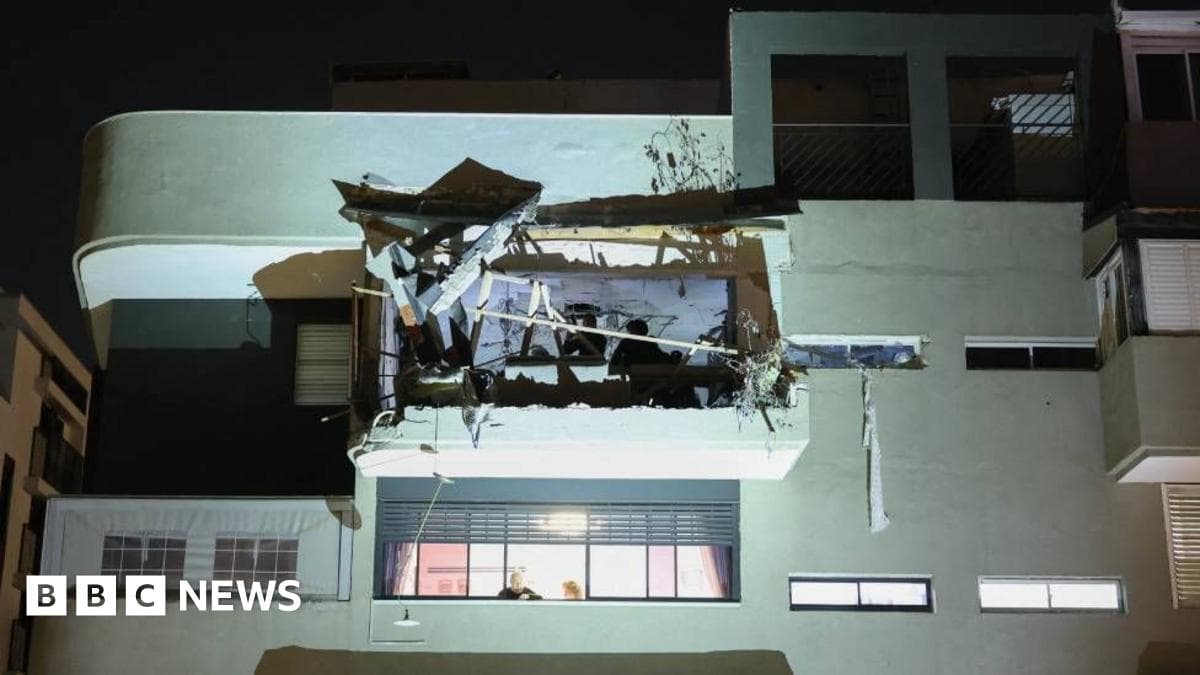
Iran Attacks Israel with Cluster Bomb, Killing Elderly Couple in Ramat Gan
Key Takeaways
- Iran launched a cluster bomb that killed an elderly couple in their top-floor apartment.
- The strike occurred late at night in central Israel.
- Debris showed the bomb's path with a hole in the ceiling.
Attack Details
An Iranian cluster bomb strike in central Israel resulted in the deaths of an elderly couple in Ramat Gan.
“An Iranian cluster bomb punched through the ceiling of an elderly couple’s top-floor apartment in central Israel late at night — and killed them both… An Iranian cluster bomb punched through the ceiling of an elderly couple’s top-floor apartment in central Israel late at night — and killed them both before anyone nearby could do anything to stop it”
The attack occurred late at night when the bomb flew through the ceiling of a residential apartment building.

According to witness accounts, the victims were an elderly couple, one of whom had mobility issues that prevented them from reaching shelter in time.
The strike represents a concerning development in the conflict, as Iran has increasingly shifted toward using cluster munitions.
Cluster munitions pose greater challenges to air defense systems and carry higher risks for civilian populations.
Cluster Munitions Threat
Cluster munitions have emerged as particularly problematic weapons in this conflict due to their indiscriminate nature.
Unlike conventional ballistic missiles or rockets, cluster bombs disperse multiple submunitions across a wide area when they reach their target.
Israeli military spokesman Lt Col Nadav Shoshani explained that each missile carrying cluster bombs contained 20 to 80 munitions that were 'very difficult to stop.'
This technical challenge is compounded by the fact that cluster munitions are internationally controversial weapons.
Many countries have banned their use under the Convention on Cluster Munitions due to their indiscriminate nature and danger to civilians.
Human Impact
The human impact of the strike was vividly captured by eyewitness accounts and the physical evidence left at the scene.
“An Iranian cluster bomb punched through the ceiling of an elderly couple’s top-floor apartment in central Israel late at night — and killed them both… An Iranian cluster bomb punched through the ceiling of an elderly couple’s top-floor apartment in central Israel late at night — and killed them both before anyone nearby could do anything to stop it”
Sigal Amir, who lived next door to the deceased couple, provided a harrowing description of the moment the bomb struck.
'We heard three noisy interceptions, but on the fourth one, we knew it was our house,' she recounted.
'There was a massive boom and I felt a pain in my ear from the blast.'
Amir described how the neighbors' door was blown off and their house was filled with dust 'like snow.'
The physical evidence documented by the BBC at the scene told a grim story: a large hole in the ceiling where the bomb punched through.
Shrapnel holes across the back walls showed the force of the explosion.
A walking frame lay upended on the floor under the ash-covered furniture and rubble.
Civilian Vulnerabilities
The strike exposes critical vulnerabilities in civilian protection systems, particularly for vulnerable populations.
Safe rooms, while often lifesaving, are only effective for those who can access them in time.
The elderly couple's inability to reach shelter due to mobility issues underscores how certain populations face categorically different levels of risk.
This vulnerability extends beyond the elderly to include people with disabilities, young children, and others with limited mobility.
The strike represents a grim reminder that technological defenses cannot fully protect all citizens.
Significant gaps remain in protection for society's most vulnerable members.
Strategic Implications
The use of cluster munitions by Iran marks a significant escalation in the ongoing conflict between Iran and Israel.
“An Iranian cluster bomb punched through the ceiling of an elderly couple’s top-floor apartment in central Israel late at night — and killed them both… An Iranian cluster bomb punched through the ceiling of an elderly couple’s top-floor apartment in central Israel late at night — and killed them both before anyone nearby could do anything to stop it”
Iran has increasingly shifted toward using more cluster munitions as the war has progressed.
This reflects both tactical adaptations and strategic messaging in the conflict.
The fact that cluster munitions penetrated some of the world's most sophisticated air defense systems raises serious questions.
Israel operates Iron Dome, David's Sling, and Arrow systems, yet cluster munitions proved difficult to stop completely.
The dispersed nature of submunitions means complete protection remains elusive.
This technological challenge will shape future military strategies and civilian defense protocols.
Both sides will continue to adapt their approaches in this evolving conflict.
More on Iran

Israel strikes Iran's Pars gas field as Tehran vows revenge
14 sources compared
Trump threatens to blow up South Pars gas field if Iran attacks Qatar again
10 sources compared

UAE Halts Habshan Gas Facility Operations After Debris From Intercepted Missiles
10 sources compared

Iran Threatens Gulf Energy Facilities After Israel Strikes South Pars Gas Field
11 sources compared