Full Analysis Summary
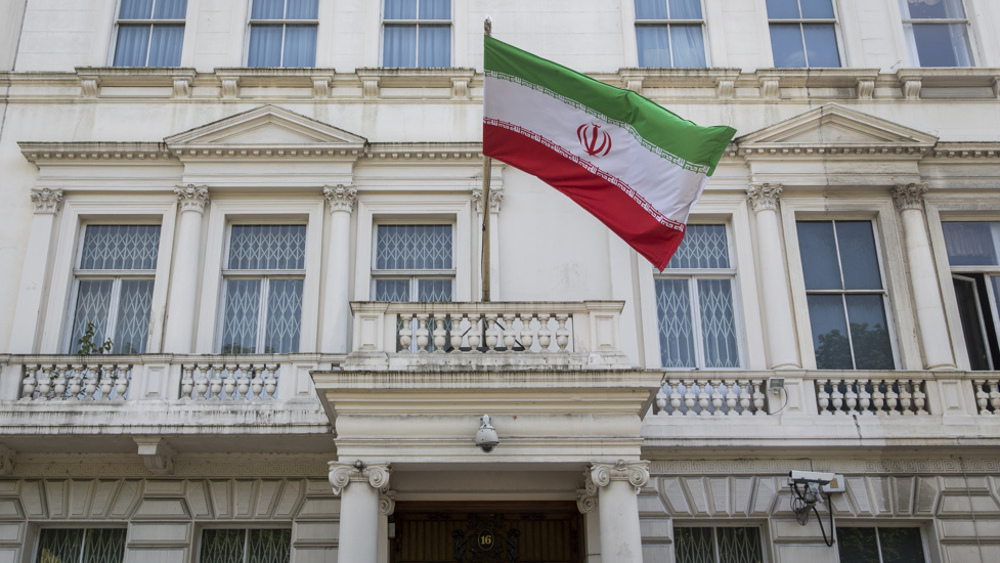
London embassy flag protest
Members of the Iranian diaspora held a protest at the Iranian embassy in Kensington, London.
An activist pulled down Iran's national flag from the embassy and briefly hoisted a pre-1979 'lion and sun' banner from before the 1979 Revolution.
The embassy later restored its state flag and posted that 'Iran's flag is flying high.'
London police made arrests in connection with the demonstration.
Tehran responded by summoning the British ambassador and lodging a formal diplomatic protest.
Coverage Differences
Tone and detail emphasis
Azerbaycan24 (Asian) presents the incident focusing on the embassy flag removal, the diaspora protest’s link to unrest in Iran and immediate policing actions, reporting both the restored flag and arrests; PressTV (West Asian) emphasizes Tehran’s diplomatic reaction and names the British ambassador, highlighting alleged British police failures; Geo News (Asian) frames the embassy incident alongside Tehran’s broader domestic messaging about the protests and casualties. Each source reports quotes or actions rather than stating them as the outlet’s own opinion.
Tehran diplomatic protest
Tehran’s diplomatic protest was led by Alireza Yousefi, identified in sources as a senior foreign ministry official.
Azerbaycan24 described his démarche as a "strong protest" over the "disrespect."
PressTV reports Yousefi condemned what he called British police failures to secure the mission.
He demanded the UK meet its obligations to protect diplomats and urged action against groups and media he accused of promoting violence and terrorism.
Geo News links the summons to what Tehran labelled "interventionist comments" by Britain’s foreign minister.
Coverage Differences
Narrative focus
PressTV (West Asian) quotes Alireza Yousefi directly and foregrounds Tehran’s accusation of British police and media failures; Azerbaycan24 (Asian) highlights the “strong protest” phrasing and notes the restored flag and UK response; Geo News (Asian) intersects the embassy incident with Tehran’s framing of external meddling (“interventionist comments”). All three report Yousefi’s actions or comments as reported statements rather than the outlets endorsing them.
Reporting on UK response
British officials’ responses are reported differently across the outlets.
Azerbaycan24 notes the UK Foreign Office 'denied a formal summons,' and cites ITV reporting the ambassador only 'had a meeting' at the ministry.
PressTV, by contrast, names the envoy as Hugo Shorter and says the British ambassador 'expressed regret and said he would convey Iran’s protest to his government.'
Geo News records that Britain’s foreign office 'had no immediate comment.'
Those variations leave ambiguity about whether Tehran’s move was treated as a formal summons or a lower-level diplomatic meeting.
Coverage Differences
Contradiction/missed information
Azerbaycan24 (Asian) reports the UK Foreign Office denied a formal summons and cites ITV saying the ambassador only “had a meeting”; PressTV (West Asian) reports the ambassador by name and that he “expressed regret” and would convey the protest; Geo News (Asian) says Britain’s foreign office had “no immediate comment.” This shows a factual discrepancy in how the UK response and the level of diplomatic engagement are portrayed — the sources are reporting different statements from UK entities or different outlets about the same event.
Media coverage of Iran unrest
The embassy incident is presented against the backdrop of wider unrest in Iran.
Azerbaycan24 situates the diaspora protest in support of nationwide unrest that began on Dec. 28 after a currency collapse drove up food and staple prices and escalated into violent clashes with security forces.
Geo News underscores Tehran's domestic messaging, with officials urging families to keep children from joining protests and labeling some demonstrators 'rioters and terrorists' who they say 'behead and kill,' while state TV showed funeral processions for security personnel killed in the unrest.
PressTV's coverage focuses on the diplomatic fallout and security of the mission rather than the domestic casualty counts.
Coverage Differences
Tone and narrative emphasis
Azerbaycan24 (Asian) emphasizes economic triggers and the diaspora’s link to unrest; Geo News (Asian) highlights Tehran’s harsh characterization of some protesters and the funerals for security forces; PressTV (West Asian) centers on the diplomatic repercussions and security failings rather than domestic casualty reporting. Each outlet thus selects different aspects of the same broader story to foreground.
Outlet framing comparison
The three outlets present overlapping facts but place emphasis on different elements.
Azerbaycan24 emphasizes the diaspora protest, the restored flag, and the UK's denial of a formal summons.
PressTV foregrounds Tehran's complaint, names the ambassador Hugo Shorter, and quotes Iran's accusation of police failures.
Geo News situates the embassy episode alongside Tehran's domestic claims of external interference and reports on casualties and funeral processions.
These differences reflect outlet perspectives: PressTV leans into Iranian diplomatic framing, while the Asian outlets give more space to both the diaspora action and Tehran's domestic narrative.
The coverage leaves some factual ambiguity about the British side's exact response.
Coverage Differences
Synthesis/Tone and source influence
This paragraph explicitly contrasts source types: PressTV (West Asian) emphasizes Iran’s diplomatic framing and security criticisms, while Azerbaycan24 and Geo News (both Asian) combine reporting on the diaspora action with Tehran’s domestic narrative and UK response. The paragraph notes that discrepancies about whether a formal summons occurred are present across the sources and that each outlet reports statements (quotes) or actions rather than asserting the outlet’s own view.