
Iran War Pushes Up Fuel Prices, Ethiopian Airlines Cancels 100 Flights Weekly
Key Takeaways
- Iran war drives up global jet fuel prices and disrupts supply.
- Gulf energy hub status magnifies spillovers from Iran war.
- African economies face losses and disruptions from the fuel shock.
Fuel shock hits airlines
The war in Iran is driving a sharp rise in global oil and jet fuel prices, and that fuel shock is hitting African airlines through higher operating costs and widespread flight disruptions.
“- Africa’s aviation sector is under pressure as the war in Iran drives a sharp rise in global oil and jet fuel prices”
Business Insider Africa says the aviation sector is under pressure as “the war in Iran drives a sharp rise in global oil and jet fuel prices,” and it links the disruption to cancellations and rerouting.
It reports that Brent crude was trading near $98 per barrel in early Wednesday trading, reflecting a rise of more than 30% since the onset of hostilities, citing Reuters.
Ethiopian Airlines is described as one of the hardest hit, with weekly losses of about $137 million tied to cancellations, according to Lemma Yadhecha, the airline’s business manager.
Yadhecha said, “The airline has cancelled more than 100 flights a week… and we have lost about $137 million in a week,” framing the losses as a direct result of the crisis.
The article also says uncertainty persists even after a ceasefire announcement briefly raised hopes of stabilisation, and it adds that Willie Walsh, head of the International Air Transport Association, said restoring fuel supply chains could take months due to disruptions in Middle Eastern refining capacity.
How the chokepoint transmits risk
Beyond airlines, the economic mechanism described in Economics Observatory is rooted in the Strait of Hormuz as a “chokepoint” for global energy flows.
It says around “20 million barrels of oil pass every day – roughly one-fifth of global petroleum consumption,” and it describes the corridor as linking major producers such as Iraq, Kuwait, Saudi Arabia and the United Arab Emirates to global markets.
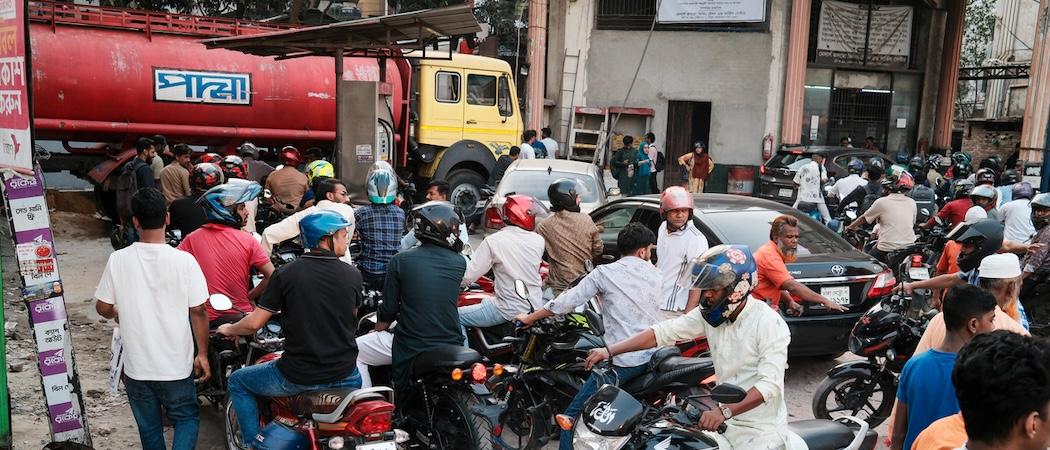
The article emphasizes that even limited disruptions can trigger large movements in global energy prices because energy supply is concentrated through a single geographical passage.
It also ties this to developing economies already adjusting after the Russia-Ukraine war, noting that prior to 2022 Russia and Ukraine together accounted for a large share of global wheat, maize and sunflower oil exports.
Economics Observatory says disruptions to Black Sea shipping routes triggered a sharp rise in global food prices, with the FAO Food Price Index reaching record highs in 2022, and it adds that costs remain elevated relative to pre-pandemic levels.
It argues that while there has not yet been a sustained full closure of the Strait of Hormuz, there have been increased risks to maritime transport, including periods when tanker traffic experienced decline or rerouting and shipping insurance costs rising sharply, “increasing by more than 1,000% in some cases.”
The piece further explains that oil markets respond strongly to geopolitical risk, describing Brent crude prices as highly volatile with prices ranging from $85 to $120 per barrel over short periods, and it frames the key feature as “increased volatility” rather than only higher prices.
Imported inflation and policy strain
Semafor frames the Iran war’s impact on Africa as a “lag effect” that works through energy, fertilizer, and shipping costs, disrupting growth even after earlier gains.
“Yinka’s view Sub-Saharan Africa entered 2026 with its fastest economic growth in a decade but that momentum has been upended by the disruption in fuel supply caused by the US and Israeli war with Iran”
It says Sub-Saharan Africa entered 2026 with its fastest economic growth in a decade, but that momentum has been “upended by the disruption in fuel supply caused by the US and Israeli war with Iran.”
Semafor reports that last week the International Monetary Fund trimmed its 2026 outlook for Africa to 4.3%, “30 basis points down from its earlier forecast,” and it describes the sharper signal as the risk that output could contract by twice as much across the region in a prolonged conflict scenario.
It quotes Standard Chartered Bank’s Africa CEO Dalu Ajene saying, “I think the GDP impact could be deeper as the war becomes protracted,” linking the concern to higher energy, fertilizer, and shipping costs rippling through fragile economies.
Semafor also describes how “imported inflation” is already visible, saying oil exporters may enjoy a temporary windfall while most African economies, reliant on imported fuel, are “reeling.”
It reports that in Ethiopia, Prime Minister Abiy Ahmed urged citizens to ration fuel, and it describes South Africa’s President Cyril Ramaphosa calling on the international community to “redouble efforts” toward restraint and adherence to international law.
The article adds that African finance ministers in Washington were “scrambling to secure financing as conditions tightened,” and it characterizes the gains of 2025 as “hard won,” as the IMF noted.
Semafor’s narrative connects the external shock to domestic economic anxiety by describing resilience as “once again an urgent test.”
Tourism and household losses
Business Insider Africa extends the impact beyond airlines into tourism and local revenue, describing how flight disruptions and higher costs are reaching businesses that depend on air connectivity.
It says the crisis is “spilling into tourism,” with businesses reporting “declining bookings and revenue losses,” and it gives a specific example from South Africa.
Cape Town-based tour operator Emraan Roode told the outlet, “I’ve lost between $21,000 and $30,000 over the past few months due to the war,” and he attributed the losses to “cancellations and reduced bookings from international clients.”
The same article links the airline disruptions to operational changes such as rerouting, describing how Kenya Airways is rerouting more European passengers through its Nairobi hub to bypass traditional Gulf transit points.
It quotes Kenya Airways chief executive George Kamal saying the airline is “leveraging the disruption to reposition its network.”
In the broader aviation picture, Business Insider Africa quotes AviationGhana managing partner Dominick Andoh saying the spike has already altered how African airlines procure fuel, including that “It has affected how much African carriers purchase aviation fuel for their operations.”
The outlet also reports that Andoh said “The prices of tickets have gone up,” and it adds that fuel surcharges on tickets sold since the war broke out, especially in April, have risen by various percentages.
The tourism and household angle is reinforced by Economics Observatory’s description of how fuel price increases propagate quickly into food systems through higher costs of transport, fertiliser and production, and it warns that rising food prices reduce real incomes, increase poverty rates and heighten malnutrition risks.
Volatility, risk premium, and next steps
Across the sources, the shared theme is that the Iran war’s economic effects are transmitted through volatility and risk premiums rather than only through direct supply stoppages.
“The Gulf region remains central to the global energy system”
Economics Observatory says there has not yet been a sustained full closure of the Strait of Hormuz, but it describes “increased risks to maritime transport,” including tanker rerouting and shipping insurance costs rising sharply, “increasing by more than 1,000% in some cases.”
It adds that this “war-time risk premium” raises the effective cost of transporting oil, even when physical supply remains available, and it describes oil markets as responding strongly to geopolitical risk with Brent crude prices ranging from $85 to $120 per barrel over short periods.
Business Insider Africa similarly describes uncertainty persisting even after a ceasefire announcement, and it quotes Willie Walsh saying restoring fuel supply chains could take months due to disruptions in Middle Eastern refining capacity.
The aviation article also includes a warning from Nigerian billionaire Aliko Dangote at the Semafor World Economy summit in Washington, DC, saying, “The majority of African airlines won’t be able to survive” the current spike in fuel costs.
It also reports that airlines are adjusting strategies, including Kenya Airways rerouting through Nairobi and analysts discussing measures such as fuel hedging and stockpiling, even as the conflict continues.
Economics Observatory adds that governments often intervene through subsidies, but that comes at a significant fiscal cost that can reduce spending on social services, while also noting that persistent exposure to external shocks can undermine economic growth by discouraging investment through higher interest rates aimed at curbing attendant inflation, worsening fiscal balances and increasing debt burdens.
Semafor’s framing of the “lag effect” adds that the IMF warned output could contract by twice as much across the region in a prolonged conflict scenario, and it quotes Dalu Ajene that the GDP impact could deepen as the war becomes protracted.
More on Iran

Trump Says U.S.-Iran Memorandum Will Be Signed Sunday, Strait of Hormuz Reopens
10 sources compared

Donald Trump Says U.S.-Iran Deal Will Be Signed Sunday, Strait of Hormuz Reopening
16 sources compared

Trump Says U.S.-Iran Memorandum Will Be Signed Sunday as U.S. Shoots Down Iranian Drones
11 sources compared

Donald Trump Says U.S.-Iran Memorandum Will Be Signed Sunday, Strait of Hormuz To Reopen
12 sources compared