Full Analysis Summary
Iran internet blackout protests
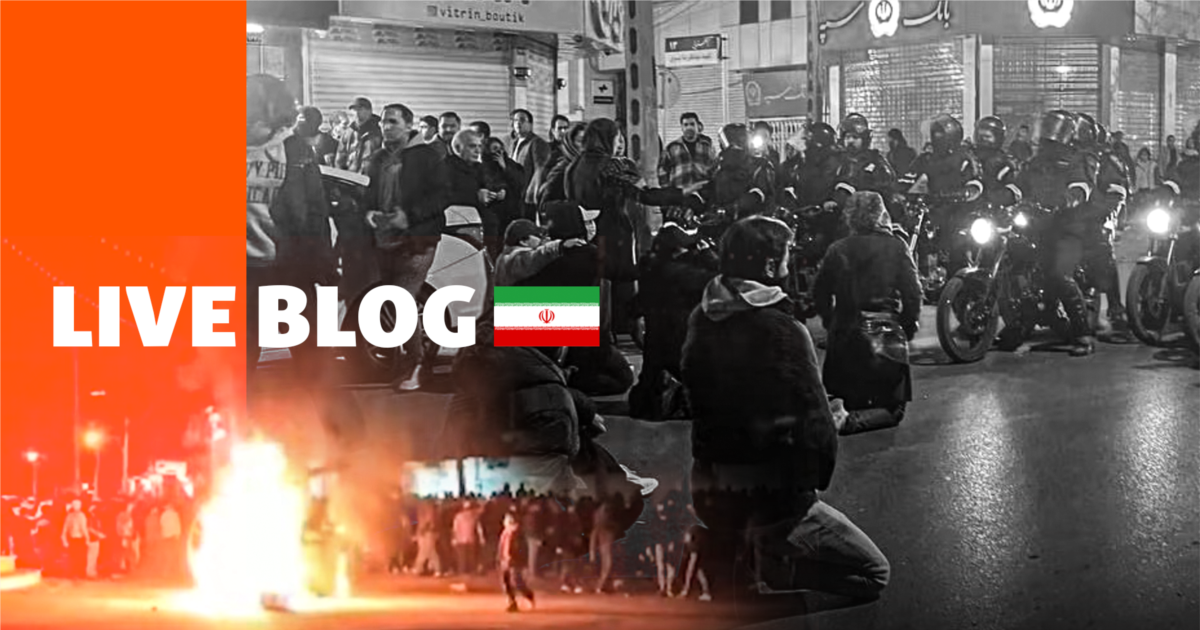
Iran has imposed a near-total nationwide internet and telecom blackout amid mass anti-inflation protests that began in late December, a move widely reported as a government effort to stifle demonstrations and limit information flow.
Radio Free Europe/Radio Liberty notes the country was in an 'internet/telecom blackout for its 18th day on Jan. 26' and that officials estimate the outage is costing the economy tens of trillions of rials per day.
NPR frames the disruption as a 'near-total government-ordered internet blackout' used to 'suppress more than two weeks of protests over soaring inflation and a sharp devaluation of the currency,' and reports that only 'about 3% of people in Iran remain online via the satellite service Starlink'.
Hindustan Times' coverage emphasizes regional and geopolitical reverberations, noting U.S. rhetoric about an 'armada' moving toward the region that has 'raised tensions with Tehran'.
Coverage Differences
Tone and emphasis
RFE/RL emphasizes the blackout's duration, economic cost and frames the overall response as a "brutal crackdown" on protests; NPR emphasizes the technical character of the shutdown and the role of satellite access like Starlink in keeping a small part of the population online; Hindustan Times foregrounds geopolitical fallout (U.S. rhetoric) rather than the technical or human-cost aspects. Each source is reporting its own focus rather than quoting another outlet. These differences show RFE/RL concentrating on human and economic impact, NPR on connectivity mechanics and monitoring, and Hindustan Times on diplomatic/military tensions.
Media coverage comparison
Reporting differs on the immediate human toll and how casualties are presented.
RFE/RL cites U.S.-based HRANA that, as of Jan. 26, listed "6,126 confirmed deaths (5,777 protesters, 86 children, 214 government-affiliated forces, 49 other civilians) and another 17,091 deaths 'under investigation'".
RFE/RL describes security-force violence documented by human-rights monitors and social-media footage.
NPR centers coverage on the protests' causes — "soaring inflation and a sharp devaluation of the currency" — and how the blackout limits outside verification.
Hindustan Times does not prioritize casualty figures in the excerpt provided but instead highlights diplomatic exchanges and how external actors are reacting.
The sources therefore offer different focal points: RFE/RL foregrounds casualty counts and rights monitoring, NPR foregrounds technical suppression and economic causes, and Hindustan Times foregrounds geopolitics.
Coverage Differences
Narrative focus / Missed information
RFE/RL reports detailed casualty counts from HRANA and explicitly calls the response a "brutal crackdown," while NPR emphasizes the mechanics of the internet blackout and its role in suppressing evidence without repeating the detailed death toll. Hindustan Times’ snippet omits casualty details and instead reports on geopolitical responses (e.g., U.S. armada remarks and Iran’s diplomatic thanks to India), indicating differing priorities rather than contradiction.
Blackout health and information impacts
The blackout has had immediate public-health and information consequences reported by the outlets.
RFE/RL quotes Iran's Health Ministry via Tasnim that many injured fear hospitals after reports of security raids, that authorities urged people to seek care, and that the ministry reported more than 3,000 recent injured visitors and roughly 13,000 related surgeries.
NPR explains how shutdowns work, how some images and videos still get out, and that scientists are remotely monitoring the country's connectivity, indicating both obstacles to care-seeking and limits to external verification.
Hindustan Times does not detail health-system impacts in the excerpt but highlights how international reactions, such as the U.S. president's rhetoric and India's UN vote, shape the broader diplomatic context around the unrest.
Coverage Differences
Detail emphasis / Omission
RFE/RL provides explicit health-system figures and quotes the Health Ministry urging injured people to seek care; NPR focuses on information flow, monitoring and technical aspects of the blackout; Hindustan Times omits health details and instead reports diplomatic and geopolitical developments. This reflects each source’s editorial emphasis rather than a factual contradiction.
International reactions overview
International reactions and security movements are threaded through the coverage but emphasized differently.
RFE/RL reports that the U.S. has moved warplanes, air defenses and an aircraft carrier to the region and notes the UAE urged diplomacy and would not allow its territory to be used for hostile action.
Hindustan Times cites former President Trump's 'armada' remarks as raising tensions and quotes Iran's ambassador to India thanking New Delhi for opposing an expanded UN Human Rights Council probe.
NPR notes that an information blackout limits outside observers' ability to follow and verify events on the ground and international responses, citing the small fraction of people still reachable via Starlink.
Coverage Differences
Narrative / Source focus
RFE/RL lists specific military movements and regional diplomatic comments as part of its timeline; Hindustan Times foregrounds political statements by external leaders and Iran’s diplomatic gratitude to India; NPR highlights the blackout’s effect on external monitoring of these developments. None of these are direct contradictions but represent different narrative angles: RFE/RL on military/diplomatic facts, Hindustan Times on political signaling, NPR on the information environment.
Media coverage comparison
RFE/RL provides the most explicit human-rights framing and casualty counts.
NPR offers a technical explanation of how the blackout works and what limited lines of information remain.
Hindustan Times highlights diplomatic and regional political reactions, including U.S. statements and Iran’s praise for India’s UN vote, to shape the broader context.
The accounts are complementary in some respects and demonstrate differing editorial priorities.
Those priorities are casualty and rights emphasis (Radio Free Europe/Radio Liberty), connectivity and verification emphasis (NPR), and geopolitical/diplomatic emphasis (Hindustan Times).
Where reporting is ambiguous or limited, for example when NPR’s excerpt does not provide HRANA casualty numbers or Hindustan Times omits health and casualty figures, that ambiguity should be noted rather than filled in from other sources.
Coverage Differences
Summary / Editorial emphasis
Each source steers readers to different primary takeaways: RFE/RL toward human-rights violations and casualty tallies, NPR toward the mechanics of suppression and monitoring challenges, and Hindustan Times toward geopolitical consequences and diplomatic choices. These are differences of emphasis rather than factual contradiction; when information is absent or ambiguous in one source (e.g., casualty counts in Hindustan Times), that absence is noted rather than assumed to mean a different factual picture.