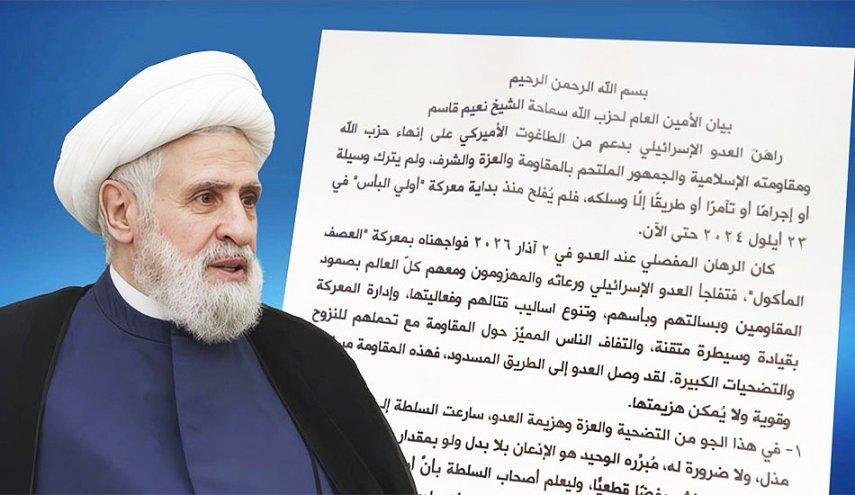
Hezbollah Secretary-General Naim Qassem Rejects Direct Negotiations With Israel Under Fire
Key Takeaways
- Qassem rejects direct negotiations with Israel, deeming them irrelevant and of no concern.
- Resistance remains ready, staying in the field to respond to violations.
- Authority should return to the people, safeguarding Lebanon's rights and sovereignty.
Hezbollah rejects direct talks
Sheikh Naim Qassem, the Secretary-General of Hezbollah, said in a statement that Hezbollah will continue its war against Israel “without borders,” rejecting any negotiation “under fire” and calling direct talks an “imposition of surrender.”
“Monday, 27/04/2026 ArEnFrEs [](http://almanar”
In a separate statement carried by Al-Manar TV Lebanon, Qassem said: “Let it be made unequivocally clear that direct negotiations with the enemy and their outcomes are, for us, as if they do not exist and of no concern whatsoever.”
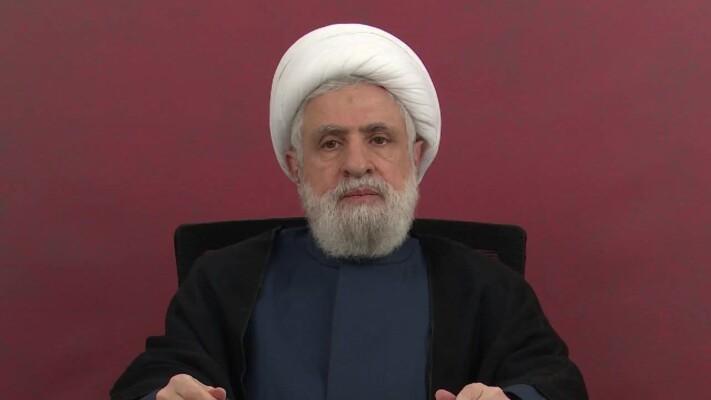
PressTV also carried Qassem’s dismissal of direct negotiations, saying “We categorically reject direct negotiations, and those in power must know that their conduct will neither benefit Lebanon nor benefit themselves.”
The same line of argument was repeated in coverage by قناة العالم, which said the authorities must “halt direct negotiations with the Israeli enemy and adopt indirect ones.”
Across the outlets, Qassem tied the rejection of direct negotiations to a broader insistence that the “entry point and the solution are the five points” that must be achieved first.
In Al-Manar’s live feed, the statement appeared alongside reports from south Lebanon, including “shelling by Israeli Merkava targeting the border town of Bint Jbeil” and a “demolition operation” in Taybe, as the political message was delivered.
Ceasefire linked to Iran
PressTV framed Hezbollah’s position on ceasefire and negotiations around Iran’s role in talks, saying Hezbollah’s secretary general stated that “Iran’s insistence on ending Israeli aggression against Lebanon during indirect negotiations with Washington was the decisive factor that made a ceasefire with Israel possible.”
Sheikh Naim Qassem said: “A ceasefire would not have been achieved without Iran’s position during the Pakistan talks,” and he described Tehran’s push for a Lebanon ceasefire as “a major condition for any progress in the talks and the start of the second round of negotiations.”
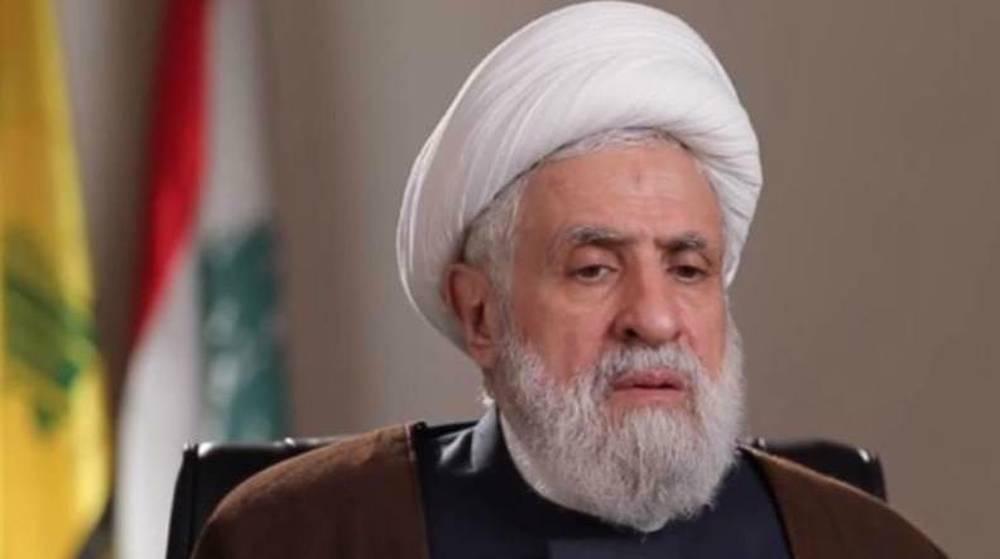
PressTV also said that this pressure “finally forced US President Donald Trump and the Tel Aviv regime to comply on this issue,” while also asserting that Israel was trying “to continue the war on Lebanon despite the ceasefire in Iran.”
In the same PressTV coverage, Qassem said: “The resistance continues to be strong and cannot be defeated, and the enemy was surprised by the steadfastness of the fighters,” and he added that Hezbollah would “respond to Israeli aggression and confront it.”
Al-Manar TV Lebanon’s live feed placed Qassem’s remarks in the same day’s context of ongoing violence in south Lebanon, reporting “shelling by Israeli Merkava targeting the border town of Bint Jbeil” and “demolition operation” in Taybe.
Elnashra also carried Qassem’s insistence that the “temporary ceasefire could not have happened without the resistance fighters' jihad on the noble southern fronts,” describing it as “a legendary performance that astonished the world.”
Five points and no trust
Qassem’s statements across outlets converged on a set of conditions he said must come first, with Elnashra and قناة العالم both spelling out the “five points” as a framework for any next step.
“Hezbollah’s secretary general says Iran’s insistence on ending Israeli aggression against Lebanon during indirect negotiations with Washington was the decisive factor that made a ceasefire with Israel possible”
In Elnashra, Qassem said the “next step is to implement the five points: a permanent halt to aggression in all of Lebanon—air, land, and sea—an Israeli withdrawal from the occupied territories to the borders, the release of prisoners, the return of residents to their villages and towns up to the borders, and reconstruction with international and Arab support and national responsibility.”
He added that “a ceasefire means a complete halt to all hostilities,” and because Hezbollah “do[es] not trust this enemy,” “the fighters will stay in the field with their hands on the trigger, and they will respond to each violation of aggression accordingly.”
In قناة العالم, the same five-point logic was presented as “the entry point and the solution are the five points to be achieved before anything else: stopping the aggression by land, sea, and air; Israel’s withdrawal from the occupied territories; the release of prisoners; the return of residents to all their villages and towns; and reconstruction.”
That outlet also argued that the resistance is “a reaction to the aggression rather than a cause,” and it said “the weapon of the resistance is to deter the aggression.”
PressTV carried a parallel warning that Hezbollah would not return to what existed before March 2, with Qassem stressing: “We will not return to what existed before March 2. We will respond to Israeli aggression and confront it.”
Numbers, casualties, and attacks
The sources also embedded specific casualty and attack figures within Hezbollah’s messaging and the broader reporting of the conflict.
PressTV stated that “According to Lebanese authorities, nearly 2,500 people have been killed in Lebanon since the Israeli regime launched its renewed offensive following Hezbollah’s 2 March operation.”
In قناة العالم, Qassem’s statement included a detailed account of “the bloody Wednesday of the Israeli aggression on Beirut and all of Lebanon,” saying it involved “200 airstrikes in ten minutes, more than 300 civilians martyred and more than 1,200 wounded.”
Elnashra similarly described the scale of military imbalance and referenced the “massing one hundred thousand soldiers on the border,” while also asserting that Hezbollah could not be reached “nor in 45 days in the Battle of the Devoured Hay.”
Al-Manar’s live feed, meanwhile, reported immediate incidents in south Lebanon, including “shelling by Israeli Merkava targeting the border town of Bint Jbeil” and “demolition operation in the border town of Taybe,” placing Qassem’s political statements alongside active battlefield updates.
The same Elnashra coverage also referenced a “Battle of the Devoured Hay” and said the first week plan failed to reach “the Litani,” while PressTV tied the negotiation timeline to “On March 2” and to the “Iran-US ceasefire on 8 April.”
State Department text and blame
Elnashra and قناة العالم both described how Hezbollah viewed official U.S. documentation and Lebanese government actions during the ceasefire period.
“As Sheikh Qassem stated in his statement, this authority should not be the authority of a faction but the authority of the people, based on the consensus on which the Taif Agreement—and our current constitution—was built”
In Elnashra, Qassem said Hezbollah “read a publication issued by the U.S. State Department titled: 'Ceasefire Agreement Between Lebanon and Israel—April 2026,' issued after the ceasefire took effect,” and he argued that it “means nothing in practical terms, but it is an insult to our country Lebanon that the text was dictated by America and speaks on behalf of the Lebanese government.”
He quoted the document’s phrasing that “The Government of Israel and the Government of Lebanon have agreed to the following text,” and he said “everyone knows that the Government of Lebanon did not meet, nor did it issue approval for this statement.”
In قناة العالم, Qassem similarly criticized a Washington meeting and the U.S. State Department’s output, saying “the authorities resisted, so Tuesday was a day of shame and dishonor in Washington at a direct meeting with the enemy; afterward, the U.S. State Department issued an agreement noting the Lebanese government’s signature on it without meeting.”
He added that the agreement “a ceasefire by Lebanon, and giving Israel a free hand to continue the aggression,” and he asserted that “the Israeli enemy justifies that the Lebanese authorities are not concerned with stopping the ceasefire!”
PressTV also included Qassem’s broader critique of the Beirut government, saying he “sharply criticized the Beirut government for making concessions to the occupying Tel Aviv regime,” and he urged officials to abandon the initiative seeking direct talks in favor of indirect negotiations.
More on Lebanon
Eastern Chad Fighting Kills 42 After Water Well Dispute Between Rival Families
10 sources compared

Israeli Strikes Kill 14 in Southern Lebanon as IDF Targets Hezbollah Sites
33 sources compared
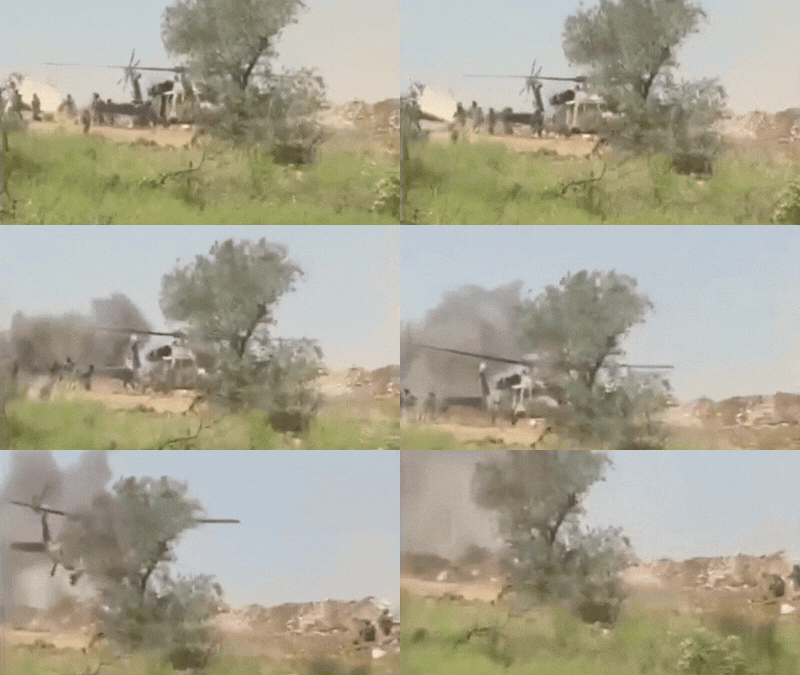
Hezbollah Drone Strike Kills Israeli Sergeant Idan Fooks in Taybeh, Southern Lebanon
10 sources compared

Israeli Strikes Kill 14 In Southern Lebanon, IDF Issues Evacuation Warnings
47 sources compared