
Israeli Strikes Kill 14 in Southern Lebanon as IDF Targets Hezbollah Sites
Key Takeaways
- Israeli airstrikes in southern Lebanon killed 14 people and wounded 37.
- Two children and two women were among the dead.
- This marked the deadliest day since the ceasefire amid ongoing accusations of violations.
Ceasefire, Then Strikes
Israeli strikes in Lebanon on Sunday killed 14 people, Lebanon’s Ministry of Health said, including “two children and two women,” and injured 37 others.
The BBC reported that an Israel Defense Forces (IDF) spokesperson issued evacuation warnings for several villages in southern Lebanon, writing that residents “must evacuate” immediately and that staying would be “endangering their life”.
The IDF later said it carried out “artillery and aerial strikes” targeting Hezbollah operatives and sites in southern Lebanon that it claims were used “to advance attacks against IDF soldiers”.
The Guardian also described the day as “the deadliest day since a ceasefire between Israel and Hezbollah came into force over a week ago,” citing the same health ministry toll of 14 dead and 37 wounded.
Kurdistan24 and Daily Sabah similarly tied the spike to a fatal drone strike on IDF troops and said the raids that followed killed at least 14 in Lebanon.
In parallel, Hezbollah launched three drones towards Israel, the IDF reported, which it said were intercepted by Israel’s air force before they crossed the border, according to the BBC.
The BBC further said the two countries remain under a “precarious semi-permanent ceasefire” that took effect on 16 April and was extended by three weeks on Thursday last week.
Drone Death in Taybeh
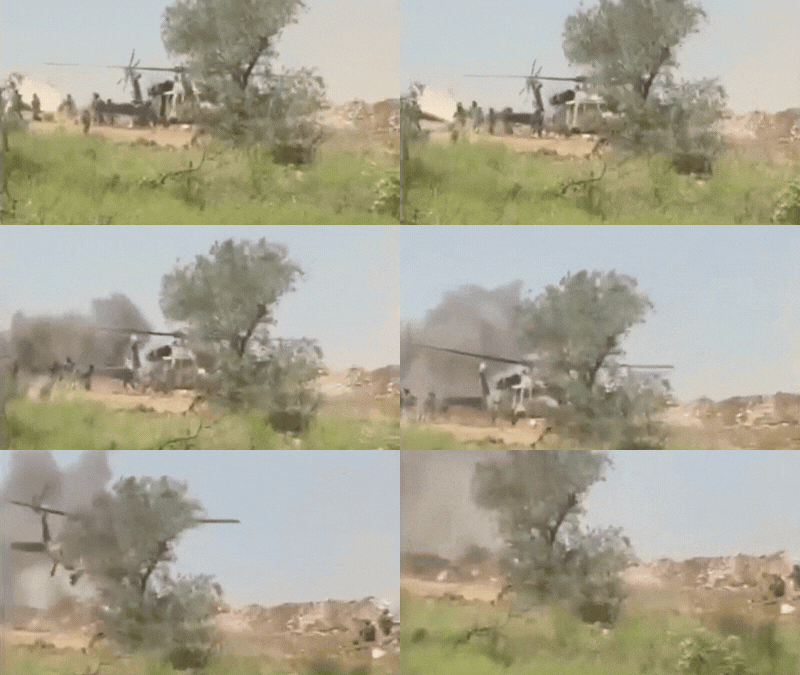
The Sunday escalation was catalyzed by a Hezbollah explosive drone attack in southern Lebanon that killed an IDF soldier and wounded others, with the incident occurring in the town of Taybeh.
Kurdistan24 said the strike happened in Taybeh, “situated within the Israeli-declared security zone,” and reported that Sgt. Idan Fooks, 19, of the 7th Armored Brigade’s 77th Battalion, was killed while his unit attempted to repair a disabled tank.

Kurdistan24 added that an IDF probe found a Hezbollah explosive-laden drone struck the group during the repairs, and that as an Israeli Air Force helicopter arrived to evacuate the wounded, Hezbollah launched two additional drones.
The Media Line similarly described that “a Hezbollah drone packed with explosives struck beside them” while troops worked to repair a tank near Taybeh, and said one additional drone was intercepted while the other landed nearby without causing further casualties.
JNS.org identified the same soldier as Sgt. Idan Fooks, 19, and said he was “the third Israeli soldier to be killed in Southern Lebanon since a ceasefire came into effect on April 17, and the first to be killed in a direct Hezbollah attack during the truce”.
The BBC also reported that a “19-year-old IDF soldier had been killed and six others injured by a Hezbollah drone attack in Lebanon”.
In response to the drone strike, the IDF said it carried out “artillery and aerial strikes” and targeted Hezbollah operatives and sites, while Hezbollah said it would not stop attacking Israeli troops inside Lebanon and towns in northern Israel as long as Israel continued “ceasefire violations”.
Netanyahu’s ‘Freedom of Action’
Israeli Prime Minister Benjamin Netanyahu framed the strikes as enforcement of the ceasefire’s terms and as a response to Hezbollah, speaking at a cabinet meeting on Sunday.
The BBC reported that Netanyahu said the IDF is “active, and it is acting with force” in Lebanon, stating Hezbollah’s actions are “disintegrating the ceasefire”.
He added, “We are acting vigorously according to the rules we agreed upon with the United States, and incidentally, with Lebanon as well,” and said the approach means “freedom of action, not only to respond to attacks, which is obvious, but to thwart immediate threats and also to neutralise emerging threats”.
The Guardian quoted Netanyahu telling the cabinet meeting, “Hezbollah’s violations are, in practice, dismantling the ceasefire,” and included his line that “we act vigorously according to the rules we agreed upon with the United States, and also, by the way, with Lebanon.”
Daily Sabah likewise reported Netanyahu saying the military was “vigorously” targeting Hezbollah and quoting him on “freedom of action” and pre-emption, including “This means freedom of action not only to respond to attacks ... but also to pre-empt immediate threats and even emerging threats”.
Hezbollah’s response, as quoted by The Guardian, was that it would not wait for diplomacy that has “proven ineffective” or rely on Lebanese authorities that had “failed to protect the country.”
The BBC also reported that Hezbollah said it would not cease attacks as long as Israel continued “ceasefire violations,” while the IDF repeated evacuation warnings for towns beyond the “yellow line” and said it struck Hezbollah “military structures”.
Evacuation Zones and Towns
Across Sunday’s reporting, the “yellow line” and evacuation warnings shaped how the strikes were experienced on the ground, with multiple outlets describing Israeli warnings for residents and the areas targeted.
The BBC said the IDF issued evacuation warnings for several villages in southern Lebanon and later said it struck Hezbollah “military structures” overnight, while The Guardian described Israeli troops operating inside what they labelled a “yellow line,” a ribbon of Lebanese territory “around 10km deep” along the border.

The Guardian said the Israeli military repeated the warning on Sunday, telling residents to leave seven towns beyond the “buffer zone” it occupied before the ceasefire, and it specified that the towns are north of the Litani River and the zone occupied by Israeli troops.
Kurdistan24 listed the “flagged villages” as Mayfadoun, Shoukine, Yohmar, Arnoun, Zawtar al-Sharqiyah, and Kfar Tebnit, and said that in Zawtar al-Sharqiyah the NNA reported an Israeli strike destroyed a mosque and another religious building after an earlier drone strike on a motorcycle.
TRT World similarly said the Lebanese state news agency reported demolitions targeting homes and infrastructure between the towns of Yaroun and Bint Jbeil, and described strikes in the Tyre district including Burj Qallawiyeh and gunfire toward Mansouri and Bayt al-Sayyad.
Daily Sabah reported heavy traffic heading north as people fled following the warning and said the NNA reported strikes in Kfar Tibnit and Zawtar al-Sharqiyah, including destruction of a mosque and another religious building.
WAFA’s report, citing the Lebanese Ministry of Health, focused on the same 14-death and 37-injury toll and said the strikes were on Sunday, while Middle East Monitor added that the toll related to strikes carried out on 26 April and described a “scorched earth” policy aimed at establishing a buffer zone to prevent more than one million displaced Lebanese from returning to their homes.
What Comes Next
The stakes of Sunday’s violence were laid out in both the immediate military posture and the diplomatic uncertainty around the ceasefire.
“Israeli army carries out demolitions of homes and infrastructure in southern Lebanon Naim Berjawi 26 April 2026•Update: 26 April 2026 Türkiye, İstanbul At least 14 people, including two children, were killed and 37 others injured on Sunday in a series of Israeli airstrikes targeting multiple areas in southern Lebanon, marking an escalation since a ceasefire took effect on April 17”
The BBC said the ceasefire took effect on 16 April and was extended by three weeks on Thursday last week, and it quoted Netanyahu saying Israel would act “according to the rules we agreed upon with the United States,” while Hezbollah and Israel continued to accuse each other of violating the agreement.

Kurdistan24 described the “recent spike in violence” as signaling a “precarious collapse of the diplomatic efforts led by the United States to stabilize the border,” even after the ceasefire was extended by three weeks.
The Guardian reported that the US-mediated ceasefire started on 16 April and has been extended to mid-May, while also noting that both sides continued to fire and trade blame over breaches.
In parallel, the BBC reported that Iran’s Foreign Minister Abbas Araghchi returned to Pakistan on Sunday to set out Tehran’s framework for resuming peace negotiations with Washington, and said he was expected to meet Russian President Vladimir Putin in Moscow on Monday.
The BBC also said that shortly after Araghchi left for Oman, Trump announced he was cancelling a planned trip by special envoy Steve Witkoff and his son-in-law Jared Kushner to Islamabad, and it described the White House position that Iran wanted to talk but Tehran insisted that no direct negotiations with the US were ever scheduled.
JNS.org added that Netanyahu issued a statement mourning Sgt. Idan Fooks and said “Idan fought with bravery and courage alongside his comrades to restore security to the residents of the North, and this is what we shall continue to do.”
More on Lebanon

Eastern Chad Fighting Kills 42 After Water Well Dispute Between Rival Families
10 sources compared
Hezbollah Drone Strike Kills Israeli Sergeant Idan Fooks in Taybeh, Southern Lebanon
10 sources compared

Israeli Strikes Kill 14 In Southern Lebanon, IDF Issues Evacuation Warnings
47 sources compared
Israel Kills Six Hezbollah Fighters in Southern Lebanon After Ceasefire Extension
13 sources compared