Protests31 January, 20262 min read
Iranian President Accuses U.S., Israel and Europe of Arming and Inciting Anti‑Regime Riots
This article is an automated aggregation of coverage from news outlets. Our editorials offer in-depth analysis curated by the NewsCord team.
Pezeshkian accused the United States, Israel and European governments of provoking nationwide protests. Pezeshkian alleged foreign actors supplied equipment, resources and support to inflame unrest.

7 outlets told this the same way.
Accusations over protest unrest
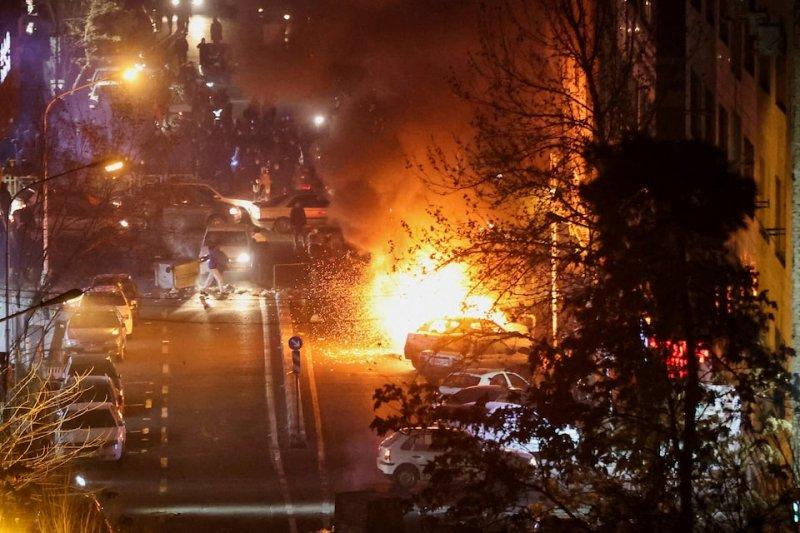
Iranian President Masoud Pezeshkian publicly accused the United States, Israel and European leaders of actively fomenting the nationwide protests that began in late December.
“Pezeshkian told state TV that foreign powers ‘supplied resources’ and sought to ‘tear this country apart,’ saying the unrest was more than a spontaneous social protest.”
He said foreign powers 'supplied resources' to try to 'tear this country apart.'

Pezeshkian named former U.S. President Donald Trump and Israeli Prime Minister Benjamin Netanyahu as part of those he blamed, and made the comments on state television as the two-week demonstrations over soaring inflation and living costs largely subsided after a violent crackdown.
Disputed protest fatalities
Pezeshkian said the immediate context was a two-week wave of demonstrations over high inflation and living costs that began in late December and was met with a forceful government crackdown. Rights group HRANA reports about 6,563 killed, including approximately 6,170 protesters and 214 security personnel.
Iranian officials, including Foreign Minister Abbas Araqchi, have given a lower total of roughly 3,100 fatalities and say about 2,000 of the dead were security forces. The discrepancy in figures is reported across outlets and underscores competing narratives over the scale of violence.
Iran's strategic stance
Iranian officials, notably Foreign Minister Abbas Araqchi, framed the unrest as not only externally instigated but also as a test of regime stability and of Iran's strategic posture. Araqchi told CNN Türk that Iran will not negotiate over its missile programme and rejected talks that he said would amount to regime-change pressure, while also saying Tehran remains open to regional dialogue and prepared for either negotiations or military confrontation. Several outlets report that the U.S. has conditioned resumed talks on Iran curbing its missile programme—an Iranian red line, according to these reports.
“Araqchi told CNN Turk Iran will not negotiate over its missile program, rejected talks framed as leading to regime change, and said the regime is stable. He also said Iran is prepared both for negotiations or for military confrontation but remains open to regional dialogue.”
Regional diplomacy and tensions
Beyond Tehran’s statements, reporting highlights heightened regional diplomacy and signals of military posture.
Turkish, Emirati and Saudi efforts are described as seeking to avert a U.S.–Iran military clash.

Some outlets cite Israeli media reporting that a U.S. Navy destroyer docked at Eilat amid rising tensions.
Coverage also notes that former U.S. President Trump has voiced support for demonstrators.
U.S. officials say they are reviewing options, though no decision on military action has been reported.
Contested regional reporting
Taken together, regional reporting frames the story as a contested account. Tehran presents the unrest as externally incited sabotage, while international rights monitors report a substantially higher death toll. Outside media point to elevated military signalling and diplomatic manoeuvres.
“Iranian President Masoud Pezeshkian and Foreign Minister Abbas Araqchi accused the U.S., Israel and European countries of exploiting Iran’s economic troubles to provoke and fracture society during nationwide protests that began in late December over high inflation and living costs.”
The three primary sources provided—The Vibes, Latest News from Azerbaijan and The Hindu—largely overlap in factual points but differ in emphasis and sourcing. None of the provided snippets offers independent verification of the casualty discrepancy. One listed source, İlke Haber Ajansı, did not provide usable text in the supplied materials.
