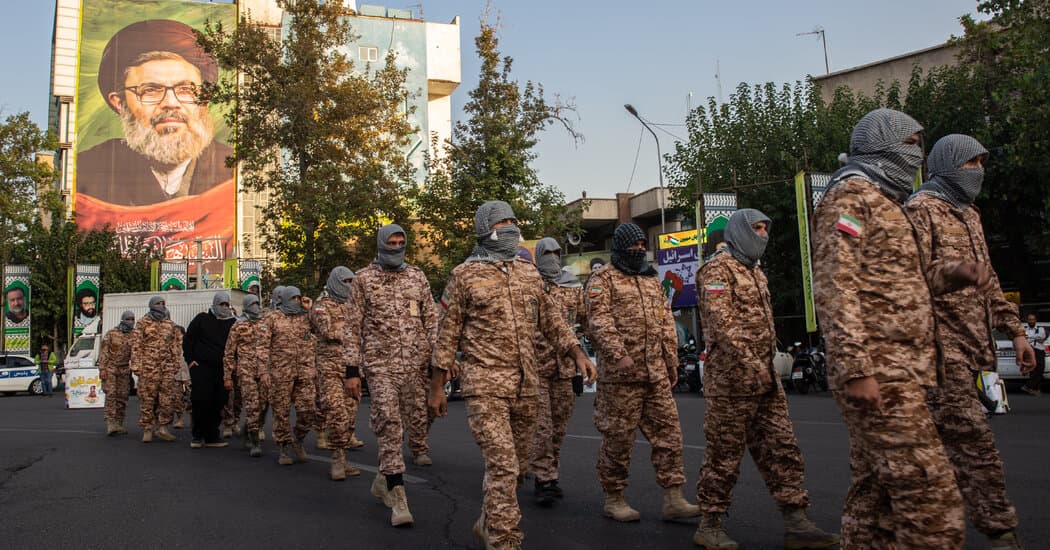
Iran's Revolutionary Guards Deploy Militiamen Across Tehran
Key Takeaways
- Islamic Revolutionary Guards Corps deployed militiamen in Tehran neighborhoods hours after Israeli and American airstrikes.
- Guards wield pervasive military, political and economic clout throughout Iran.
- Their power functions as the main impediment to regime change or political reform.
Rapid Guard deployment
Within hours of the first Israeli and American airstrikes on Iran, militiamen linked to the Islamic Revolutionary Guards Corps (IRGC) deployed across Tehran and other urban centers, appearing in plainclothes with assault rifles to man checkpoints, search cars and cellphones, and line up black anti‑riot vehicles in places like closed schoolyards; analysts and eyewitnesses described these moves as creating an illusion of control for outsiders and fear for residents who might otherwise protest.
“War in theMiddle East Advertisement Supported by With their pervasive military, political and economic clout, the Guards are often considered the main impediment to regime change, or any change, in Iran”
"Within hours of the first Israeli and American airstrikes hitting Iran last weekend, militiamen from the Islamic Revolutionary Guards Corps deployed in neighborhoods across Tehran, the capital, and in most urban centers," stated The New York Times, which added that witnesses saw "men in plainclothes, often armed with Kalashnikov assault rifles, manning checkpoints where they searched cars and cellphones," and that "Black anti‑riot vehicles were lined up in places like closed schoolyards."
IRGC's domestic power
Observers and analysts portrayed the IRGC as the backbone of a militarized Iranian state whose military, political and economic clout make it the primary obstacle to regime change.
President Trump publicly urged the Guards to disarm to bolster popular uprisings, but analysts in the article judged that scenario unlikely given the Guards' entrenched role.
The New York Times described the Guards as "the spine of a militarized state," noting that their "pervasive military, political and economic clout" is often considered the main impediment to regime change, and that while "President Trump has suggested that the Guards drop their weapons to buttress popular support for regime change," analysts called that prospect "highly unlikely."
Historical origins
The article placed the IRGC in historical context, tracing its origins to the aftermath of the 1979 Islamic Revolution when Ayatollah Ruhollah Khomeini distrusted the regular armed forces (Artesh) and founded revolutionary forces to consolidate control.
“War in theMiddle East Advertisement Supported by With their pervasive military, political and economic clout, the Guards are often considered the main impediment to regime change, or any change, in Iran”
The Times cited a remark attributed to Khomeini—"Artesh has the Shah in its blood"—to explain why the Guards were created as a separate force.
The piece noted that in the revolution's early days Khomeini "did not trust the armed forces, known as Artesh," and that this mistrust helped produce revolutionary militias that became institutionalized as the IRGC.
Social control tactics
The reporting emphasized the IRGC's role in social control inside Iran, citing experts who described the Guards and associated militias as instruments used to surveil and intimidate the population during crises.
Saeid Golkar, who authored a book on the Basij militia, told the Times the deployment aimed to "create fear for people so they do not dare come out to the street."
The article detailed tactics — checkpoints, cellphone searches and strategically positioned vehicles in areas seen as less vulnerable to strikes — as part of a pattern of internal control.
Source limitation note
The available snippet of the Times article is incomplete, and the publication appended a retrieval notice indicating trouble loading the full content.
“War in theMiddle East Advertisement Supported by With their pervasive military, political and economic clout, the Guards are often considered the main impediment to regime change, or any change, in Iran”
Because only this article was provided, broader perspectives and corroboration from other outlets are not available here, and readers should be aware the summary is limited to the Times' reporting as supplied.
The article itself notes both eyewitness video evidence and analyst commentary but the remainder of the piece could not be retrieved in the provided snippet, which states: "We are having trouble retrieving the article content. Please enable JavaScript in your browser settings."
More on Iran
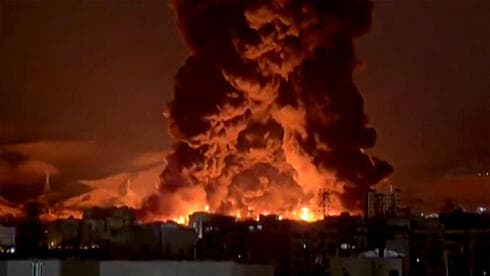
US obliterates military targets on Iran’s Kharg Island, Trump warns
13 sources compared
US Deploys About 2,500 Marines to Middle East After Iran Attacks Gulf Shipping
33 sources compared
FBI Warns of Iranian Drone Plot Based on Unverified Tip; California Says No Credible Threat
10 sources compared

White House Demands ABC Retract Report Claiming Iran Sought To Launch Drone Attacks On California
11 sources compared