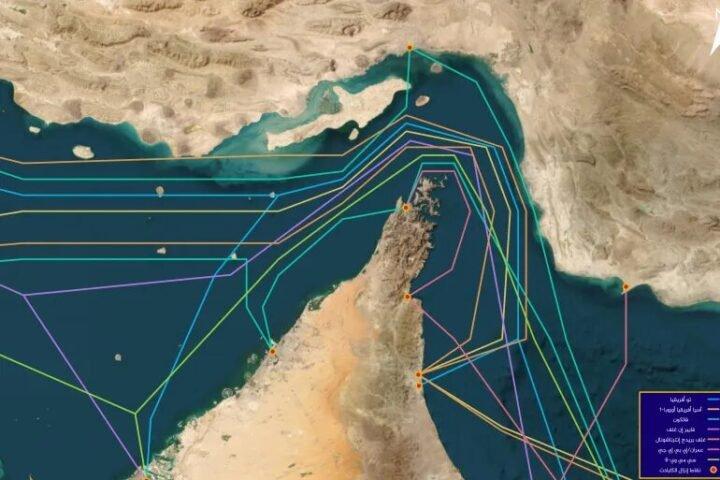
Iran’s Revolutionary Guards Threaten Permit System for Strait of Hormuz Internet Cables
Key Takeaways
- Iran plans to impose transit fees on subsea internet cables crossing the Strait of Hormuz.
- Global tech firms could be charged for using Hormuz cables, per multiple outlets.
- Iran explores regulatory control over critical internet infrastructure as part of its Strait strategy.
Permit system threat
Iran’s Revolutionary Guards threatened to place internet fibre-optic cables passing through the Strait of Hormuz under a “permit system,” as Tehran seeks tighter control over a route for energy, trade and communications.
The threat focused on cables including a branch of the AAE-1 (Asia-Africa-Europe 1) system, with Alan Mauldin of TeleGeography saying, “These cables carry all types of data, from videos, emails and social media traffic to financial transactions and government communications,”.

ECOticias reported that Iran is floating a plan to charge or regulate submarine internet cables through the Strait of Hormuz, and said the proposal could pull Google, Meta, Microsoft, Amazon, telecom operators, banks, and cloud providers into the dispute.
ECOticias also said the Strait of Hormuz is about 24 land miles wide at its narrowest point, and cited the U.S. Energy Information Administration that oil flows through the strait averaged about 20 million barrels per day in 2024.
ECOticias added that Tasnim News Agency identified systems including FALCON, GBI, and Gulf-TGN as cable routes tied to the region, linking data centers across Asia, Europe, and the Middle East.
Digital toll debate
France 24 said Iranian media, citing Fars, reported Tehran intends to impose transit fees on submarine cable operators passing through the Strait of Hormuz, framing the “treasure” at the bottom of the strait as a tool to strengthen control.
France 24 reported that Fars said Iranian authorities would be the sole entity authorized to maintain these cables or oversee their operators, and that operators would be required to obtain “approval from the Iranian government” to continue operating them.

In a separate report, Mont Carlo International said Iranian military spokesman Ibrahim Dhu al-Faqari confirmed the orientation and wrote on X, “We will impose charges on internet cables.”
Mont Carlo International also quoted Mostafa Taheri, a member of the Industry Committee of the Iranian Parliament, estimating potential revenues from transit fees at around $15 billion.
The same outlet described legal and technical questions about Tehran’s ability to control global digital infrastructure, including that U.S. sanctions on Iran make it difficult for global companies to make payments to Iran.
Ceasefire backdrop
The cable threats and “digital toll” discussions are unfolding alongside a separate U.S.-Iran ceasefire extension, after Iran targeted a US air base in Kuwait following US strikes on what Washington called an Iranian drone operation.
Arab News said the United States and Iran agreed a memorandum-of-understanding to extend the truce for 60 days pending President Donald Trump’s approval, and that the agreement will state how to address Iran’s stockpile of highly enriched uranium.
Arab News also reported that US Central Command said US forces had shot down five Iranian attack drones and struck a ground control station in the port city of Bandar Abbas that was about to launch a sixth.
The Globe and Mail’s opinion piece described Iran’s closure of the Strait of Hormuz at the end of February as “weaponiz[ing] international commerce,” and said policy makers faced worries about how Iran’s actions would affect their economies.
The Globe and Mail added that Philippine President Ferdinand Marcos, Jr. revealed on March 3 that the country had only 50 to 60 days of oil stocks, and said Philippine consumer prices jumped 7 per cent in April, up from 2 per cent just before the war began.
More on Iran
U.S. Strikes Iran After Trump Says Ceasefire Is Over, Iran Hits U.S. Allies
22 sources compared
Israeli-American Attack Killed Ayatollah Ali Khamenei as His Body Was Buried in Mashhad
23 sources compared
United States Strikes Hit Bushehr as Iran Says 14 Killed in Past Two Days
17 sources compared

Iran Launches More Strikes After US Attacks Hit Southern Iran, US Central Command Says
36 sources compared