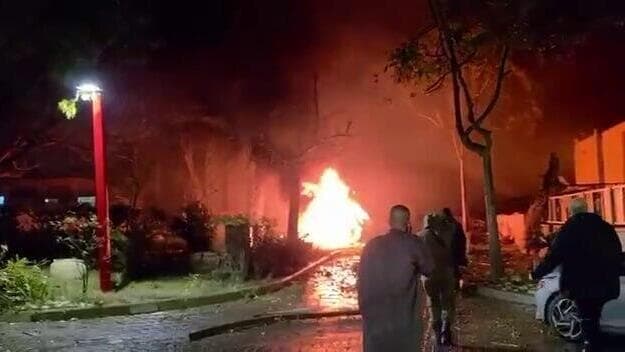
Israel and U.S. Strike Natanz Nuclear Facility Again; Iran Blames Attack
Key Takeaways
- Iran launched missiles at Dimona and Arad in southern Israel, injuring dozens.
- Natanz enrichment facility in Iran was struck again in a joint US-Israeli airstrike.
- No radiation leak reported at Natanz after the strike, per Iran and IAEA.
Natanz Strike
Iran's main nuclear enrichment facility at Natanz was targeted in a coordinated airstrike on Saturday morning, marking the second time the strategic site has been attacked since the U.S.-Israel war against Iran began three weeks earlier.
Iranian state media and officials directly blamed the United States and Israel for the attack, with Iran's Atomic Energy Organization describing it as part of ongoing 'criminal attacks' against the country's infrastructure.

The semi-official Tasnim News Agency reported that the Shahid Ahmadi Roshan enrichment facility was struck, violating international laws including the Treaty on the Non-Proliferation of Nuclear Weapons (NPT).
Despite the attack, Iranian authorities confirmed no radiation leakage occurred and residents in the surrounding area remained safe.
The facility, located approximately 220 kilometers southeast of Tehran, serves as Iran's primary uranium enrichment center and had already sustained damage during the first week of the conflict and during the 12-day war in June 2025.
Iranian Retaliation
In direct retaliation for the Natanz strike, Iran launched missile attacks targeting Israeli communities near the country's main nuclear research facility, escalating the conflict to a dangerous new phase.
Iranian state television framed Saturday's strikes as a 'response' to the earlier attack on Natanz, with missiles hitting the southern cities of Dimona and Arad.

The attacks resulted in extensive damage and significant casualties, with Israeli emergency services reporting over 100 people wounded, including a 10-year-old boy in critical condition with multiple shrapnel wounds.
Three-story buildings collapsed and fires broke out in Dimona, while Arad suffered damage to at least 10 apartment buildings, three of which were completely destroyed.
Iran's Parliament Speaker Mohammad Bagher Ghalibaf declared that Israel's failure to intercept missiles in the 'highly protected Dimona area' represented 'operationally, a sign of entering a new phase of the battle,' claiming Israel's skies had become 'defenseless.'
Nuclear Safety Concerns
The International Atomic Energy Agency (IAEA) closely monitored both the Natanz attack and Iranian retaliation, reporting no abnormal radiation levels at either nuclear facility.
“In a qualitative escalation that moves the American-Israeli war on Iran to a new level of the 'mutual deterrence' equation, the city of Dimona in southern Israel—home to the main nuclear facility—was hit by an Iranian missile strike that left widespread destruction, in an attack Tehran explicitly announced as a direct response to the bombing of the Natanz nuclear facility”
The UN nuclear watchdog confirmed it had been informed by Iran about the strike on Natanz and found 'no increase in off-site radiation levels reported,' while also stating it had not received any indication of damage to Israel's Shimon Peres Negev Nuclear Research Center in Dimona.
IAEA Director General Rafael Grossi reiterated his call for 'maximum military restraint should be observed, in particular in the vicinity of nuclear facilities,' warning of potential nuclear safety risks.
The agency noted that the bulk of Iran's estimated 970 pounds of enriched uranium is stored elsewhere, beneath rubble at its Isfahan facility.
Russian Foreign Ministry spokesperson Maria Zakharova condemned the attacks, stating they posed 'a real risk of catastrophic disaster throughout the Middle East,' while Israel's military denied responsibility for the Natanz strike despite mounting evidence of Israeli involvement.
Regional Escalation
The exchange of nuclear facility strikes has significantly escalated regional tensions, with both sides signaling continued military operations despite growing international concern.
Israeli Defense Minister Israel Katz announced that 'the intensity of the attacks that the IDF and the U.S. military will carry out against the Iranian terrorist regime and against the infrastructures on which it relies will increase significantly' in the coming week.

Meanwhile, Iranian officials vowed to rebuild the damaged Natanz facility, with President Masoud Pezeshkian stating that 'Destroying buildings and factories will not create a problem for us, we will rebuild and with greater strength.'
The conflict has already caused over 1,500 deaths in Iran according to Iranian health ministry figures, with additional casualties in Lebanon, Iraq, Israel, and other regional states.
Military experts noted that Iran's missile capabilities appear more resilient than anticipated, with former Royal Navy commander Tom Sharpe observing that the Iranian attack 'shows that they can still move these mobile launchers around, undetected, spin up and fire without being struck.'
Mixed Signals
The Trump administration has sent mixed signals about the future of the conflict, creating uncertainty about the war's direction and duration.
“- Analysts say Iran's Islamic government has survived the loss of its top leaders and that its strike capacity is proving more durable than expected”
President Donald Trump claimed the U.S. is 'getting very close to meeting our objectives as we consider winding down our great Military efforts in the Middle East,' while simultaneously threatening Iran with a 48-hour ultimatum to reopen the Strait of Hormuz or face obliteration of its power plants.

'If Iran doesn't FULLY OPEN, WITHOUT THREAT, the Strait of Hormuz, within 48 HOURS from this exact point in time, the United States of America will hit and obliterate their various POWER PLANTS, STARTING WITH THE BIGGEST ONE FIRST!' Trump wrote in a Truth Social post.
However, his administration confirmed it was sending more troops to the region and had lifted some sanctions on Iranian oil to address soaring energy prices.
Meanwhile, Britain authorized U.S. use of its military bases for 'specific and limited defensive operations' against Iranian missile sites targeting ships in the Strait of Hormuz, while Saudi Arabia declared several Iranian diplomats 'persona non grata' after downing 20 Iranian drones.
More on Iran

Trump threatens Iran with power-plant strikes if Hormuz isn’t reopened
25 sources compared

President Trump Threatens to Obliterate Iran's Power Plants If Strait of Hormuz Isn't Opened
10 sources compared

Iran strikes Dimona and Arad near Israel's main nuclear facility
43 sources compared

Trump Threatens to Obliterate Iran's Power Plants If Strait of Hormuz Opens Within 48 Hours
20 sources compared