Gaza Genocide01 February, 20263 min read
Israel Bans Doctors Without Borders From Gaza After Charity Refuses to Hand Over Palestinian Staff List
This article is an automated aggregation of coverage from news outlets. Our editorials offer in-depth analysis curated by the NewsCord team.
Israel banned MSF from Gaza, ordering the charity to leave the enclave by Feb. 28. Israel demanded MSF's Palestinian and international staff lists, alleging ties to Hamas.

5 outlets told this the same way.
Outlets did split on Thousands March in London Calling for Britain to Stop Arming Israel and Impose Sanctions →
BBC was read line by line by the Watchdog: 5.5. See the score →
MSF barred in Palestinian territories
Israel has formally banned Doctors Without Borders (MSF) from operating across Gaza and the occupied West Bank.
“Israel has banned Doctors Without Borders (MSF) from operating across Gaza and other Israeli-occupied territories after the charity refused to hand over lists of Palestinian and international staff without concrete assurances about how the information would be used and protected.”
The ban followed MSF's refusal to hand over lists of its Palestinian and international staff and included an order for the charity to leave Gaza by Feb. 28, according to government statements and reporting.
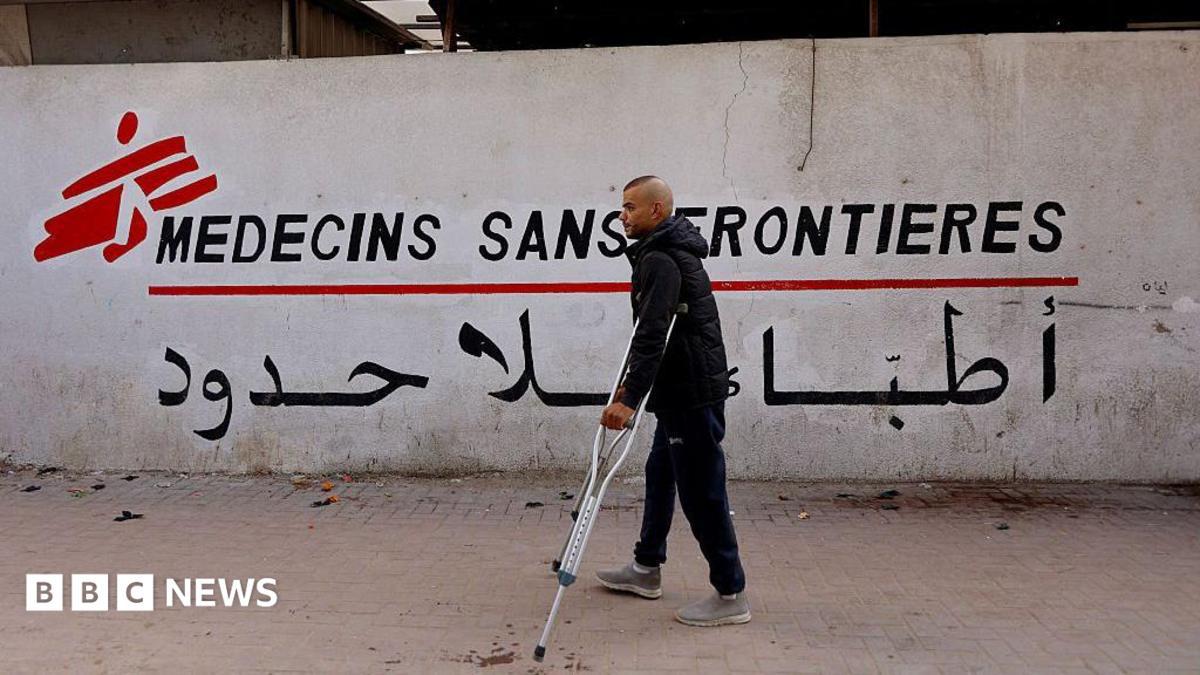
PressTV reports the ban followed MSF's refusal to provide staff lists 'without concrete assurances about how the information would be used and protected.'
TRT World notes the Ministry of Diaspora Affairs said the order came after MSF's 'refusal to submit lists of local and international staff' and set the Feb. 28 deadline.
Middle East Eye similarly reports Israel has banned MSF from operating in Gaza and the West Bank after the charity refused to hand over staff lists.
These outlets attribute the ban directly to Israeli authorities and describe MSF's withdrawal or suspension as a direct consequence of the charity's refusal to comply with the data demand.
MSF suspension and allegations
Israeli authorities justified the suspension as a security and administrative measure, and the foreign ministry said MSF had promised in January to share staff lists while accusing the group of 'having something to hide.' TRT World reports the ministry framed staff-list demands as standard registration intended to 'prevent humanitarian cover being used for hostile or terrorist purposes' and said the lists would be used only internally and not shared externally.
Middle East Eye records Israeli allegations that two MSF employees had links to Hamas and Islamic Jihad, claims that MSF strongly denies. All three sources attribute these security claims to Israeli officials rather than endorsing them as proven facts.

MSF staff list dispute
MSF has publicly refused to hand over the lists without guarantees that the data would be protected and would not endanger staff. PressTV notes MSF said it had offered to 'exceptionally provide a defined staff list to avoid suspension' but could not obtain assurances that the information 'would be used only for administrative purposes and would not endanger employees.'
“MSF says it had offered to exceptionally provide a defined staff list to avoid suspension from March 1 but could not obtain guarantees that the data would be used only for administrative purposes and would not endanger employees.”
TRT World quotes MSF saying it 'would not hand over staff lists because Israel has not provided assurances to protect its personnel or allow independent management of its operations.' Middle East Eye reports that, in response to the Israeli demand, the ministry said MSF 'chose to withdraw from Gaza rather than comply,' framing the charity's decision as a refusal to accede to the security requirement.
Gaza medical services crisis
Humanitarian sources warn the ban will further degrade medical services in Gaza, where MSF (Doctors Without Borders) is a major provider of care. TRT World states that MSF is a major provider of medical care in Gaza and that suspending its work is expected to further damage already scarce health services. PressTV and TRT frame the ban within the wider destructive toll on Gaza, with PressTV citing roughly 71,800 Palestinians killed, more than 171,480 wounded, and roughly 90% of civilian infrastructure destroyed.
TRT reports that Israel's nearly two-year war has killed almost 71,800 Palestinians and wounded more than 171,400. These reports attribute the humanitarian damage and casualty figures to Israel's military campaign and portray the suspension as intensifying civilian suffering.

Media framing differences
PressTV (a West Asian outlet) foregrounds the human cost and highlights MSF’s insistence on staff safety. TRT World (West Asian) emphasizes the ministry’s procedural justification and the immediate operational impact. Middle East Eye (a Western alternative) foregrounds the ban and the ministry’s allegation that MSF staff had links to armed groups.
“Israel has banned Doctors Without Borders (MSF) from operating across Gaza and other Israeli-occupied territories after the charity refused to hand over lists of Palestinian and international staff without concrete assurances about how the information would be used and protected.”
All three explicitly attribute claims—Israeli accusations, MSF refusals, and expected harm to health services—to the parties making them rather than asserting independent proof. These variations show how source type influences focus: West Asian outlets center humanitarian toll and operational detail, while the Western alternative stresses political-legal framing and allegations.