Full Analysis Summary
West Bank displacement
Israel launched a military offensive called Operation Iron Wall in late January and early February.
The offensive forced about 32,000 Palestinians from three refugee camps in the northern West Bank, including Nur Shams and Jenin, out of their homes and left the camps largely emptied by the end of February.
Residents describe siege tactics, cuts to power, water and internet, bulldozer demolitions, and frantic flight with little more than the clothes they were wearing.
The Israeli military says demolitions were needed to open access routes to counter armed groups it blames for attacks.
Human rights groups and media reporting describe the operation as the biggest West Bank displacement since 1967, with around 32,000 people displaced and more than 850 homes and buildings destroyed according to Human Rights Watch.
Coverage Differences
Tone and legal framing
BBC (Western Mainstream) reports the displacement, residents' accounts, and the Israeli military's justification, focusing on descriptive reportage and quoting both residents and the military. In contrast, Malay Mail (Asian) relays Human Rights Watch's legal assessment, reporting HRW's statement that the operation included violations of international law, 'war crimes' and actions amounting to 'ethnic cleansing' by preventing returns and demolishing homes. The BBC reports the military’s stated operational rationale; Malay Mail highlights HRW’s criminal and ethnic-cleansing claims.
Displacement, protests and reporting
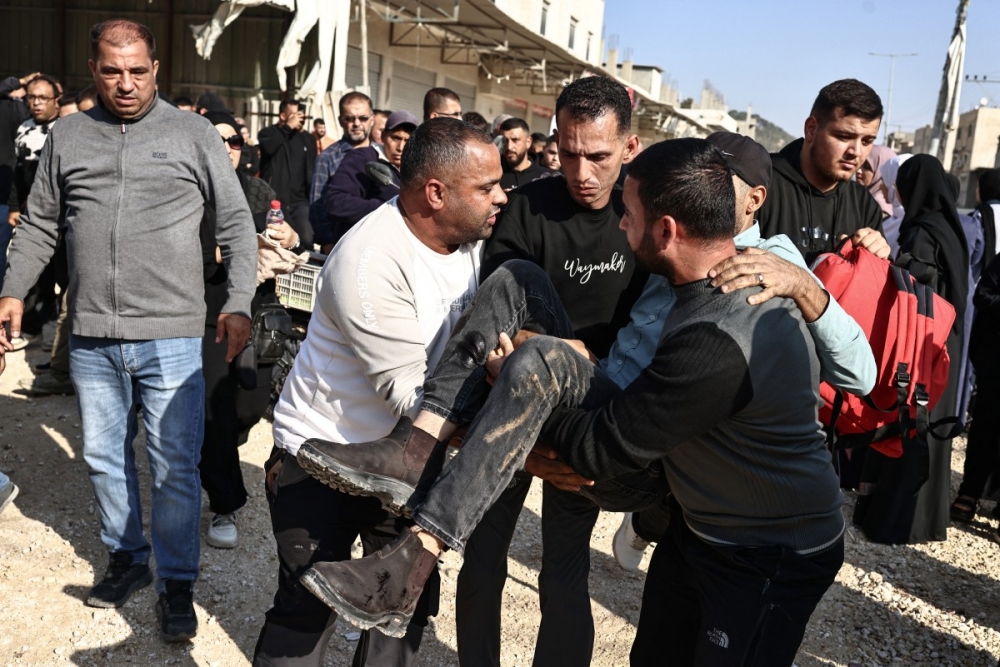
Displaced families are sheltering in schools, improvised outdoor spaces and crowded communal settings, and survivors describe terror and loss as they fled, often carrying only what they wore.
The BBC records personal accounts such as Nehaya al-Jundi from Nur Shams and Nidal Abu Nase from Jenin, who describe the scramble to escape.
Malay Mail reports displaced people sheltering in a nearby school in Tulkarem's camp and quotes a father, Irhil, saying "Our life was better" before displacement.
It also reports demonstrations by roughly 150 displaced people near Nur Shams demanding the right to return, during which gunfire from troops injured an Al Jazeera journalist.
These accounts illustrate the immediate humanitarian crisis and the risks faced by journalists reporting on protests.
Coverage Differences
Human impact emphasis
BBC foregrounds individual testimonies and the scale of displacement, giving names and descriptions of terror and flight. Malay Mail supplements personal hardship with broader humanitarian detail (crowded sheltering in schools) and documents HRW’s legal framing; it also reports incidents involving journalists and protests. The Malay Mail thus mixes on-the-ground humanitarian detail with legal and media-impact reporting, while BBC centers displaced people's testimonies and the numerical scale of displacement.
Allegations and military rationale
Human rights organisations and residents accuse Israel of using tactics that amount to collective punishment and possible ethnic cleansing by preventing returns and demolishing homes.
Human Rights Watch told reporters the operation included violations of international law, 'war crimes' and actions that 'amount to ethnic cleansing'.
The BBC records residents saying 'They punished ordinary people. This is collective punishment.'
The Israeli military counters that the operation was necessary because the camps had become 'terror hubs' and that demolitions created access routes and reduced militant activity.
The reporting therefore pits residents and HRW's legal accusation against the military's operational rationale.
Coverage Differences
Contradiction and attribution
BBC reports residents’ claim of 'collective punishment' and quotes the Israeli military’s operational justification, maintaining a descriptive stance. Malay Mail relays HRW’s direct legal condemnation, explicitly using terms like 'war crimes' and 'ethnic cleansing' — these are HRW’s claims as reported by Malay Mail. The BBC frames residents' statements as testimony and also reports the military's claim that the camps were 'terror hubs'; Malay Mail foregrounds HRW’s legal charges in addition to the military’s defense.
Post-operation displacement
Ten months after the operation, about 32,000 people remain displaced and unable to return.
Many will find their homes destroyed if and when returns are allowed.
Camp residents, whose families in many cases have lived in camps since the 1948 Nakba, fear that temporary displacement may become permanent.
They also circulate rumours about possible return dates.
The military asserts the operation has "significantly reduced militant activity" but gives no end date.
Uncertainty about return and the scale of destruction underpin concerns that displacement could be long-term or permanent.
Coverage Differences
Emphasis on long-term consequences
BBC emphasizes the scale and longevity of displacement, describing it as 'the biggest West Bank displacement since 1967' and noting that many homes will be destroyed. Malay Mail emphasises the humanitarian reality of sheltering and residents' fears of permanence and reports claims that the military gives no end date while saying it reduced militant activity. BBC focuses on historical and numerical context; Malay Mail foregrounds current humanitarian arrangements and HRW's warning about permanence and legal implications.