Full Analysis Summary
Expanded control in Gaza
Israeli forces have expanded control beyond the ceasefire's temporary yellow line into northern and central Gaza, pushing deeper into populated areas.
They have demolished buildings and built tall observation outposts atop cleared land and high earthworks.
Satellite imagery and analysis, including BBC Verify, show these outposts were created by demolishing buildings, clearing land, and constructing high earthworks across northern Gaza.
Imagery indicates continued demolition since the ceasefire, particularly in Jabalia around the Indonesian Hospital.
Al Jazeera reports that satellite imagery, reported by Haaretz and analyzed by The New York Times, shows Israel has pushed the temporary yellow line deeper and continued demolition of neighborhoods.
Reports also document early raids east of Gaza City and in central Gaza, including areas east of Deir al-Balah and al-Bureij camp, with vehicles penetrating east of Deir al-Balah amid heavy gunfire.
Coverage Differences
Tone and emphasis
Al-Jazeera (West Asian) frames the expansion as reported satellite analysis from Haaretz and The New York Times and notes tactical raids and gunfire, emphasizing reporting and attribution. Countercurrents.org (Other) emphasizes the physical construction of outposts and demolition as an ongoing occupation tactic, citing ‘BBC Verify’ and using stronger accusatory language about continued demolition. The sources differ in tone: Al-Jazeera reports the imagery and military praise, while Countercurrents highlights structural changes on the ground and sustained demolition after the ceasefire.
Attribution
Al-Jazeera attributes the satellite findings explicitly to Haaretz and The New York Times analyses, while Countercurrents reports the same phenomena but cites BBC Verify among its sources and frames the actions as construction of occupation infrastructure.
Yellow line discrepancies
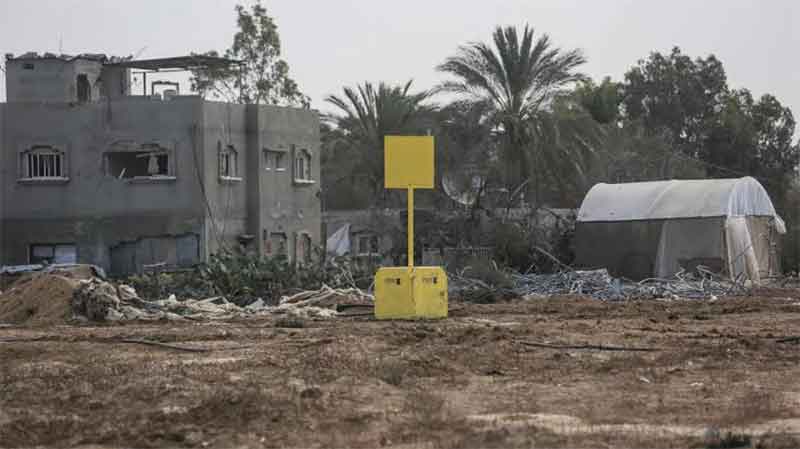
On the ground, the mapped 'yellow line' does not match Israeli barriers and fortifications.
Imagery shows yellow concrete barriers placed hundreds of metres west of the military's published line.
Large stretches without barriers leave residents uncertain where the military-designated 'dangerous combat zone' lies.
Countercurrents documents that imagery shows discrepancies between where yellow concrete barriers have actually been placed and the 'Yellow Line' location on official military maps, noting that in Shujaiyeh the barriers sit roughly 300 metres west of the line.
The same source says blocks have not been placed along about 10 km of territory.
Al-Jazeera's cited New York Times analysis reports extensive structural destruction - more than 2,500 buildings and facilities destroyed since the ceasefire began - which aligns with evidence of demolished areas turned into observation outposts and barriers.
Coverage Differences
Detail vs. scale
Countercurrents (Other) provides granular, location-specific details about barrier placement and missing blocks in Shujaiyeh, while Al-Jazeera (West Asian) relays NYT’s larger-scale tally of destroyed buildings (over 2,500). Countercurrents highlights local uncertainty caused by inconsistent barrier placement; Al-Jazeera highlights the broader scale of destruction.
Narrative focus
Countercurrents emphasizes the practical impact on civilians’ ability to know safe areas and the physical presence of Israeli occupation works, whereas Al-Jazeera centers on satellite analyses that quantify destruction and note shifts in control; both report demolition, but Countercurrents foregrounds local civilian uncertainty.
Human cost in Gaza
Reports say the expansion and demolition have direct human costs, with Israeli strikes across the Strip killing at least 16 Palestinians following a U.S. announcement of a 'second phase'.
Those reports also document worsening humanitarian conditions, including 'deadly winter conditions in Gaza affecting displaced people and infants,' according to Dr Ranjan Solomon.
Countercurrents republishes an opinion by Dr Gideon Polya alleging a Gaza 'genocide' and claiming 875,000 Gazans were killed over two years.
Al Jazeera reports raids, heavy gunfire, and satellite-documented destruction that underscore a sustained Israeli military campaign expanding control.
Civilians face exposure to demolitions, raids, and dire humanitarian conditions.
Coverage Differences
Severity and legal framing
Countercurrents reproduces and highlights an opinion that calls the actions ‘genocide’ (Dr Gideon Polya), explicitly using that legal and moral framing; Al-Jazeera reports the military operations, imagery, destruction numbers, and ministerial praise without adopting the ‘genocide’ label in the excerpt supplied. This shows Countercurrents advancing a human-rights/legal interpretation, while Al-Jazeera focuses on reporting analyses and official reactions.
Humanitarian focus
Countercurrents places explicit attention on humanitarian consequences (winter conditions, infant risk, deaths from strikes) and includes advocacy-oriented opinion; Al-Jazeera’s excerpt emphasizes imagery and analysis of territorial expansion and destruction counts, less explicit on humanitarian detail in the supplied text.
Media coverage and responsibility
Coverage differences matter for how readers understand responsibility and intent.
Al-Jazeera relays satellite analyses and notes that 'Israeli Defense Minister Yisrael Katsal publicly praised soldiers as those reports of continued destruction circulated,' which situates the Israeli government's response next to the imagery reports.
Countercurrents, by aggregating analyses (BBC Verify, local reporters) and publishing opinion pieces calling the events 'genocide,' treats the expansion and demolition as part of a purposeful campaign of occupation and systematic killing.
These divergent emphases—Al-Jazeera's reporting of cited analyses and official statements versus Countercurrents' aggregation plus legal and moral condemnation—produce different narratives about culpability and the human toll.
Coverage Differences
Official reaction vs. moral condemnation
Al-Jazeera includes the official response, noting that ‘Israeli Defense Minister Yisrael Katsal publicly praised soldiers,’ which frames the actions as state-endorsed military operations. Countercurrents collects critical and accusatory commentary, including calls to label the actions ‘genocide’ and reporting fatalities and humanitarian crises; this frames the same facts as moral crimes rather than purely military operations.
Scope of evidence cited
Al-Jazeera cites Haaretz and The New York Times satellite analyses to quantify destruction and shifting control; Countercurrents cites BBC Verify and local reports and bundles those with opinion and humanitarian reports, expanding the scope beyond imagery to legal and civilian-impact claims.