
Israel Kills Four Lebanese Paramedics in Consecutive Ambulance Strikes in Mayfadoun
Key Takeaways
- Israeli triple-tap strikes hit ambulance teams in Mayfadoun, killing paramedics.
- Casualties among paramedics vary: reports say three to four killed, others injured.
- Amnesty International and others condemn attacks on healthcare workers amid Lebanon fighting.
Quadruple Tap in Mayfadoun
Israeli strikes in southern Lebanon turned into a pattern of repeated attacks on ambulances and rescue teams, with the Guardian describing a deadly sequence it called a “quadruple tap.”
“Breaking News Close Breaking News Tickerclose-prominent Trump says Israel and Lebanon's leaders will speak on Thursday Close Breaking News Tickerclose-prominent”
The Guardian reported that when paramedics from the Islamic Health Association (IHA) responded to an Israeli airstrike in the city of Mayfadoun, “most of the paramedics held back” after seeing colleagues killed by “double-tap attacks targeting rescuers.”
The IHA medics “rushed to the scene,” and by the time other emergency workers arrived, the Guardian said the IHA medics “had indeed been caught in a second strike.”
The Guardian added that rescuers began evacuating wounded colleagues, “only for their ambulances to be hit in two further attacks,” as “Israel carried out three consecutive strikes on three sets of ambulances and medical workers.”
In total, the Guardian said the attacks “killed four medics and wounded six more, from three different ambulance corps, according to medical sources.”
The Guardian also reported that “Three of the medics were from the Hezbollah-affiliated IHA and Amal-affiliated medical corps, while one was from the Nabatieh emergency services organisation,” and it noted that under international law “all medics are protected and are considered non-combatants, regardless of political affiliation.”
The Guardian further described a video in which rescuers were seen loading wounded people into ambulances when “a bomb lands next to their vehicle,” and it quoted a paramedic filming the scene saying, “Oh God, oh God,” as shrapnel shattered the ambulance window.
Funerals and the Human Cost
The aftermath of the Mayfadoun “quadruple tap” included funerals in Nabatieh, where medics mourned colleagues killed in the attacks, according to the Guardian.
The Guardian identified one of the dead medics as Fadel Sarhan, 43, and it reported that he was survived by his eight-year-old daughter.
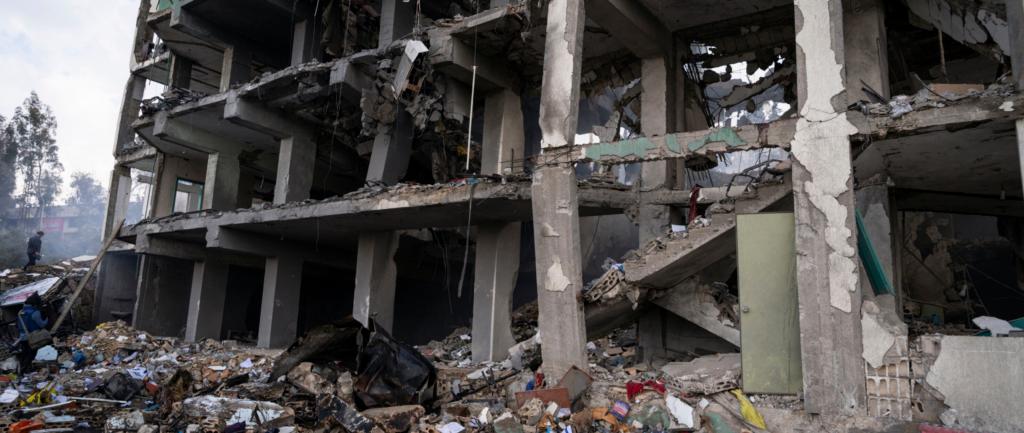
The Guardian quoted Ali Nasr al-Deen, head of the Mayfadoun civil defence centre, saying, “Fadel was a very loved person. He had a bold personality, but at the same time, he was emotional. He was well liked and responsible,” and it added that Nasr al-Deen said, “It’s a huge loss for us.”
The Guardian also included Nasr al-Deen’s description of Sarhan’s personal habits, including that “He used to feed the cats and dogs,” and that “He would bring pet food from Beirut so they wouldn’t go hungry.”
The Guardian said such funerals have become increasingly common, with healthcare workers killed by Israeli bombings “on a near daily basis,” and it cited Mohammed Suleiman, whose 16-year-old son, Joud, was killed while on duty as a paramedic by an Israeli strike weeks earlier.
The Guardian reported that Suleiman joined his peers in burying another of his friends on Thursday, linking the latest deaths to a longer pattern of attacks on medical personnel.
In parallel, the National reported that “Last night, Tibnin Governmental Hospital was targeted again,” quoting former health minister Dr Firass Abiad, and it said the hospital is the only operational facility in southern Lebanon.
Accusations, Law, and Official Statements
Lebanese officials and medical groups condemned the attacks as deliberate targeting of healthcare workers, while the Israeli military did not immediately respond to comment requests, according to the Guardian and BBC.
The Guardian reported that Lebanon’s ministry of health accused Israel of deliberately targeting ambulance crews, quoting the ministry’s statement that “Paramedics have become direct targets, pursued relentlessly in a blatant violation that confirms a total disregard for all norms and principles established by international humanitarian law.”
The BBC similarly quoted the Lebanese health ministry describing Wednesday’s attacks as a “flagrant crime,” and it said the ministry stated, “Paramedics have become direct targets, pursued relentlessly in a blatant violation that confirms a total disregard for all norms and principles established by international humanitarian law.”
The BBC described how a team from the Islamic Health Association was attacked while trying to rescue people from the site of an Israeli attack in Mayfadoun, and it said the ministry reported that one paramedic was killed and a second remains missing.
The BBC then reported that when a second team from the Islamic Health Association headed to the site, “it too was attacked,” and it said three paramedics were wounded, before two ambulances of the Risala Scout Association and the Nabatieh Ambulance Service were also attacked.
The BBC reported that two paramedics were killed and three others wounded, and it identified one of the victims as Fadel Serhan, a 43-year-old paramedic with the Risala Scout Association.
The BBC also quoted Amnesty International’s Kristine Beckerle, saying, “Under international humanitarian law, civilians, including healthcare workers, do not lose their protected status simply based on an affiliation,” and it added that Beckerle said “deliberately striking medics performing their humanitarian functions is a serious violation of international humanitarian law and could constitute a war crime.”
Tebnine Hospital Hit After Mayfadoun
The Guardian reported that after the ambulance attacks outside Nabatieh, Israel struck the vicinity of the governmental hospital in Tebnine, south Lebanon, and it described the strike as the second time in two days that Israeli bombings damaged the healthcare facility.
The Guardian said the strikes injured 11 hospital workers and damaged the emergency department, citing the World Health Organization (WHO).

It also reported that a video of Tebnine hospital from 14 April showed workers trying to clear “shattered concrete and debris” from the emergency department after a strike blew in the windows.
The Guardian quoted the WHO head, Tedros Adhanom Ghebreyesus, saying, “I reiterate the call for the immediate protection of healthcare facilities, health workers, ambulances and patients. There must be safe, sustained and unhindered humanitarian access across Lebanon.”
The Guardian added that an ambulance in Tebnine was also struck on Thursday, leading to the critical injury of two medics, according to the Lebanese ministry of health.
The National’s account aligned with the focus on Tibnin Governmental Hospital, saying Israeli strikes hit the only operational facility in southern Lebanon, wounding staff and damaging the emergency department, and it said the Red Cross reported the hospital had been attacked twice in recent days.
The National also stated that “The hospital, which has been attacked twice in recent days, is the only operational health facility in the south of the country,” and it quoted Dr Firass Abiad’s X post: “The only operational hospital in the most southern regions, where the Israeli attacks are relentless.”
Numbers, Negotiations, and Escalation
The sources place the ambulance and hospital attacks within a wider escalation that began on 2 March, while also describing ongoing talks between Lebanon and Israel.
The Guardian said Israel has “so far killed 91 healthcare workers and wounded 214 more in Lebanon since the Israel-Hezbollah war started on 2 March,” and it added that it has “given little justification” beyond accusing Hezbollah of using ambulances and hospitals to transport fighters and weapons “without providing evidence.”

The Guardian also reported that the Israeli military did not immediately respond to a request for comment, and it described the “quadruple tap” as arising from a “three-wave attack after the initial one.”
The National similarly said renewed fighting with Hezbollah began on March 2, and it reported that “At least 91 health workers have been killed in Israeli strikes since then,” with “32 in less than two weeks” and “nearly half of them in one day.”
The BBC added a broader casualty context, reporting that “More than 2,100 people have been killed and 7,000 others wounded since the start of the war in Lebanon on 2 March,” and it said the ministry’s figures “do not distinguish between combatants and civilians.”
The BBC also reported that “The number includes at least 260 women and 172 children,” and it said “The ministry says 91 health professionals have been killed and 208 other wounded in the war.”
Finally, TRT عربي reported that “The Lebanese Foreign Ministry also said it had filed an urgent complaint with the United Nations,” and it described an Israeli Security Cabinet discussion of an American proposal to halt fighting, quoting an Israeli official as saying, “There are talks to halt the fighting with Lebanon, and a proposal was submitted at the request of the United States, but the fire will not stop as long as Hezbollah continues to fire.”
More on Other

Israel Intensifies Ceasefire Violations, Establishing ‘Yellow Line’ in Southern Lebanon
37 sources compared

Pope Leo XIV Leads Open-Air Mass in Douala as 120,000 Attend
15 sources compared

Israel And Lebanon Hold Historic Talks In Washington To Disarm Hezbollah
18 sources compared

NASA Artemis II Crew Returns Safely After Record-Breaking Moon Voyage
16 sources compared