Full Analysis Summary
Displacement in southern Gaza
Israel’s military offensive has turned southern Gaza — particularly the Al-Zahraa/Netzarim axis — into vast tented refugee camps after massive raids destroyed homes, universities and high-rise buildings.
Hundreds of families have been forced into makeshift shelters supervised by the Egyptian Committee for Gaza Reconstruction.
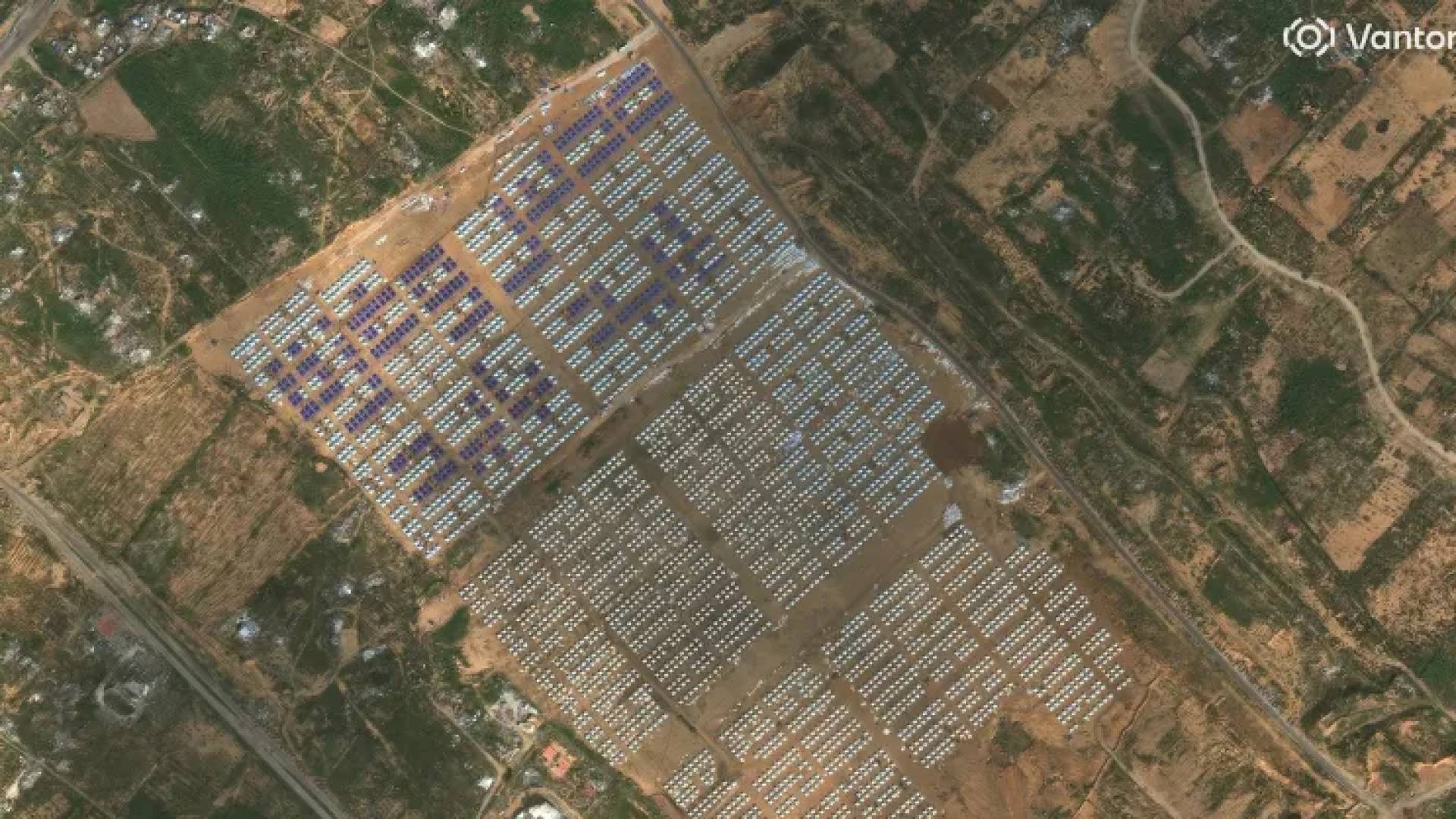
Satellite imagery and on-the-ground reporting show rows of tents stretching across areas that were once residential neighbourhoods and campuses.
These images underscore large-scale civilian displacement and the destruction wrought by Israel’s attacks in the area.
The rapid growth of these encampments has turned former neighbourhoods into temporary cities of displaced people seeking shelter from Gaza’s harsh winter.
Coverage Differences
Tone and evidence detail
Both sources report mass displacement and tent camps in Al-Zahraa/Netzarim, but Al-Jazeera Net (West Asian) emphasizes technical satellite evidence — citing U.S. firm Vantor imagery dated Dec. 4, 2025 to Jan. 21, 2026 and a measured area of roughly 655,000 square meters — while Roya News (West Asian) focuses more on the human and humanitarian framing, describing supervision by the Egyptian Committee and the visual scale of civilian displacement. Al-Jazeera provides precise measurements and dates; Roya emphasizes community destruction and the transformation into tent camps.
Destruction and displacement reports
The destruction was inflicted by Israel's military assault.
It razed universities, residential towers and neighbourhoods, leaving families without homes and pushing them into tents under the supervision of reconstruction authorities.
Both articles explicitly attribute the destruction to Israel's operations: Roya News calls it Israel's military assault, and Al-Jazeera Net documents buildings destroyed during Israel's offensive, linking the razing to the military campaign that precipitated the displacement.
Coverage Differences
Attribution clarity and phrasing
Both sources attribute destruction to Israel, but Roya News uses the phrase "Israel’s military assault," emphasizing the military nature of the action and the human consequences, while Al-Jazeera Net uses "Israel’s offensive" alongside satellite imagery to document physical damage. Roya stresses humanitarian consequences and camp problems; Al-Jazeera supplies photographic evidence and mapping details. Neither source uses euphemisms; both directly name Israel's role.
Camps' humanitarian crisis
Roya News warns that humanitarian conditions in the camps are dire, citing worsening sanitation, failed food distribution, and limited medical access as tents multiply.
Al-Jazeera Net's imagery shows how rubble and winter weather compound shelter needs, allowing observers to see small tent clusters swell into sprawling encampments.
Both sources portray the camps as temporary but unsustainable refuges that highlight the long-term challenges of rebuilding after Israel's campaign destroyed civilian infrastructure.
Coverage Differences
Focus on immediate needs versus visual documentation
Roya News foregrounds urgent humanitarian failures — sanitation, food and medical access — whereas Al-Jazeera Net foregrounds visual and spatial evidence from satellite photos showing the expansion of tents across former neighborhoods; Roya frames the issue as a growing humanitarian crisis, Al-Jazeera emphasizes the scale and the transformation visible in imagery. Together they provide both human-impact claims and visual corroboration.
Sources on Palestinian displacement
The two West Asian sources broadly agree on facts — massive destruction from Israel’s military assault, the establishment of tent camps under Egyptian supervision, and acute humanitarian strain — but they emphasize different details that shape reader interpretation.
Al-Jazeera Net provides precise satellite verification and spatial metrics.
Roya News emphasizes the lived humanitarian crisis and authorities' warnings about sanitation, food, and medical failures.
Because both sources are West Asian, they share a regional perspective that centers Palestinian displacement and civilian suffering, and neither excerpt uses the term "genocide," so applying that label would go beyond what these articles explicitly state.
Coverage Differences
Narrative emphasis and scope
Al-Jazeera Net (West Asian) emphasizes empirical satellite evidence and metrics (dates, area size, imagery by Vantor) that document the camps’ expansion, while Roya News (West Asian) emphasizes humanitarian consequences — sanitation, food distribution and medical access issues — and the visual scale of displacement. Both sources name Israel's role; neither uses the term "genocide" in the provided text, so characterizing the events as genocide would not be strictly supported by these excerpts alone.