
Israeli Drone Kills Lebanese Red Cross Medic Hasan Badawi Near Bint Jbeil
Key Takeaways
- Lebanese Red Cross medic Hasan Badawi killed by Israeli drone near Bint Jbeil.
- Israeli strikes in southern Lebanon killed multiple people, including medics, amid ongoing hostilities.
- Ceasefire extensions have not stopped fighting; residents warned to flee beyond buffer zones.
Paramedics hit in strikes
A Lebanese Red Cross volunteer medic, Hasan Badawi, was killed earlier this month while en route to his latest assignment in southern Lebanon, where he had been racing toward the location of military strikes as a first responder.
NBC News said Badawi, 31, a father of one with a baby on the way, was killed “allegedly cut down by an Israeli drone,” and that his team wore the standard Lebanese Red Cross uniform and a clearly marked ambulance.
The Lebanese Red Cross said their mission was “directly targeted,” and NBC News reported that one of Badawi’s colleagues was wounded.
NBC News also said the Red Cross had coordinated safe passage for the mission, while the Israeli military told NBC News it was aware of reports of a Red Cross team being “affected” and that the strike was under review.
The NBC News report placed the incident on April 12, as Israeli forces moved toward the key Hezbollah stronghold of Bint Jbeil.
NBC News further said Badawi joined what aid groups say is a growing list of front-line medics and other health workers killed since Israel invaded Lebanon more than six weeks ago.
The report added that, according to the Lebanese health ministry, at least 100 health workers have died since the U.S. and Israel attacked Iran on Feb. 28, setting off a wider war across the Middle East.
Ceasefire strain and new deaths
As the conflict in Lebanon continued, Israeli strikes killed 14 people and wounded 37 on Sunday, according to Lebanon’s health ministry, and the CBC report said the death toll included two children and two women.
CBC said Israel warned residents beyond the “buffer zone” it occupied before a ceasefire that has failed to fully halt hostilities, telling people to head north and west away from seven towns.
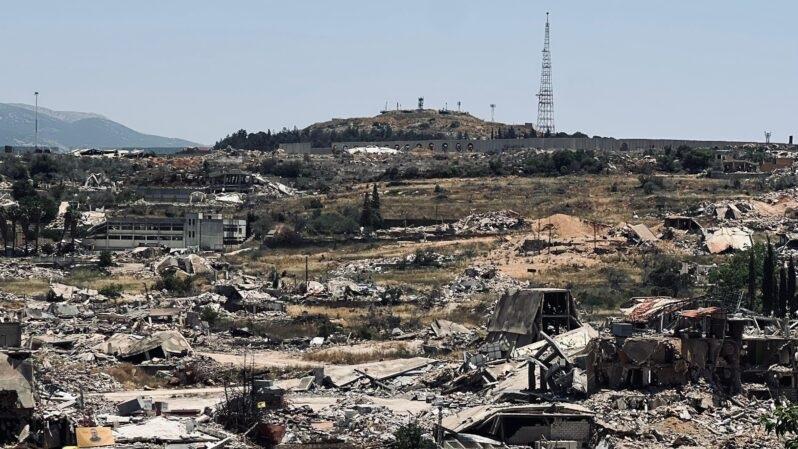
The CBC report quoted an Israeli military spokesperson saying Hezbollah was violating the ceasefire and that Israel would act against it, while also saying the military struck Hezbollah fighters, rocket launchers and a weapons depot.
CBC also reported that Israel said one of its soldiers was killed as the ceasefire came under further strain.
The CBC account said the towns were north of the Litani River and the zone in southern Lebanon occupied by Israeli troops, who continued military operations despite the ceasefire.
Hezbollah, in turn, told CBC it would not cease its attacks on Israeli troops inside Lebanon and on towns in northern Israel as long as Israel continued its “ceasefire violations.”
CBC added that the U.S.-mediated ceasefire started on April 16 and has been extended to mid-May, bringing a reduction in hostilities while both sides continued to fire and trade blame over breaches.
Numbers of humanitarian deaths
NBC News connected the killing of paramedics in Lebanon to a broader pattern of humanitarian workers being killed in conflicts, citing figures from the Lebanese health ministry and from a warning to the United Nations Security Council.
It said at least 95 emergency medical services workers and volunteers, mainly paramedics, are among those killed, with scores more injured since Israeli forces launched its ground and aerial assault in Lebanon after Hezbollah attacked Israel in support of Iran.
NBC News also reported that Tom Fletcher, the undersecretary-general for humanitarian affairs and emergency relief coordinator, warned the U.N. Security Council of a “chilling pattern” of humanitarians being killed in conflicts.
NBC News quoted Fletcher saying that in 2025 alone, at least 326 aid workers died in 21 countries, bringing the total number of humanitarians killed in three years to over 1,010.
It further said Fletcher told the Security Council that, of those killed across that three-year period, more than 560 died in the Gaza Strip and the Israel-occupied West Bank during Israeli operations.
NBC News added that Fletcher said at least 130 were killed in Sudan, 60 in South Sudan, 25 in Ukraine and 25 in the Democratic Republic of the Congo, and that he said the rise has not been an “accidental escalation,” but instead marked a “collapse of protection” for humanitarians amid a “broader attack on the U.N. Charter and on international humanitarian law.”
The NBC News report also cited Tommaso Della Longa of the International Federation of Red Cross and Red Crescent Societies, who said the number of humanitarian workers killed had “skyrocketed” in recent years.
Competing claims on targeting
The reports also diverged in how they framed attacks on medical workers and the broader conduct of the war, with different outlets emphasizing different allegations and counter-allegations.
NBC News described the Lebanese Red Cross saying Badawi’s team was “directly targeted,” while the Israeli military said it was aware of reports of a Red Cross team being “affected” and that the strike was under review.

France 24 reported that a health authority affiliated with Hezbollah announced that one of its medics was killed along with a wounded person he was transporting in an Israeli airstrike on an ambulance belonging to it in southern Lebanon, and it said the Israeli army renewed its threat to target ambulances and medical facilities in Lebanon, accusing Hezbollah of using them in a “military” way.
SANA, meanwhile, said four Lebanese were killed as a result of Israeli airstrikes on southern Lebanon, and it quoted the Ministry of Health saying "Two medics were killed while on their way to carry out a rescue mission in the city of Nabatieh".
SANA also said the ministry described the deaths as “a deliberate obstruction to rescue work” and “an insistence on the flagrant violation of international humanitarian law.”
Monte Carlo Doualiya said that on March 9, 2026, the Lebanese Health Ministry reported two people were killed and six others among ambulance crews were injured in raids on the towns of Tirdba and Joya.
It also said that, according to the latest official Lebanese toll, the number of dead in the country since the outbreak of the confrontation between Israel and Hezbollah last Monday rose to 394 dead and more than a thousand injured, according to Lebanese Health Minister Rakan Nasr al-Din on Sunday, March 8.
Calls to stop and next steps
While the fighting continued, multiple outlets reported calls for action aimed at halting attacks and addressing the humanitarian fallout.
“To view this content on YouTube, you must allow YouTube's audience metrics collection and ads”
NBC News said governments around the world sounded the alarm over the growing number of humanitarian workers being killed in Lebanon, and it reported that Canada issued a joint statement alongside the United Kingdom, Australia, Japan, Jordan and other nations warning that attacks on aid workers “must stop” and calling for international law to be upheld.

NBC News also quoted Aseel Baidoun, deputy director of advocacy and campaigns at Medical Aid for Palestinians, saying, “It’s not about paramedics doing what they have to do to be recognizable or protected under international law,” and adding, “It’s about facing an army that does not recognize international law or any protected persons under international law,”.
In a different framing, MTV Lebanon quoted Plasschaert saying “Three UN peacekeepers killed and nine Lebanese medics killed in a single day, and it's time to act,” and it argued that “Lebanon today is but a pale shadow of what it once was” while calling for an “immediate ceasefire to halt the destruction.”
MTV Lebanon’s report also said Plasschaert called for “An agreement on basic confidence-building measures” and for “Stepping up Lebanese efforts to consolidate the state's central role in decisions of war and peace,” including addressing “the issue of weapons outside state authority.”
CBC reported that Israel’s Prime Minister Benjamin Netanyahu said at a cabinet meeting in Jerusalem, “We act vigorously according to the rules we agreed upon with the United States, and also, by the way, with Lebanon,” and he framed Israel’s actions around “the security of Israel, the security of our soldiers, the security of our communities.”
Hezbollah’s response in CBC was that it would not wait for diplomacy that has “proven ineffective” or rely on Lebanese authorities that had “failed to protect the country.”
More on Lebanon
Eastern Chad Fighting Kills 42 After Water Well Dispute Between Rival Families
10 sources compared

Israel Orders Evacuation of Seven South Lebanon Towns North of Litani River
44 sources compared
Israel Kills Six Hezbollah Fighters in Southern Lebanon After Ceasefire Extension
13 sources compared

Netanyahu Orders IDF To Vigorously Strike Hezbollah Targets In Lebanon
17 sources compared