Ukraine War05 May, 20268 min read
Kenyan Clinton Nyapara Mogesa Died After Russia Promised Jobs, Foreign Policy Says
This article is an automated aggregation of coverage from news outlets. Our editorials offer in-depth analysis curated by the NewsCord team.
Kenyan Clinton Nyapara Mogesa died shortly after arriving in Moscow amid recruitment scheme. Russia's African recruitment web is expanding, pulling Africans into Ukraine's war.

Kenyan recruits to the front
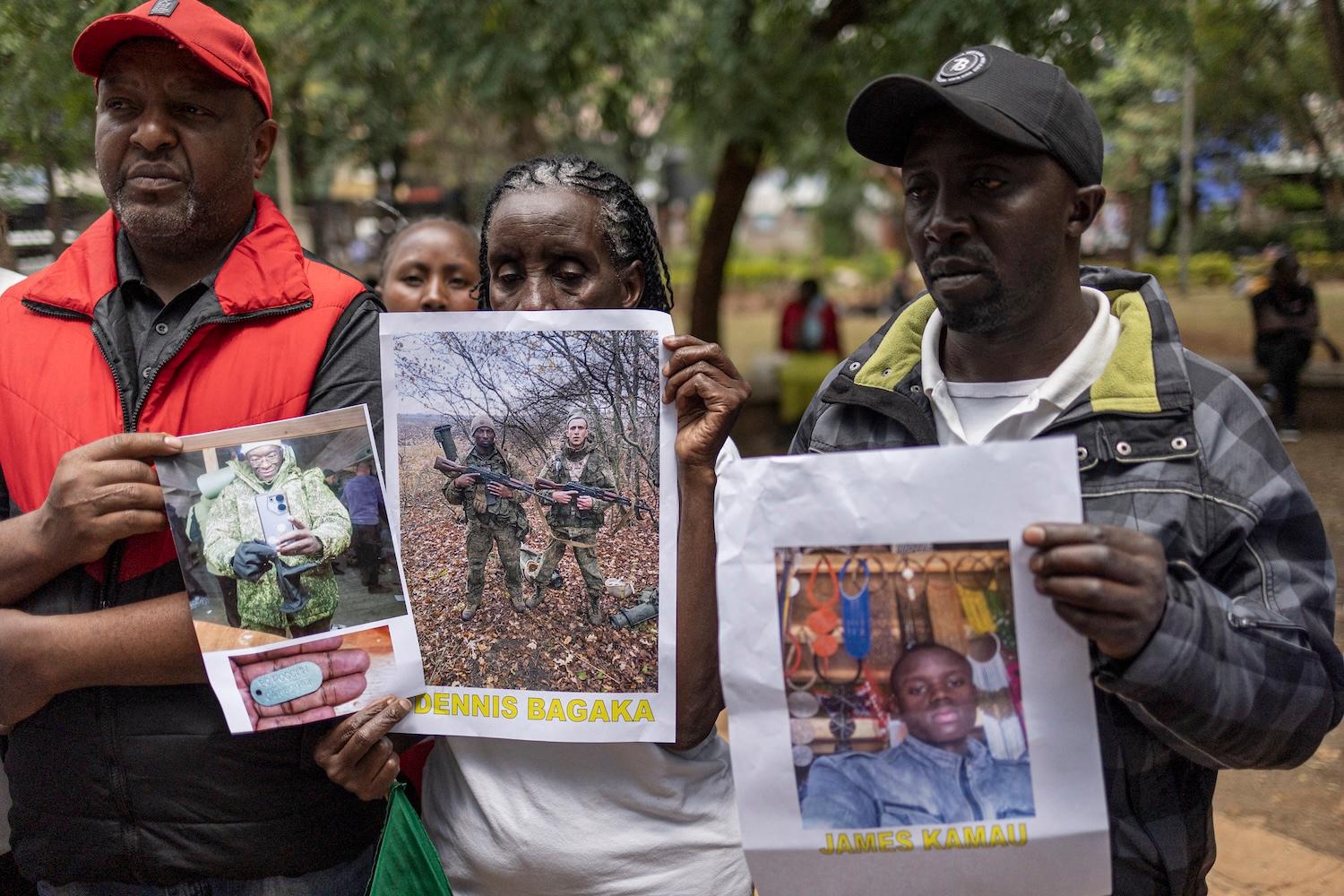
A Kenyan man, Clinton Nyapara Mogesa, was pulled into Russia’s war after a job promise that began in October 2025, when he called his brother, Vincent, in Kenya to say he had found another job “this time, in Russia.”
Foreign Policy says Mogesa did not say what kind of work it was, but “Two days after arriving in Moscow, Clinton told Vincent that he was beginning military training,” and “Weeks later, he said he was waiting to be deployed.”

After that, “the calls stopped,” and the Mogesa family learned what had happened “months later from Ukrainian military intelligence,” which “published photographs of Clinton and reported his death at a Russian-occupied site in eastern Ukraine in January.”
Foreign Policy adds that Ukrainian military intelligence assessed that Mogesa was “carrying the passports of two other Kenyan citizens,” which Ukraine assessed likely belonged to “individuals recruited under similar circumstances and potentially destined for future assault operations.”
The same article places Mogesa’s death within a broader recruitment pattern across Africa, while also tying it to Ukraine’s intelligence reporting and to Russia’s reliance on foreign recruits since its full-scale invasion in 2022.
The Foreign Policy account also cites Kenya’s National Intelligence Service figures “as of Feb. 18,” saying “more than 1,000 Kenyans have been recruited to fight in Russia’s war in Ukraine,” with “39 hospitalized, 30 repatriated, and 28 missing in action.”
It further states that at that time Kenya assessed “35 were in military camps or bases, 89 were on the front line, one was detained, and one had completed their contract,” and that “Ukrainian military intelligence has reported two additional Kenyan deaths.”
How recruitment networks work
The recruitment pipeline described by Foreign Policy and echoed by other outlets is built around job offers that blur civilian work and military service, with intermediaries and contracts that recruits cannot fully understand. Foreign Policy says Kenya’s recruitment pipeline is “facilitated by local agencies—some operating informally, others as registered labor export firms—working with intermediaries linked to networks in Russia and the Middle East.” It adds that these agencies “advertise overseas employment targeting former military personnel, police officers, and unemployed young men,” and that “The offers include salaries of about $2,700 a month; signing bonuses; and, in some cases, promises of fast-tracked Russian citizenship.”
Foreign Policy also describes how many recruits believe they are traveling for civilian work, quoting Fred Ojiro of Vocal Africa: “These are not soldiers who signed up to fight,” and “They are young men who believed they were traveling for ordinary jobs and instead found themselves in a war with no way out.” The Al Jazeera Net account frames the same mechanism as deception and lure, saying “many of these youths are lured with promises of ordinary civilian jobs in Russia, ranging from guarding to cooking,” and that “after arriving in Russia they are forced to join the Russian forces in their battles in Ukraine.” It also says “a string of sham companies lacking credibility operates on the African continent to recruit youths to fight,” often “appearing under the guise of travel agencies or employment agencies,” and that “the contracts the paper reviewed were in Russian, meaning Africans could not read them.”
In the same Al Jazeera Net piece, Russian Foreign Minister Sergei Lavrov is quoted as acknowledging foreigners’ involvement while denying forced recruitment, stating that “volunteers arrive there in full compliance with Russian law.” The article also quotes Kremlin spokesperson Dmitry Peskov saying, “We are not aware of any such cases,” while the Ukrainian ambassador to South Africa, أُلْكْسَنْدَر شِيرْبَا, counters that “I am stunned by the scale of deception, inhumanity, and imperialism toward Africans in need of money.”
Voices: families, analysts, investigators
The reporting includes direct voices from human rights workers, crisis researchers, and investigators describing how recruits are pulled in and what they experience once recruited. Foreign Policy quotes Fred Ojiro, who works for Vocal Africa, saying, “These are not soldiers who signed up to fight,” and adding, “They are young men who believed they were traveling for ordinary jobs and instead found themselves in a war with no way out.” The same article quotes Pauline Bax, the deputy program director for Africa at the International Crisis Group, who says, “People take a chance to go and get a visa for Russia, especially now that visas for Europe have become increasingly difficult,” and adds, “Many migrants, she added, do not fully understand the risks involved.”
In TV5MONDE’s account of All Eyes on Wagner’s report The Business of Despair, investigator Lou Osborn tells the outlet that “We mainly find unskilled profiles and people from the armed forces, that is, those who have undergone military training,” and that “We also count Africans already settled in Russia, notably in the university system, with high qualifications.” Lou Osborn also describes the recruitment mechanism, saying, “We were able to speak with a Russian recruiter who was advertising offers to join the army in Kenya,” and she adds that during the conversation the recruiter “indicated that he was serving as cover for the Russian security services.” Le Point Afrique quotes Vincent Gaudio, a member of All Eyes on Wagner, explaining that “The starting point was recruitment messages we spotted in our monitoring activities on networks related to Wagner,” and that “The investigation lasted more than six months.”
Gaudio also describes how the investigation followed Ukrainian communications, saying, “In parallel, Ukrainian communications reported African citizens captured or killed on the front,” and that they “gradually followed the thread.” Across these accounts, the investigators and analysts converge on the idea that recruitment is not simply a matter of ideology, but is tied to economic pressure and to intermediaries that can operate across borders.
Numbers and disputes across outlets
The scale of African recruitment and deaths is presented differently across the sources, with varying totals and time windows that complicate a single unified picture.
Foreign Policy says Ukrainian military intelligence warns that Moscow plans to recruit “at least 18,500 foreign fighters in 2026,” and it also cites casualty estimates that “Russian forces have suffered about 1.3 million casualties throughout the war,” while also reporting Kenya’s National Intelligence Service counts “as of Feb. 18.”

In contrast, TV5MONDE reports that All Eyes on Wagner “estimates that at least 1,417 Africans were sent to the Ukrainian front by Russia between 2023 and mid-2025,” calling it a “minimal figure,” and it says the collective “traces the life histories of these fighters from 35 African countries.”
Le Point Afrique similarly states that All Eyes on Wagner reveals “1,417 Africans enlisted in the Russian army since 2023, including 316 believed dead in Ukraine,” and it frames the death rate as “above 22%.”
Al Jazeera Net, meanwhile, says “According to the American New York Times, thousands of African youths are fighting alongside the Russian army on Ukrainian soil,” and it adds that “some have been killed,” while also quoting specific claims about salaries and benefits, including “monthly salaries of 3,000 dollars” and “benefits around 18,000 dollars,” and “promises of obtaining Russian citizenship after six months of work.”
TF1 Info focuses less on totals and more on evidence from videos, stating that “At least two videos of 'African mercenaries' in Ukraine have appeared online,” and it says fact-checkers “confirm their authenticity,” while also describing a location “in the Lyman area” that it says is “difficult to confirm from these images alone.”
The TF1 Info report also includes a specific claim about a captured Ugandan mercenary, saying that on “January 7, the Ukrainian armed forces announced that they had captured a Ugandan mercenary,” presented as “Richard,” who claims to have reached a checkpoint “near Lyman to surrender.”
These differences show how outlets choose different anchors—Kenya’s national intelligence counts, All Eyes on Wagner’s compiled lists, New York Times-based descriptions, and video-based fact-checking—to describe the same phenomenon.
What comes next for governments
The sources describe immediate and longer-term consequences that extend beyond the battlefield, including government actions, repatriation pressures, and warnings about recruitment.
“Foreign fighters do not hold any command posts. They are used as an assault force.”
Foreign Policy says Nairobi has “acknowledged and condemned Russian recruitment within its borders,” and it describes how Kenya’s National Intelligence Service tracked “more than 1,000 Kenyans” with “39 hospitalized, 30 repatriated, and 28 missing in action as of Feb. 18,” while also listing “one was detained” and “one had completed their contract.”
Al Jazeera Net reports that “Kenyan authorities announced new measures to curb their youths from falling into this trap,” saying “the government has strengthened oversight of young people leaving the country on international trips.”
TV5MONDE adds that Lou Osborn hopes other African countries “take up the issue,” and she says, “We are heavily solicited on the question of the repatriation of bodies,” while lamenting, “She believes this issue has not been sufficiently discussed with African countries and should be.”
Le Point Afrique frames the recruitment as a “structured system” and includes a question-and-answer in which Vincent Gaudio says the investigation sought to determine whether “we were facing a strategy directed, directly or indirectly, by the Russian state,” and it also describes how “Foreign fighters do not hold any command posts. They are used as an assault force.”
Foreign Policy similarly warns that Ukrainian intelligence says Moscow plans to recruit “at least 18,500 foreign fighters in 2026,” suggesting the strategy “is likely to intensify,” and it ties this to Russia’s reliance on contract soldiers after partial mobilization in 2022.
TF1 Info adds a different kind of consequence by showing how video evidence is being used to document mistreatment and language barriers, including an Institute for the Study of War note that as of “December 16,” the command of a brigade deployed to Lyman indicated that Russian forces “had difficulty communicating with the African mercenaries from unspecified countries due to the language barrier.”
The TF1 Info report also quotes a senior French military official describing the strategy as “recourse to cannon fodder” and mentions “suicide attacks with massive losses.”