China12 November, 20252 min read
Landslide Collapses Hongqi Bridge in China's Sichuan Province Months After Opening
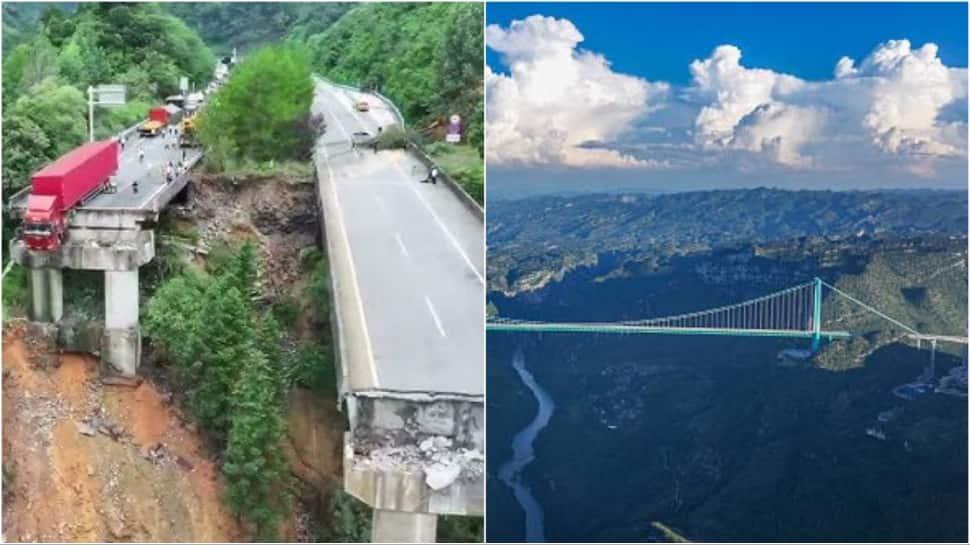
Landslides caused part of the Hongqi Bridge to collapse, sending concrete into the river. The 758‑metre bridge, months after opening, served the national highway linking Sichuan and Tibet.
21 outlets told this the same way.
Hongqi Bridge collapse
On Nov. 11, a recently completed section of the Hongqi Bridge in Maerkang (Barkam), Sichuan province, partially collapsed after landslides struck the mountainside above the structure.
“A newly built Hongqi Bridge in Maerkang, Sichuan province, partially collapsed on Tuesday, Nov. 11 — only months after opening. The 758‑metre bridge on a national highway (built by Sichuan Road & Bridge Group to improve links between Sichuan and Tibet) failed after landslides and cracks in a nearby mountainside, which officials say were likely worsened by water accumulation from a nearby reservoir. The collapse, captured on video and widely shared online, produced a large dust plume. Authorities had closed the structure a day earlier after slope and road cracks were reported. No casualties have been reported.”
Video of concrete and structural elements tumbling circulated widely online and produced a large dust plume.

Authorities had closed the bridge a day earlier after cracks and slope movement were detected, and officials reported no casualties.
The span, reported as roughly 758 metres in many accounts, formed part of a national highway linking central China with Tibet.
The contractor said the bridge had been finished earlier this year.
Bridge collapse and response
Reports place the collapse at the approach span and adjoining roadbed, where slope failure undermined foundations. Several outlets say inspection crews had noticed cracks and terrain shifts, and that police closed the route the day before.
Emergency teams evacuated stranded vehicles and cordoned off the area, while engineers inspected remaining sections to prevent further damage. Officials and contractors described the cause as landslides and geological instability, and a technical investigation has been launched to determine whether design or construction issues also played a role.

Road collapse response summary
Authorities say a prior closure likely prevented fatalities. Police halted traffic after engineers reported cracks and slope movement, then evacuated stranded vehicles and set up warnings and cordons. Rescue and safety teams monitored ongoing geologic risks.
“A newly opened 758-metre Hongqi bridge in southwest China’s Sichuan province partially collapsed into the river after worsening mountain conditions triggered landslides. inspection crews had noticed cracks and terrain shifts on the mountain, and the bridge—part of the national highway linking China’s heartland with Tibet—had been closed to traffic, so there were no casualties.”
Multiple outlets repeated official statements that no casualties were reported and described precautionary evacuations and road suspensions. Footage released by state media and videos circulating on social platforms helped reporters verify the collapse and the emergency response timeline.
Infrastructure failure context
Beyond the immediate incident, several outlets place the collapse in a wider context of recent infrastructure failures and concerns about rapidly built projects in China's western, mountainous regions. Reporters and commentators cite earlier fatal collapses and weather-related infrastructure stress as background that has heightened scrutiny of construction quality and safety oversight. Some coverage explicitly links the Hongqi failure to those broader resilience questions and past tragedies.
Variations in news coverage
Coverage differences also reflect varying editorial practices: some outlets reproduce or rely on tabloid or partner reporting (News.au reproduces New York Post material), some provide sparse or partial posts (The Independent), and at least one listed source here supplied no usable article text in these snippets (Al Jazeera). Technical or specialist sites (parametric-architecture) add engineering-oriented details, such as the main span remaining intact or the bridge's height above the gorge, that general news reports often omit. These variations affect what readers learn about proximate causes, ancillary infrastructure and investigative scope.
“The main span reportedly remains intact but the route is unusable.”