
Lebanon’s Joint Committees Adopt General Amnesty Bill, Nabih Berri Calls Parliament Session
Key Takeaways
- Joint committees approved the bill; plenary adoption expected Thursday.
- Nabih Berri convened Parliament for a Thursday session.
- Disagreement persists over groups covered and crimes excluded.
Amnesty bill advances
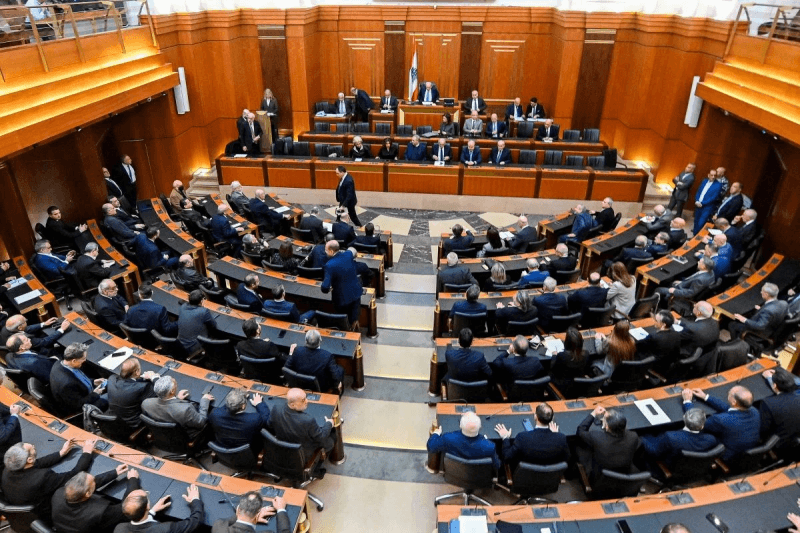
Lebanon’s joint parliamentary committees adopted a draft general amnesty law with amendments on May 19, 2026, and the text was expected to be approved in Parliament during a plenary session scheduled for Thursday at 11 a.m.
“"General amnesty" before the Lebanese Parliament”
The committees met in Parliament at Place de l’Étoile under Parliament Speaker Nabih Berri’s call, with Elias Bou Saab guiding the session and Defense Minister Michel Menassa present, while one participant described the debate as "mostly technical and calm."
The joint committees met under the guidance of Parliament’s number two, Elias Bou Saab, and the L’Orient-Le Jour report said the Parliament Bureau must meet a few hours later to prepare a plenary session so deputies vote on the text that had been missing for several weeks.
L’Orient-Le Jour also said the joint committees on Finance and Budget, Administration and Justice, National Defense, Interior and Municipalities, and Human Rights studied the amnesty bill proposal around noon, and several media outlets reported around 2:00 PM that MPs had approved the bill.
The bill’s scope, as described by L’Orient-Le Jour, included offenses related to drug consumption and unorganized drug trafficking while excluding organized trafficking, and it was tied to a broader legislative push to examine laws and draft laws on the agenda.
Competing reactions
The amnesty bill drew immediate political and sectarian reactions, with L’Orient-Le Jour reporting that the bill was at the center of the Baabda meeting between President Joseph Aoun and a delegation from the Free Patriotic Movement led by Deputy Cesar Abi Khalil.
Cesar Abi Khalil said there was a “principle agreement” with the head of state “on the necessity of addressing any injustice affecting detainees or prisoners through legal and judicial frameworks, rather than by adopting a general amnesty that would consolidate a culture of impunity,” according to remarks reported in a communiqué published by the presidency on X.
In response to the amnesty bill, L’Orient-Le Jour reported that the vice president of the political bureau of Jamaa Islamiya in Lebanon, Bassam Hammoud, said that “the process of discussion and examination of what is called ‘general amnesty’ is in reality a selective amnesty, particularly if it does not include all Islamist detainees,” and that the Sunni movement rejected any text going in that direction.
L’Orient-Le Jour also described protests in Ersal (Baalbek-Hermel) and in Khalde, south of the Lebanese capital, where relatives of Islamist detainees blocked the road for a time before it was reopened after the intervention of the army and security forces.
An Anadolu Ajansı report framed the parliamentary debate as heated for three weeks, citing political and sectarian divisions over which groups are covered and which crimes are excluded, while also linking the dispute to prison overcrowding and calls to address the conditions of “Islamic detainees.”
Prisoner scope and risks
Beyond the immediate committee vote, Anadolu Ajansı said the bill’s draft notes that Lebanon previously experienced political divisions that contributed to overcrowding in prisons, delays in issuing judgments, and security detention notices affecting hundreds of citizens without judicial authorization.
“The joint committees on Finance and Budget, Administration and Justice, National Defense, Interior and Municipalities, as well as on Human Rights, met in Parliament around noon to study the amnesty bill proposal, according to the National Information Agency (ANI, official)”
The same report said the draft includes amnesty for all perpetrators and participants as principals or partners, while exceptions cover crimes affecting state security, premeditated murder of civilians or soldiers, treason and espionage, and drug crimes if there are more than two prosecutions or more than two prior convictions.
Anadolu Ajansı also described the “dilemma of the Islamic detainees,” saying the term refers to about 400 prisoners, most of them at Roumieh Prison in central Lebanon, including 170 Syrians, with more than half held without trial.
The report added that unofficial figures published by informal rights organizations put prison overcrowding at more than 330 percent of capacity (8,500 inmates), and it said the number of deaths in prisons in 2025 surpassed 48 while 11 prisoners have died since the start of 2026 to date.
In parallel, L’Orient-Le Jour reported that on Sunday the families of Lebanese army soldiers killed during the Abra clashes in 2013 sent an open letter to President Joseph Aoun urging him not to include the perpetrators of these crimes in the law, with the clashes in June 2013 between the army and a Salafi group led by Sheikh Ahmad al-Asir in Abra near Sidon leaving 29 dead including 18 soldiers.
More on Lebanon
Joseph Aoun Urges Donald Trump To Continue US Support After Israel Framework Agreement
24 sources compared

Israel’s Givati Brigade Completes Mission In Southern Lebanon After Eight Months
15 sources compared

Syria Signals Diplomacy After Asaad Al-Shaibani Lebanon Trip, Rejects Military Intervention Against Hezbollah
29 sources compared
Nabih Berri Says Israel Tries to Drag Lebanese Army Into Confrontation With Resistance
14 sources compared